The minibus shudders to a halt on a dusty stretch of asphalt where a hand-painted sign points toward “Gu Zhen.” No ticket booth, no turnstile, just a narrow lane slipping between two whitewashed walls into the shade of ancient camphor trees. An elderly woman selling dried persimmons from a bamboo basket waves me toward the stone archway. The air here smells of wood smoke, damp earth, and the sharp tang of fermented bean curd frying in a wok somewhere unseen.
Finding the Village
Zhangguying sits about eighty kilometers southeast of Yueyang city, tucked into a fold of the Mufu Mountains where Hunan meets the Jiangxi border. Most visitors arrive via Yueyang’s main long-distance bus station on Balingzhong Road. Look for the window marked for Zhangguying Town (张谷英镇); buses leave roughly every forty minutes once they fill up. The ride takes just under two hours, winding past rice paddies and orange groves before climbing into the hills.
The bus deposits passengers at the modern township center—a cluster of concrete shops and a police box. Do not wander the new streets looking for history. Instead, flag down one of the electric three-wheelers idling by the station. Say “Gu Zhen” (古镇) to the driver. The fare is a few yuan. The cart rattles down a tree-lined avenue for five minutes before the road narrows to a flagstone lane barely wide enough for two shoulders. That is the entrance.
Walking the Wooden Arteries
The village was laid out during the Ming dynasty by the Zhang clan, who migrated from Jiangxi seeking a site that satisfied strict fengshui principles: a jade belt of water wrapping the front, a screen of mountains guarding the rear. They built not as individuals but as a single organism. Over 1,700 rooms connect through internal corridors, shared courtyards, and covered walkways. You can walk for twenty minutes—kitchen to ancestral hall to bedroom to granary—without ever stepping under open sky.
Start at the main gate, where a pair of stone lions guard a lintel carved with bats and peaches. Turn left into the first courtyard. The floor is worn smooth by centuries of cloth soles. Look up: the roof beams are joined without a single iron nail, locked together by mortise and tenon, the dougong brackets flowering outward like frozen fireworks. Sunlight cuts through the smoke vents, illuminating dust motes above a shrine where incense ash curls beside a bowl of tea.
- Follow the central axis: Gate → Ancestral Hall → Opera Stage → Rear Garden.
- Peek into side rooms. Many are still lived in; knock before entering.
- Count the wells. There are eighteen fed by mountain springs, each with a distinct mineral taste.
- Find the “One-Line Sky” alley—a slit between buildings where you touch both walls with outstretched elbows.
The local museum occupies a restored wing near the opera stage. It holds land deeds, imperial examination plaques, and a genealogy scroll that stretches the length of the hall. The curator, a retired schoolteacher, will point out the character for “Zhang” written in seven different calligraphic styles. No English labels exist. Bring a translation app or simply study the objects: a rice measure, a wedding sedan chair, a set of bronze weights.
The Hill Behind the Rooftops
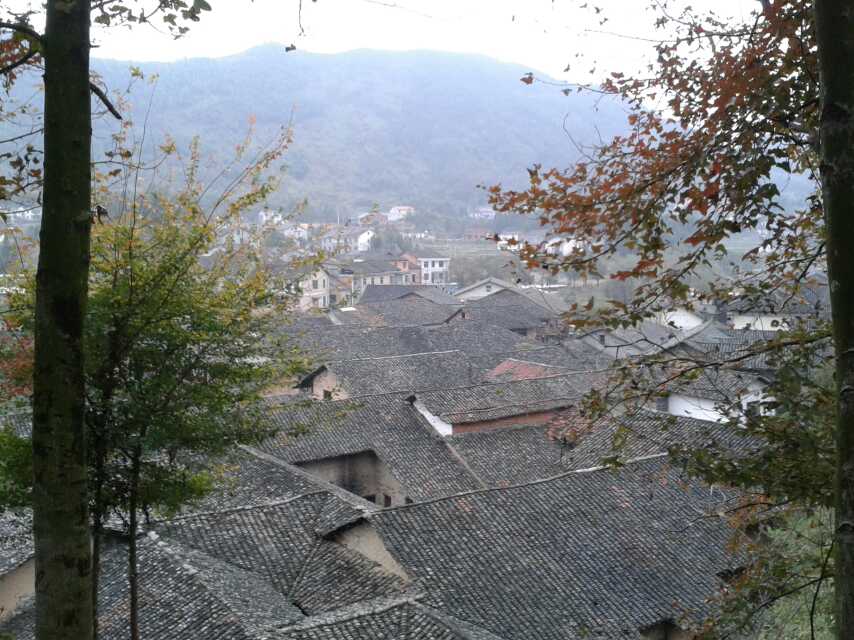
Behind the village rises a wooded knoll, not a mountain but a green hump crowned by a small pavilion. A stone stair climbs from the rear lane, passing a shrine to the Earth God where villagers tuck oranges and firecracker debris. The ascent takes fifteen minutes at a slow pace. Halfway up, pause at a flat rock. Below, the village reveals its true shape: a dark, undulating sea of grey-black tiles and grey-white walls, pierced by the silver thread of the creek. No single roof dominates. The clan built for collective survival, not individual glory.
From the pavilion, a dirt path continues along the ridge. It loops toward a bamboo grove and a forgotten tea terrace. In late spring, the air thickens with the scent of camellia blossoms. In autumn, persimmons hang like lanterns on bare branches. The trail is unmarked but obvious; locals use it to reach firewood plots. Wear shoes with grip. The stones turn slick after rain.
Eating at a Family Table
There are no restaurants with menus. Food happens in kitchen courtyards. The signature dish is You Doufu (油豆腐)—blocks of fresh tofu deep-fried until the skin puffs into a golden balloon, crisp and hollow, then braised in a broth of chili, garlic, fermented black beans, and mountain spring water. The skin drinks the sauce; the interior stays custard-soft. Eat it with a bowl of red rice steamed in a wooden barrel.
- You Doufu method (home style): Cut firm tofu into 3-cm cubes. Heat rapeseed oil to 180°C. Fry until cubes float and swell. Remove. In a clay pot, sauté ginger, garlic, douchi, and dried chili. Add water, soy sauce, a pinch of sugar. Simmer tofu ten minutes. Finish with scallion and wild peppercorn oil.
- Ordering in a household: Ask the hostess, “You Doufu you ma?” (Have fried tofu?). She will nod and disappear into the back. Twenty minutes later, a steaming earthenware pot arrives.
- Side dishes to expect: Pickled long beans, stir-fried bamboo shoots, cold pig ear dressed with chili oil, steamed fish head with chopped chili.
- Drink: Homemade rice wine served in tiny porcelain cups. It tastes sweet, then burns clean.
Do not ask for vegetarian substitutions. The broth base almost always contains pork fat or dried shrimp. If you avoid meat, order plain steamed vegetables and rice. The hostess will not be offended; she will simply bring extra bowls of the pickles.
Sleeping Inside the Walls
Accommodation means a spare room in a family compound. No reception desk, no key cards. You negotiate at the gate or through a WeChat contact arranged in Yueyang. The room will have a hardwood bed, a mosquito net, a squat toilet down the hall, and a solar water heater on the roof—hot water only after noon on sunny days. Walls are thin. You will hear the neighbor’s rooster at 4:30 a.m., the grandmother’s cough, the creak of the corridor boards as the family rises.
Bring your own towel, toothpaste, and a plug-in night light. The single bulb in the room hangs on a pull cord. Power cuts are common during summer thunderstorms. A power bank is essential. Payment is cash only, settled the next morning before departure. Typical cost for a double room with two meals: 150 to 250 yuan, depending on the season and the family’s mood.
Mistakes Newcomers Make
- Arriving at midday in high summer. The stone lanes become a radiator. Come in the cool of early morning or late afternoon. The light is better for photography anyway.
- Treating homes as exhibits. That courtyard with drying chilies? Someone’s kitchen. The bedroom with the door ajar? Someone’s nap. Ask before you point a lens.
- Expecting English. The youngest person who speaks it is likely a teenager who left for factory work in Shenzhen. Learn three phrases: “Duo shao qian?” (How much?), “Xie xie,” and “Bu yao la” (Not spicy).
- Skipping the creek walk. A path follows the water upstream past the washing stones where women still beat laundry. Ten minutes out, the village noise vanishes. You hear only water and cicadas.
- Leaving trash. No municipal collection exists. Carry out every wrapper, bottle, and battery. The village burns its own waste in a pit above the tree line; do not add to it.
When the last minibus rattles back toward Yueyang at dusk, the village exhales. Smoke rises from a dozen chimneys. The opera stage goes dark. An old man locks the main gate with a chain thick as a wrist. You carry the smell of wood smoke in your jacket, the taste of chili oil on your fingers, and the memory of a thousand rooms breathing as one.