The minibus from Shijiazhuang’s north station rattles past warehouses and vegetable greenhouses, then suddenly the road narrows and grey brick ramparts rise on both sides. You step off at the South Gate archway into a flow of electric bikes, steamed-bun vendors, and retirees doing tai chi beside the moat. No ticket booth, no turnstile — just a living neighborhood that happens to be wrapped in a Ming-dynasty wall.
Getting there without a headache
Most visitors arrive from Shijiazhuang. The fastest way is Metro Line 1 to Zhengding Railway Station, then a ten-minute walk south to the wall. If you’re landing at Shijiazhuang Zhengding International Airport, the airport express train drops you at Zhengding Airport Station; from there a local bus or a ¥30 taxi ride reaches the old town in fifteen minutes. Driving? Take the G4 Jingzhu Expressway north to the Zhengding exit — parking lots cluster near the South and West gates, but they fill by mid-morning on weekends.
Walking the wall and the four gates
The city wall forms a rough rectangle about four kilometers around. The restored southern section is widest, with brick crenellations you can touch and stairways every few hundred meters. Climbing up at the South Gate gives a rooftop view: grey tiles stretching toward the pagoda of Longxing Temple, the white stupa of Guanghui Temple piercing the skyline, and beyond them the glass towers of Shijiazhuang shimmering in the haze.
- South Gate (Yong’an) – main access from the bus stop; stele pavilion inside the barbican.
- East Gate (Yingxu) – quieter, leads straight to Linji Temple’s car park.
- West Gate (Qingyuan) – closest to the night-market alley; good sunset spot.
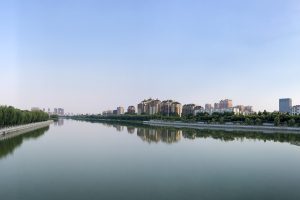
- North Gate (Zhenwu) – least restored, but the moat here still reflects willow branches.
Allow two hours for a full circuit at a strolling pace. Wear flat shoes — the brick treads are uneven and slick after rain.
Three temples you cannot skip
Longxing Temple (隆兴寺) sits a few blocks north of the South Gate. Its centerpiece is the Moni Hall, a Song-dynasty wooden structure that survived earthquakes and the Cultural Revolution because it was used as a granary. Inside, a rotating sutra cabinet — the only one of its kind left in China — still turns on a hidden spindle. Monks chant at 6 a.m. and 4 p.m.; slip in quietly through the side door if you want to hear it without the tour groups.
Guanghui Temple (广惠寺) is famous for the Flower Pagoda (华塔), a sixteen-sided, eight-story brick tower carved with Buddhas, dancers, and musicians in Tang-style robes. The pagoda leans slightly — locals say it “bowed to the emperor” — but the structure is solid. Climb the narrow internal staircase for a dizzying look down at the courtyard’s ancient ginkgo, which drops golden fans every autumn.
Linji Temple (临济寺), east of the East Gate, is the ancestral home of the Linji (Rinzai) Zen school. The Chengling Stupa, a plain brick tomb pagoda, holds the robe and bowl of Master Linji. The temple grounds are alive with novices memorizing koans under the pines. Photography is allowed in the courtyards, not inside the main hall.
Eating like a local
Zhengding’s signature dish is babaocheng (八宝城) — eight-treasure stuffed wheat gluten braised in dark soy, ginger, and star anise until the sauce clings like lacquer. You’ll find it at the canteen-style place opposite Longxing’s side gate; order a half-portion with a bowl of hand-rolled noodles in mutton broth. For breakfast, join the queue at the stall inside the West Gate selling huoshao (火烧), crisp sesame flatbreads split and stuffed with stewed pork and cilantro. Wash it down with a cup of warm doujiang from the aluminum thermos on the counter.
- Babaocheng home method: soak dried wheat gluten until soft; press out water. Stir-fry minced pork, diced shiitake, carrot, bamboo shoot, wood ear, corn kernels, and green peas. Add gluten, soy sauce, sugar, Shaoxing wine, water to cover. Simmer twenty minutes until sauce thickens. Finish with sesame oil.
- Restaurant tip: point to the picture menu on the wall — most family joints don’t have English. “Bu yao la” (no chili) works everywhere.
- Rookie mistake: skipping the cold dishes. Smashed cucumber with garlic and vinegar, and jellyfish threads in sesame oil, are the palate cleansers between heavy braises.
What locals expect and where newcomers stumble
Zhengding isn’t a theme park. Residents hang laundry from the wall’s arrow slits; kids kick footballs in the shadow of the pagoda. Speak softly inside temple halls — step over the threshold, never on it. When a monk offers a blessing knot, accept with both hands and a slight bow; a silent “thank you” is enough. Don’t climb the stupa at Linji; the fence is there for a reason.
Timing matters. The wall gates lock at 10 p.m., but the night market outside the West Gate peaks around 9 p.m. — grilled lamb skewers, stinky tofu, and piles of candied hawthorn on sticks. If you stay for the lanterns strung along the moat in the eighth lunar month, you’ll see the pagodas lit amber against the water, and the town feels exactly as it did when the Grand Canal brought silk and salt through these gates.
Common missteps: trying to “do” all three temples in ninety minutes (give each an hour), wearing heels on the wall bricks, and assuming every vendor takes mobile pay — carry small cash for the bun lady and the incense seller. Bring a folding stool if you plan to sit and sketch; the stone benches are occupied by grandfathers playing xiangqi from dawn till dusk.