The minibus sputtered to a halt on a hairpin bend above the Yuanyang terraces, the engine coughing in the thin morning air. Through the open door, a woman in a indigo-dyed jacket embroidered with silver coins stepped onto the gravel, a woven basket strapped to her back. She didn’t glance at the view that had me reaching for my camera. Instead, she scanned the irrigation channels cut into the mud, checking water levels with the practiced ease of someone whose grandparents carved these steps into the mountain. That moment — her indifference to the spectacle, her focus on the work — was the first real lesson I had about the Hani.
Where you’ll find them
Over ninety percent of China’s Hani population lives in southern Yunnan, spread across the Ailao Mountains between the Mekong and the Red River. You’ll run into them in the autonomous counties tucked under Pu’er and Honghe prefectures — places like Mojiang, Lüchun, Honghe, and Yuanyang. The villages cling to steep slopes, usually between 800 and 1,800 meters, where the rice terraces stack like shattered mirrors. If you’re heading to the famous viewpoints at Duoyishu or Bada, the people tending the paddies below are likely Hani. Further south, across the border in Vietnam’s Lai Châu and Lào Cai provinces, and in northern Laos’s Phongsaly province, the same communities go by the name Ho.
Village rhythm and the terrace system
A Hani village isn’t built for tourists. The houses — mushroom-shaped with thatched roofs — cluster tight against the slope, often sharing walls. Water is the organizing principle. A single canal feeds the whole settlement, branching into bamboo pipes that hit each terrace at a precise gradient. I watched an old man in Xinjie adjust a sluice gate with a bamboo pole, letting just enough flow into his family’s plot. He told me the system has no written manual; the knowledge lives in the wrists of the elders who maintain the channels every spring. If you stay overnight in a family guesthouse, you’ll hear the water rushing through the walls all night. It’s not decorative. It’s the sound of survival.
Clothing that maps identity
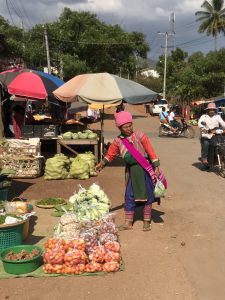
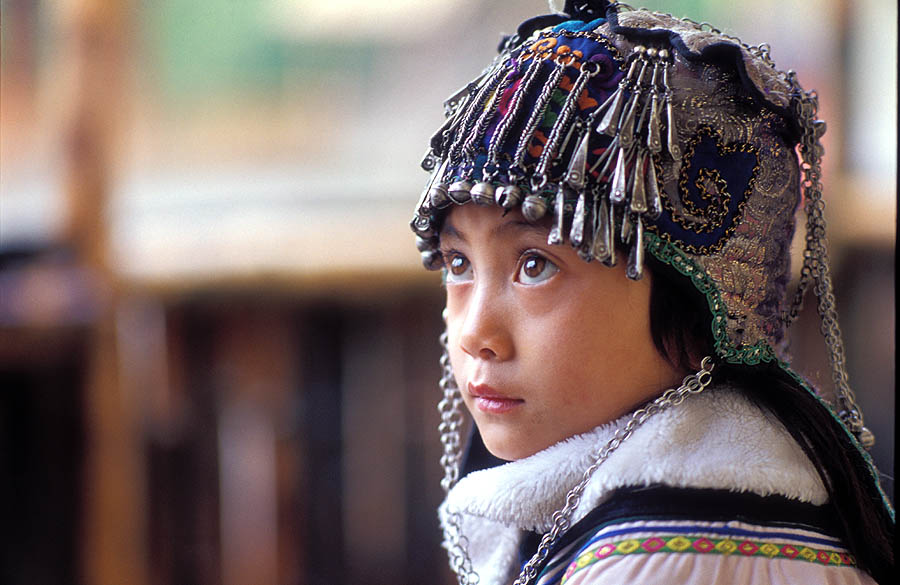
The women’s jackets tell you which subgroup you’re looking at. In Yuanyang, the Hani wear short, collarless tunics heavily embroidered at the cuffs and hem, paired with black leggings and a turban wrapped so tight it frames the face like a helmet. In Mojiang, the sleeves flare wider and the silver ornaments — chains, bells, coins — hang lower, clicking when they walk. Men dress plainer now, mostly in dark Mao suits or factory jackets, but during the October New Year festival you’ll see them in indigo turbans and embroidered sashes. Don’t assume the clothing is costume. A woman weaving a new jacket on a backstrap loom in her doorway is making workwear for the next planting season. The patterns — zigzags for mountain paths, spirals for water — are maps stitched in thread.
Language, names, and the calendar
Hani belongs to the Lolo-Burmese branch of Tibeto-Burman. It’s tonal, with seven or eight tones depending on the valley, and no widely used written form until missionaries devised a Latin script in the last century. Most people under forty speak Mandarin fluently, but the elders in remote hamlets may not. Names follow a patronymic chain: the last syllable of the father’s name becomes the first syllable of the son’s. So if the father is A-luo, the son might be Luo-de. It creates a spoken genealogy you can trace back generations. The traditional calendar runs on a twelve-month lunar cycle with an extra month inserted every three years. The biggest marker is the Kuzhazha festival — the June New Year — when the village slaughters a black pig, the elders chant the creation epic, and everyone eats sticky rice dyed yellow with turmeric and wrapped in banana leaves.
Eating with a Hani family
If you’re invited to a meal, wash your hands at the basin by the door. The table is usually a low wooden board. Dishes arrive all at once: red rice steamed in a wooden barrel, pickled mustard greens sour enough to make your jaw ache, a bowl of chili paste pounded with fermented soybeans and garlic, and maybe a plate of river fish grilled over charcoal, skin blistered and salty. You’ll get a pair of bamboo chopsticks and a communal spoon. Eat the rice first, plain, to taste the grain — it’s a variety bred for these altitudes, nutty and slightly sticky. Don’t stick your chopsticks upright in the bowl. That’s for the ancestors. And don’t finish everything on your plate; leaving a few grains signals the host provided enough.
- Red rice (heimi) — soak two hours, steam forty minutes in a wooden tub over boiling water
- Pickled mustard greens (suan cai) — salt whole leaves, weight with a stone, ferment three weeks in a clay jar
- Chili-soybean paste (la doujiang) — roast dried chilies, pound with fermented black beans, garlic, ginger, and a splash of rice wine
- Grilled river fish — gut, score the flesh, rub with salt and Sichuan pepper, cook on a wire rack over coals until skin cracks
- Turmeric sticky rice — glutinous rice soaked in turmeric water, wrapped in banana leaf, steamed
What newcomers get wrong
The biggest mistake is treating the terraces as a backdrop. I’ve seen visitors step onto paddy walls for a selfie, cracking the mud seal that holds water. The farmer has to repair that breach by hand before the next rain. Another error: walking into a house without asking. The threshold is sacred ground; the family altar sits just inside the door. Step over the sill, not on it. Don’t hand things — money, a phone, a gift — with one hand. Use both. And if an elder offers you a cup of rough rice wine from a shared gourd, take a sip. Refusing is a slight. You don’t have to drink deep, but your lips must touch the rim.
Festivals worth timing a visit for
The June New Year (Kuzhazha) falls on the first Dragon day of the sixth lunar month. Villages shut down for three days. You’ll see swing sets erected in the central clearing — young men and women kicking high, the ropes creaking — and long tables laid with thirty or forty dishes, each household contributing one. The October festival (Zalete) is smaller, focused on the new rice harvest. In Mojiang, the “Long Street Banquet” stretches hundreds of meters down the main lane; strangers pull up stools and eat together. If you go, arrive early, find a family willing to host, and bring a pack of good cigarettes or a bottle of baijiu for the host. Cash in a red envelope works too, but the gesture matters more than the amount.
Getting there without a tour bus
Fly into Kunming, take the high-speed train to Jianshui or Yuanyang (the new station is outside the old town), then hire a local driver for the last climb. The mountain roads are narrow, foggy, and often blocked by landslides in the summer rainy season. Dry season — late autumn through early spring — is safer and the terraces hold water, mirroring the sky. Stay in a village guesthouse rather than the county hotel. You’ll wake to roosters and the smell of woodsmoke, and the host will likely invite you to the morning water check. That walk along the canals, flashlight in hand, watching the village wake up — that’s the part no guidebook captures.