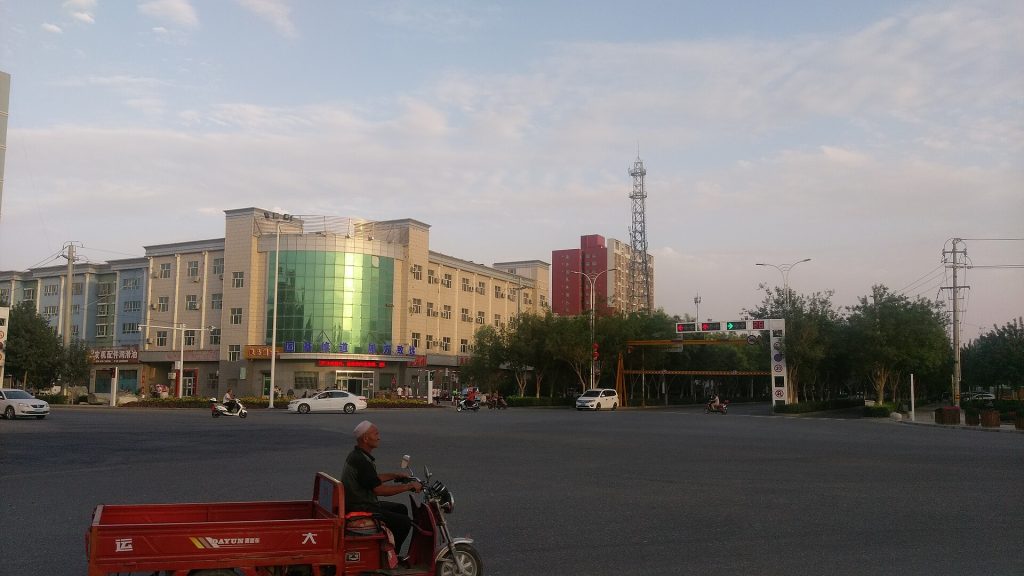
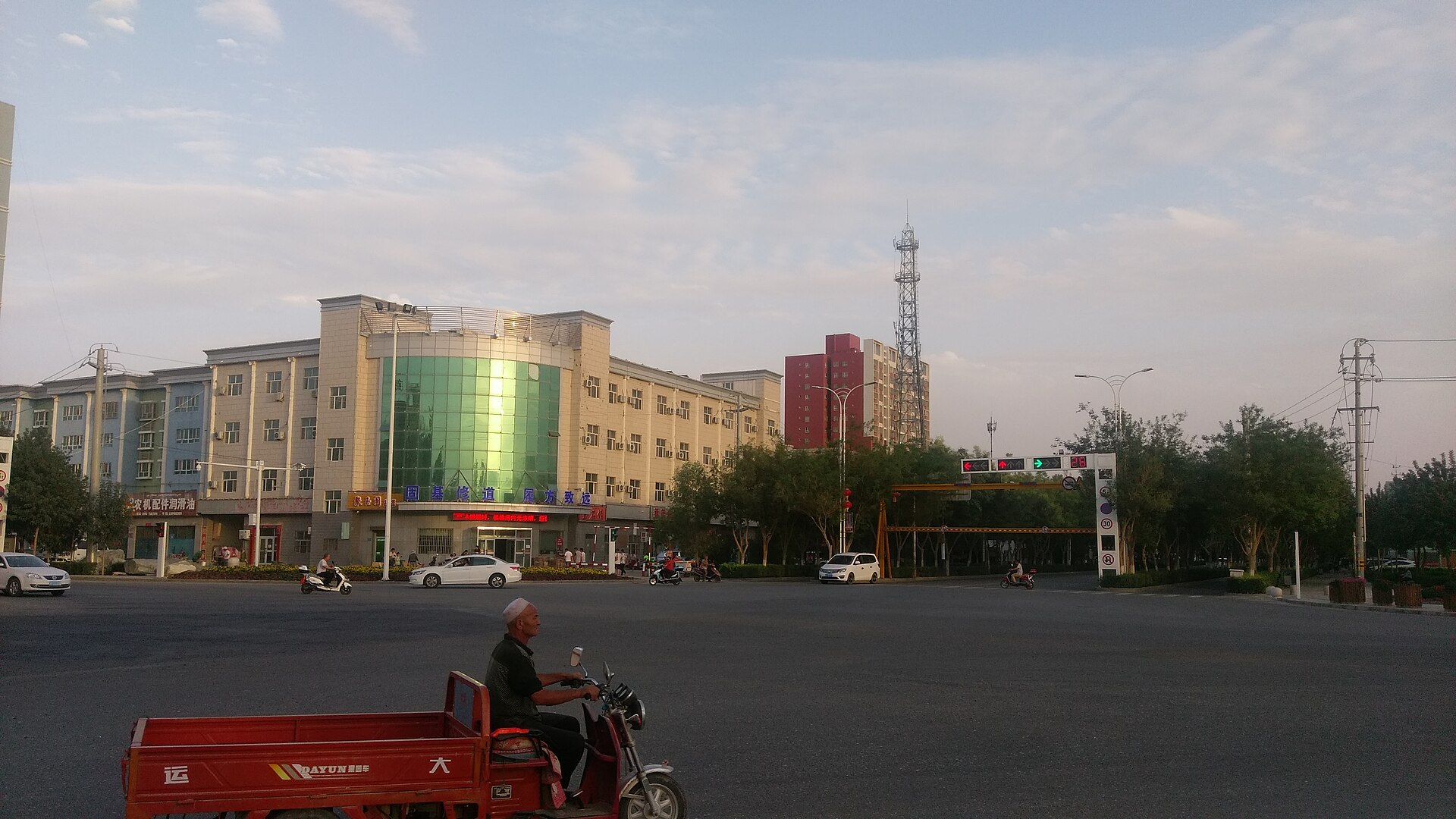
The minibus from Golmud had been climbing since midnight, its engine whining against the thin air of the Kunlun foothills. By the time the first light hit the windshield, the mountains had fallen away, replaced by a plain so flat and pale it looked like a drained seabed. Dust devils spun lazily beside the asphalt ribbon of G315. Then, rising out of the haze like a mirage that refused to vanish, came the poplar windbreaks — neat green rows guarding clusters of whitewashed houses and a single, startlingly blue swimming pool. This is Charklik, Ruoqiang County, the gateway where the Qinghai-Tibet Plateau finally surrenders to the Tarim Basin.
Getting There: The Long Road In
Most travelers arrive bone-tired from the east. The highway from Golmud stretches roughly 700 kilometers of straight blacktop across the Qaidam Basin. There are no dramatic passes here, just an endless grind through gravel desert where the only landmarks are the occasional police checkpoint and the skeletons of abandoned trucks. Shared SUVs leave the Golmud long-distance station when full — usually around dawn — and cost a few hundred yuan per seat. The ride takes ten to twelve hours if the tires hold.
Flying saves the back but costs the wallet. Ruoqiang Loulan Airport sits about sixteen kilometers southwest of town, a low terminal baking behind a fence. Flights connect from Urumqi, Korla, Qiemo, and occasionally Zhengzhou, but schedules shift with the wind and the season. An airport bus meets arrivals, terminating at the square opposite the Huyang Hotel; if you miss it, a taxi ride into town runs around fifty yuan. In winter, fog grounds planes for days, so keep a buffer if you have a train to catch in Korla.
Driving yourself? G315 is paved the whole way, but fuel stations are spaced for trucks, not sedans. Fill up in Golmud or at the big station fifty kilometers west of town. Carry extra water, a spare tire, and snacks — the service areas sell instant noodles and not much else. Heading west from Ruoqiang, the road follows the ancient Silk Road corridor toward Qiemo (Cherchen), then Niya, Minfeng, and eventually Hotan. It is a two-day drive to Hotan if you push hard, three if you stop at the desert camps.
Sleeping: Where the Poplars Block the Wind
Town clusters along a few main streets radiating from the central square. The Huyang Hotel is the default choice — clean rooms, reliable hot water, and a restaurant that serves passable laghman. Ask for a room facing the courtyard; the street side catches the early truck noise. A double runs two to three hundred yuan depending on the season.
Budget travelers gravitate to the family guesthouses tucked down the alleys behind the bus station. Look for hand-painted signs reading “家庭旅馆.” Rooms are basic — concrete floors, shared squat toilets — but the hosts often keep a kettle boiling and will share a plate of cold noodles if you arrive late. Bargain hard in the off-season; in summer, when the tour groups roll through for Loulan, prices double and rooms vanish by noon.
If you have a vehicle and gear, the best sleep is outside town. Drive ten minutes north along the desert highway until the poplars thin, pull onto a hard-packed pullout, and pitch a tent. The silence is absolute. Just secure your food — foxes are bold and ravens work in teams.
Eating: Noodles, Mutton, and the Melon That Travels
Ruoqiang sits at a culinary crossroads. Hui-style hand-pulled noodles dominate breakfast stalls — thick strands in clear beef broth topped with chili oil, cilantro, and a spoonful of pickled garlic shoots. Uyghur restaurants along the main drag serve polo (pilaf) with carrots cut into matchsticks, raisins, and chunks of mutton so tender they fall apart under the spoon. Order a side of nang, the sesame-crusted flatbread, to mop the bowl.
For a home-style meal, seek out a family kitchen that makes tuhum — steamed dumplings stuffed with minced mutton, onion, and cumin, served with a vinegar-chili dip. The dough is rolled paper-thin; you can see the filling glowing through. Eat them hot, pinching the pleated top to suck the juice before biting.
- Laghman (hand-pulled noodles): High-gluten flour, water, salt — pulled to order into boiling beef stock. Top with chili oil, cilantro, pickled garlic shoots, optional tomato-egg stir-fry.
- Polo (pilaf): Long-grain rice, mutton with bone, carrots (julienned), raisins, onions, cumin seeds, salt. Fry meat and onions, add carrots and spices, layer rice on top, steam covered thirty minutes.
- Tuhum (steamed dumplings): Flour dough rolled thin, filling of minced mutton, onion, cumin, salt, pepper. Pleat edges, steam fifteen minutes. Serve with black vinegar, chili oil, minced garlic.
- Ruoqiang gray jujubes: Small, wrinkled, intensely sweet. Eat fresh, brew in tea, or stuff with walnuts for the road.
The county is famous for its gray jujubes (hui zao) — small, wrinkled, sugar-dense fruit that appears in every market pile from late summer through autumn. Vendors sell them by the kilogram in red mesh bags. Buy a sack for the road; they don’t bruise and the sugar keeps you awake on long drives. In winter, locals brew them with ginger and red dates into a dark syrup they sip from thermoses.
Seeing: The Ancient City and the Desert That Ate It
Loulan (Kroraina) is the reason most foreigners detour here. The ruins sit roughly three hundred kilometers northeast, deep in the Lop Nur wilds, accessible only by permitted convoy. You cannot just show up. Arrange a tour through a licensed agency in Ruoqiang or Korla at least two weeks ahead — they handle the border permit, the police escort, and the supply trucks. The drive takes ten hours each way over salt flats and dunes; the convoy leaves before dawn and returns after dark. Bring a headlamp, a dust mask, and more water than you think you need.
The site itself is haunting: a few crumbling stupas, the outline of a Buddhist monastery, scattered pottery shards the color of dried apricots. The famous “Beauty of Loulan” mummy is long gone to a museum in Urumqi, but you can still find fragments of ancient textiles poking from the sand — look, don’t touch, and never pocket anything. Guides will warn you: the wind shifts fast, and disorientation kills.
Closer to town, the Ruoqiang Museum on Culture Road holds a modest but well-labeled collection: Han dynasty wooden slips, Jin dynasty documents, a recreated Loulan tomb with replica grave goods. Allow an hour. The curator sometimes gives impromptu talks in Mandarin if you catch her between tour groups.
For a half-day trip, drive thirty minutes south to the Altun Shan Nature Reserve boundary. The road climbs into the foothills where wild yaks graze and Tibetan antelope flicker at the edge of vision. No formal trails — just pullouts where you can stretch and scan the ridges with binoculars. In spring, the slopes bloom with yellow ephedra and purple astragalus. Rangers at the gate checkpoint will log your ID and remind you not to cross the invisible line into the core zone.
Moving On: West Toward the Silk Road, North to the Railhead
Westbound travelers usually aim for Qiemo next — four hours by shared van from the lot behind the bus station. Vans leave when full, roughly every two hours from 8 a.m. to 4 p.m. The road hugs the Cherchen River, passing apricot orchards and mud-brick villages where women dry mulberries on rooftops. Qiemo has a decent night market and a stronger Uyghur flavor; stay there if you want to break the long haul to Hotan.
Northbound, the new railway changes everything. Ruoqiang Station sits twenty kilometers east of town, a gleaming hall in the gravel. Trains run to Korla (six hours) and onward to Urumqi (twelve hours) on the Hotan–Ruoqiang–Korla line. Hard sleeper tickets are reasonable; book on the 12306 app or at the station window two days ahead. The station shuttle — a white minibus — meets every arrival and drops at the Huyang Hotel square. If you’re continuing to Golmud by rail, you’ll need to backtrack to Korla and catch the Qinghai-Tibet line; there is no direct north-south train yet.
Heading south? The road ends at the Kunlun foothills. Beyond lies the military zone bordering Tibet — permits are nearly impossible for foreigners. Jade hunters still sneak into the riverbeds after summer floods, but the checkpoints are tight and the fines steep. Admire the peaks from the last pullout on G315, where a stone marker reads “Xinjiang–Tibet Boundary.” Then turn around.
Mistakes That Cost Time and Comfort
First mistake: assuming the permit for Loulan can be sorted on arrival. It cannot. The paperwork moves through three offices in Korla and Ruoqiang; even domestic tourists need two weeks. Book the convoy before you leave home, or budget a week of waiting in town drinking tea at the Huyang lobby.
Second: underestimating the sun. The UV index here in summer rivals Lhasa. I watched a German cyclist turn lobster-red in forty minutes at the Loulan site. Wear a wide-brim hat, long sleeves, and zinc oxide on every exposed centimeter. Reapply after sweating through your shirt.
Third: skipping cash. The museum, the guesthouses, the van drivers, the jujube vendors — none take Alipay reliably when the signal drops, which is often. Carry small denominations of yuan (twenty and fifty notes) in a zip pocket. The nearest ATM that accepts foreign cards is the Agricultural Bank branch on Tuanjie Road; it eats cards sometimes, so withdraw in town before heading to the desert.
Fourth: trusting the map for water sources. The blue lines on satellite view are often dry salt channels. On the Altun Shan fringes, the only reliable spring is at the ranger station — and they guard it. Fill every vessel in Ruoqiang before you leave the grid.
Fifth: expecting English. Outside the tour agency office, you’ll hear Mandarin, Uyghur, and the local dialect. Learn the phrases for “water,” “toilet,” “how much,” and “I need a doctor.” Write your destination in Chinese characters on a phone note to show drivers. A smile and a offered cigarette (even if you don’t smoke) open more doors than a phrasebook.