The taxi driver slowed down before the rusted headframe of the old Longfeng Mine, its steel lattice dark against a sky the color of wet slate. Steam hissed from a vent near the pithead, mixing with the scent of coal dust and fried dough from a stall across the road. I pulled my collar tighter against the late autumn wind rolling off the Hun River and watched a group of retired miners shuffle past, their hands tucked into padded sleeves, arguing about the best way to braise pork ribs. This was my first morning in Fushun, and the city was already showing its seams — industrial muscle draped over a much older, quieter history.
Reading the City’s Layers
Fushun does not hand itself to you on a plate. It sits in eastern Liaoning, about forty-five minutes by high-speed rail from Shenyang, and wears its past in stacked strata. At the bottom lies Hetu Ala, the 17th-century Manchurian capital where Nurhaci forged the Late Jin state before his descendants swept south to become the Qing. Above that, the Japanese-built coal pits and the Soviet-era aluminium smelters that earned the city its “Coal Capital” nickname. Now, a petrochemical complex the size of a small town hums on the southern fringe, while the municipal government plants trees on slag heaps and markets the place as a “forest city.”
Most visitors come for the UNESCO sites — Hetu Ala and the Yongling Tombs — but the city rewards anyone willing to poke around the edges. The trick is to treat Fushun as two trips in one: a half-day for the imperial relics in Xinbin Manchu Autonomous County, and another day or two for the industrial heritage and the pine-forested hills that frame the urban core.
Hetu Ala and the Yongling Tombs: The Imperial Circuit
Start early. The bus from Fushun’s north station to Xinbin takes ninety minutes on the G1111 expressway, climbing through valleys where Korean pine and Mongolian oak turn burnt orange in the tenth lunar month. Hetu Ala sits on a terrace above the Suzi River. The reconstructed palace halls are modest — timber frames, grey tile, red pillars — but the layout follows the “eight banner” military organization that Nurhaci used to unify the Jurchen tribes. Walk the perimeter wall first. From the southeast corner you can see the whole complex: the Khan’s audience hall, the banner offices, the drill ground where cavalry once practiced.
Ten kilometers further up the valley, the Yongling Tombs sit in a bowl of forested hills. This is where Nurhaci’s ancestors are buried. The spirit way is lined with stone horses, camels, lions, and officials, each carved from a single block of white marble. Unlike the Ming tombs near Beijing, there are no crowds. In the quiet you hear only wind in the pines and the occasional crack of a branch. Allow two hours here. The site museum displays a few recovered artifacts — a jade belt plaque, a gilt-bronze saddle — but the real exhibit is the landscape itself, shaped by fengshui principles that predate the Qing by centuries.
- Transport: Bus 302 from Fushun North Station to Xinbin, then local taxi to Hetu Ala (20 minutes). Return the same way.
- Tickets: Combined ticket covers both sites. Buy at the Hetu Ala visitor center.
- Timing: Arrive at Hetu Ala by 9:30 AM. Finish Yongling by 3 PM to catch the last return bus.
- Footwear: Gravel paths and stone steps. Wear boots with grip.
Coal, Steel, and the Memory of Work
Back in the city proper, the Fushun Coal Mine National Mine Park preserves the Longfeng and Laohutai pits. You descend in a cage elevator — the same one miners used — to a depth of 200 meters. The air grows cool and damp. Headlamps cut through darkness where coal seams glitter in the timber props. A former foreman leads the tour. He taps a seam with his pick, explains how the “longwall” method replaced hand-pick mining in the 1950s, and points to a rusted conveyor belt that once moved 3,000 tonnes a day. He does not romanticize it. “Lungs gave out before the coal did,” he says.
Above ground, the mine museum occupies a Soviet-era administrative building. Exhibits trace the technology from Japanese steam winders to Chinese-made shearer loaders. One hall holds a wall of photographs: shift changes in 1932, a Young Pioneers brigade planting trees on a slag heap in 1978, the first women operating underground haulage trucks in 1995. Outside, a decommissioned steam locomotive sits on a siding, its boiler cold, its whistle silent.
- Tour times: First descent 9 AM, last 3 PM. Groups of 15 maximum.
- Clothing: Temperature underground stays around 12°C. Bring a fleece.
- Restrictions: No cameras with flash underground. Hard hats provided.
- Nearby: The Miners’ Canteen across the road serves a decent bowl of knife-shaved noodles in pork broth.
Pine Forests and Reservoir Shores
When the industrial weight feels heavy, head south to the Houshi Forest Park. The road climbs through stands of Korean pine planted in the 1960s to stabilize the mine tailings. At the summit, a wooden platform overlooks the Dahuofang Reservoir — a vast sheet of water held back by a concrete dam that also supplies Shenyang. In the tenth lunar month, the water turns steel-grey. Fishermen in small boats cast nets near the submerged villages. Trails loop down to the shore where you can rent a kayak for an hour. Paddle past the drowned orchard: apple tree skeletons breaking the surface, their branches white as bone.
If you have a car, continue west along the reservoir rim to the Saerhu Scenic Area. The road narrows, hugging cliffs where rock climbers test routes bolted into the granite. A small Manchu village sits in a fold of the hills. An elderly woman sells roasted chestnuts from a wok over charcoal. She speaks a few words of Manchu with her grandson — “sain” for good, “amba” for big. The language is fading, but the chestnuts are sweet.
- Access: Bus 108 from Fushun Railway Station to Houshi Park entrance (40 minutes).
- Kayak rental: 80 yuan per hour, life jacket included. Operating April to late autumn.
- Hiking: Trail to the summit takes 90 minutes one way. Marked with red paint on trees.
- Food: Bring water and snacks. The chestnut vendor only appears on weekends.
Lei Feng’s Shadow and the Living City
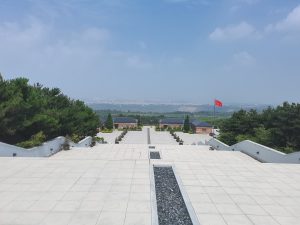
Lei Feng, the soldier held up as a model of selflessness, died in Fushun in 1962. His memorial hall sits in Wanghua District, a low building of grey brick surrounded by pine trees. Inside, glass cases hold his diary, his sewing kit, the socks he darned for comrades. School groups move through in quiet lines. A guide recites passages about “serving the people.” Outside, an old man sweeps the plaza with a bamboo broom. He served in the same regiment. “He was just a quiet boy who fixed radios,” the man tells me. “We made him a saint later.”
The memorial feels staged, but the neighborhood around it is real. Walk west along Xinfu Street at dusk. Steam rises from lamb skewer grills. A mahjong parlor clacks behind frosted glass. In a courtyard, three women sort chili peppers on a plastic sheet, their fingers moving fast. This is where Fushun lives — not in the mine shafts or the tombs, but in the smell of cumin and charcoal, the sound of tiles hitting the table, the way strangers share a bench and a bottle of cold beer.
Practical Rhythm: When to Go, How to Move
The city is easiest in the ninth and tenth lunar months — cool, dry, the forests aflame. Summer brings heat and sudden downpours that turn the mine park paths to mud. Winter drops to minus twenty; the reservoir freezes solid and the bus schedules thin out. Spring is windy, dust blowing off the petrochemical flats.
High-speed trains from Shenyang South Station run every thirty minutes. The ride is eighteen minutes. Local buses are cheap but cryptic; drivers rarely speak English. Taxis start at eight yuan. Didi works well. For the imperial sites, hire a car for the day — 300 to 400 yuan including driver wait time. It buys you flexibility at Yongling and a stop at the Manchu village without rushing.
Stay in the city center near the railway station. The hotels are functional, the restaurants late. Order the stewed pork vermicelli — wide glass noodles absorbing dark soy, star anise, and the fat of belly pork simmered until it collapses. Eat it from a chipped porcelain bowl while watching the neon of the aluminium plant reflect off the Hun River. That is the taste of Fushun: old empire, old industry, and the simple hunger that outlasts both.