The morning light hits the tiled roofs of Rongcheng’s old lanes at a slant, turning the moss on the ridges a bright, slick green. A vendor pushes a cart past the city god temple, the clatter of his wooden wheels mixing with the chant of an old woman counting beads at the incense burner. There is no rush here. The tallest thing on the skyline is a banyan tree spreading its arms over a courtyard wall, and the air carries the smell of fermented bean curd and river mud.
Getting There and Moving Around
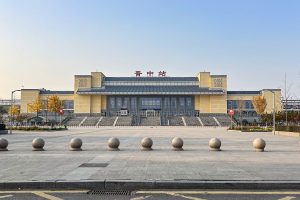
Most visitors arrive via Chaoshan High-Speed Railway Station, a glass-and-steel hub about forty minutes by car from the old city center. Taxis queue outside, but the drivers rarely speak Mandarin fluently; have your destination written in Chinese characters on your phone. A ride to the historic arcades costs roughly eighty yuan. If you prefer the bus, the K1 line connects the station to the Rongcheng District government stop, from where you can walk into the maze of lanes. Inside the old city, the streets are too narrow for cars. Locals zip through on electric scooters, silent as ghosts. Rent a bicycle from a shop near the Huangqishan Scenic Area gate — twenty yuan for a half day — and you can cover the whole heritage zone before lunch.
Walking the Arcades and Alleys
The qilou arcades on Dongping Road and Xima Road are the city’s signature. Built in the 1920s by overseas Chinese returning from Southeast Asia, they fuse Baroque pediments with Teochew wood carvings. The ground floors house hardware stores selling brass locks, tea shops weighing loose oolong by the catty, and tailors stitching mandarin-collar shirts on treadle machines. Step through a doorway and you often find a courtyard house three bays deep, its skywell open to rain and sun. The alleys branch like fish bones: some barely wide enough for two shoulders, others opening onto a sudden plaza where elders play xiangqi on stone tables. Don’t follow a map. Pick a lane, turn when it feels right, and you will hit a temple, a tea house, or a dead end with a cat sleeping on a windowsill.
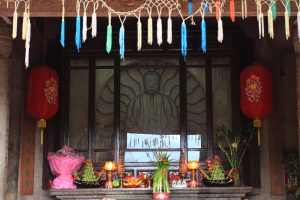
- Start at the City God Temple (Chenghuang Miao) on Xima Road — incense coils hang like chandeliers from the ceiling beams.
- Walk north to the Lin Zexu Memorial Hall, a restored mansion displaying the commissioner’s calligraphy and opium-war correspondence.
- Slip into the lane behind the memorial to find a century-old tofu pudding stall; the owner ladles silken curd into bowls with ginger syrup and crushed peanuts.
- Continue to the Huangqishan Park entrance; climb the stone steps for a view of the Rong River cutting through low-rise rooftops.
Temple Rhythm and River Time
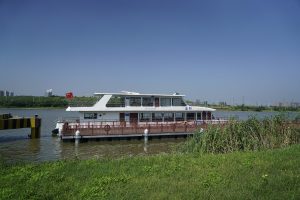
Jieyang holds more temples per square kilometer than any city I’ve known in Guangdong. The Dragon Boat Festival in the fifth lunar month turns the Rong River into a thunder corridor — drumbeats shaking the water, dragon heads lunging past the riverside promenade. But on a normal morning, the rhythm is quieter. At the Longwei Mountain Taoist complex, monks sweep the forecourt with bamboo brooms at dawn. You can join them if you arrive before seven; they hand you a broom without a word. Downriver, the Paotai (Cannon Fort) hill offers a flat walk along the old city wall footings. Fishermen cast nets from the bank, their bamboo poles propped against the railing. Stay until the sun drops behind the banyan canopy; the temple bells answer each other across the water, a conversation older than the high-speed line.
Eating Like a Local
Teochew cuisine here is not a restaurant performance — it is what people eat at home, served on lazy Susans in back-alley diners. The flavors lean salty-sweet, heavy on preserved radish, fermented bean sauce, and fresh seafood pulled from the estuary that morning.
- Kueh (rice cakes): Steamed chive dumplings with translucent skins, pink shrimp peeking through; fried taro cake cubes crisp at the edges, soft as custard inside.
- Braised goose: Whole bird simmered in dark soy, star anise, and sand ginger until the skin glistens like lacquer. Meat falls off the bone; the sauce is spooned over plain rice.
- Oyster omelette: Sweet potato starch batter fried until lacy, folded around plump oysters and coriander, dipped in chili-vinegar sauce.
- Beef hot pot (raw slices): Paper-thin beef, beef tendon, and tripe cooked in a rolling broth of satay sauce, celery, and white pepper. You swish each slice for three seconds.
- Dessert: Green bean soup with seaweed threads and sago pearls, served warm in a porcelain bowl.
For a sit-down meal, walk into any crowded place on Xima Road where the menu is handwritten on a red paper strip. Point at the characters for “braised goose” and “steamed pomfret with salted plum.” Order a pot of Tieguanyin — the waiter rinses the tiny cups with boiling water, pours high and fast, and the first infusion goes into the drain. Drink the second. If you want to cook yourself, the wet market near the City God Temple sells live mud crabs, razor clams, and bundles of chives with roots still muddy. Ask your guesthouse host for a kitchen; most family-run inns have a shared wok burner on the rooftop.
Where to Sleep
Chain hotels cluster near the high-speed station, but they sit in a generic business district. For the atmosphere you came for, book a courtyard guesthouse inside the old city. These are usually converted merchant homes: gray brick walls, exposed timber beams, rooms opening onto a central skywell. The owner often lives on site and will wake you with a tray of warm soy milk and fried dough sticks. Expect squat toilets in the cheaper rooms, shared bathrooms, and Wi-Fi that drops when the whole lane streams video. A double room with a private bath runs 180 to 300 yuan depending on the season. Reserve through a Chinese platform — foreign booking sites rarely list these places. Bring cash; many hosts don’t take cards.
What Trips You Up
First, language. The local dialect is Teochew, mutually unintelligible with Mandarin. Younger people speak Putonghua, but taxi drivers, market vendors, and temple keepers often do not. Learn the Teochew words for “thank you” (ka sia), “delicious” (ho hia), and “how much” (kui tsoi). A smile and a phone calculator cover the rest. Second, timing. The old city shuts down by nine. Shops pull their metal grates, the last tea house locks its gate, and the lanes go dark. If you want nightlife, you are in the wrong town. Third, the heat. In the sixth and seventh lunar months, the humidity presses down like a wet blanket. Carry a hand towel, drink salted lemon water, and do your walking before ten in the morning or after five. Finally, don’t expect English signage. The stone tablet at a temple gate tells a three-hundred-year story in classical Chinese. Take a photo, translate later, or ask the old man burning joss paper — he will tell you the version with ghosts in it.