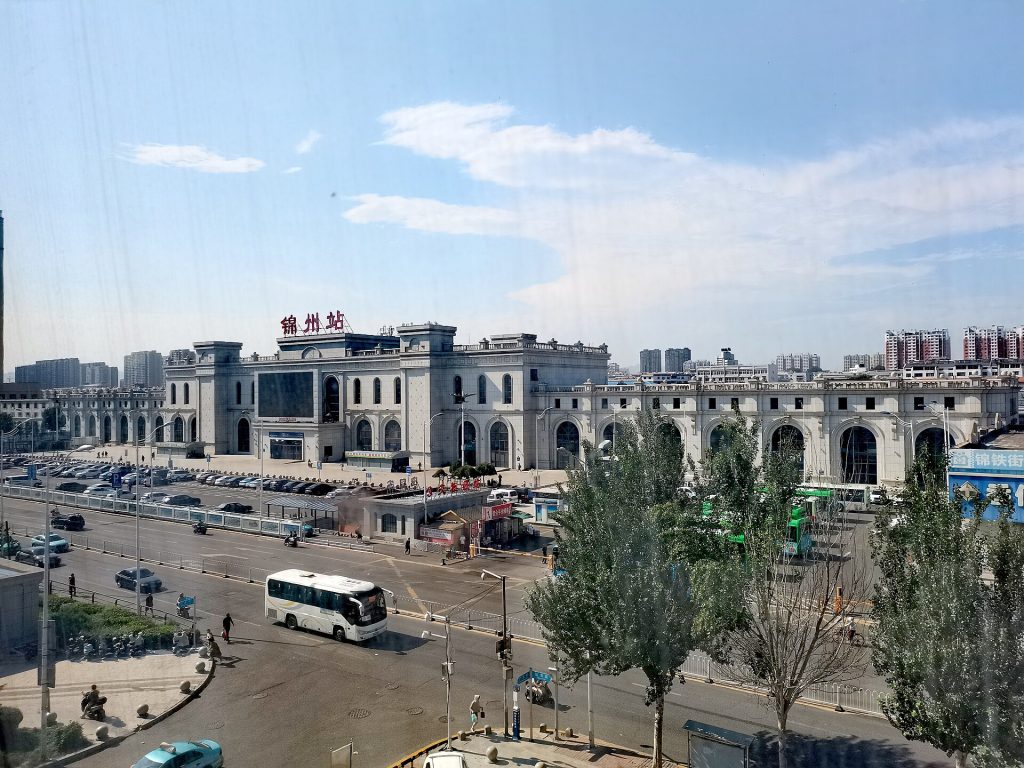
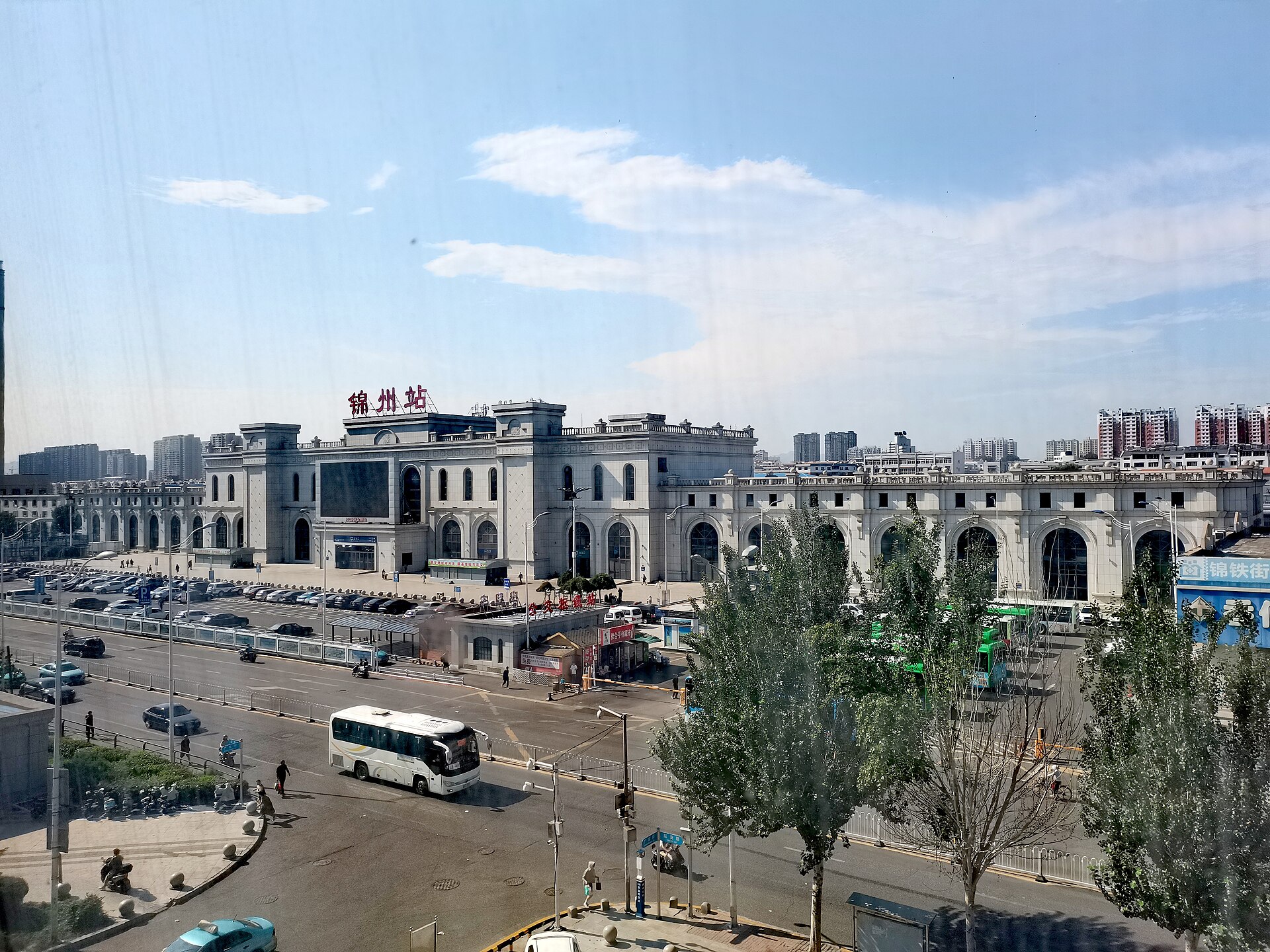
The minibus rattles past a row of open-air barbecue stalls, smoke curling into the dusk as skewers of lamb fat sizzle over charcoal. Ahead, the Liaoxi Corridor stretches flat toward the Bohai Gulf, the same narrow passage that armies have fought over for centuries. I step off near the old train station just as a vendor shouts the evening special — grilled scallops brushed with garlic and chili — and realize I have arrived in a city that feeds you before it shows you its museums.
Getting Oriented
Jinzhou sits on the western lip of Liaoning Gulf, where the coastal plain pinches tight between water and mountains. The downtown grid is compact enough to walk if you have time, but the real movement happens along the two main arteries: Nanjing Road runs east-west through the commercial core, while Beijing Road cuts north toward the highway and the fossil sites. Taxis start at a flag-fall that buys you three kilometers, and the drivers know every shortcut through the wholesale markets. City buses numbered 1 through 30 cover the tourist loop — Memorial, Pagoda, Seaside — for pocket change. If you rent a shared e-bike, scan the QR code on the handlebar and stay in the bike lane; traffic lights here are treated as suggestions.
Where the Past Stands Still
The Liaoshen Campaign Memorial sits on a hill that once bristled with artillery. Inside, the diorama of the 1948 battle fills a circular hall — tiny PLA soldiers advancing across a snowfield, Nationalist tanks burning in miniature. Veterans still come on anniversaries, laying chrysanthemums at the stone tablet. Down the slope, the Guangji Pagoda rises seven stories of Liao Dynasty brick, its eaves curved like wings. Climbing the internal staircase rewards you with a view of the modern skyline punctuated by smokestacks. Nearby, the Fengguo Temple’s main hall shelters seven towering clay Buddhas, each face distinct, carved when the Khitan ruled these plains. Incense coils hang from the rafters, and an elderly nun sweeps the courtyard with a bamboo broom, ignoring the tour groups.
Stone Bones and Sea Wind
Thirty kilometers west, the Jinzhou Fossil Park spreads across a badland of eroded red sandstone. This is the Jehol Biota, where volcanic ash buried feathered dinosaurs, early birds, and flowering plants 120 million years ago. The museum displays a Sinornithosaurus with its downy coat preserved in slate, and a Confuciusornis frozen mid-glide. Outside, you can walk the quarry paths where researchers still split shale with hammers. Bring a wide-brim hat — there is no shade — and a bottle of water from the kiosk at the gate. In late spring, the wind carries the smell of salt from the gulf and the sharp dust of exposed strata.
Closer to town, Bijia Mountain juts into the bay like a turtle’s head. At low tide, a sandbar emerges, a natural bridge of wet sand and shell grit that connects the island to the mainland. Locals time their crossing by the lunar calendar, checking the tide tables posted at the seawall. I walked it on a third-month morning, the water retreating to reveal clams spurting in the mud. Halfway across, an old man raking razor clams waved me toward a tide pool where a tiny crab molted its shell. The mountain’s summit holds a Daoist shrine to the Goddess of the Sea; the climb takes twenty minutes up stone steps worn smooth by centuries of pilgrims. From the top, the port cranes of Jinzhou Harbor look like steel giraffes against the horizon.
Eating Like a Local
Jinzhou barbecue is not a meal — it is a negotiation. You sit on a plastic stool at a streetside stall, the grill a steel trough burning fruitwood charcoal. The owner brings a tray of raw ingredients; you point, she skewers, you flip. The rhythm is fast, the beer cold, the conversation loud.
- Must-order skewers: lamb kidney (tender, faintly sweet), pork belly cubes (crust charred, fat rendered), garlic chives (whole stems, smoky), scallops on the half-shell (butter brushed, chili dusted), tofu skin rolls (crisp edges, custard center).
- Cold dishes to start: smashed cucumber with raw garlic and vinegar; jellyfish threads tossed in sesame oil and cilantro; pig ear slices with chili oil and crushed peanut.
- Staple finish: corn pancake wrapped around a fried egg and pickled mustard greens, eaten like a taco.
Restaurants with neon signs and picture menus cater to tour buses; the best smoke rises from alleys behind the department store on Shengli Street. Order by weight — “two liang of lamb, one of chives” — and watch the grill master fan the coals with a cardboard square. A common mistake: asking for “less spicy.” The chili is not a condiment; it is the architecture of the flavor. Another: eating only meat. The vegetable skewers — lotus root, king oyster mushroom, green pepper — absorb the fat and smoke, balancing the richness.
Seasonal Rhythms
Late spring brings the Apricot Blossom Festival on Yiwulü Mountain, when the slopes blush pink and city families picnic under the trees. Summer is for the seaside — Jinzhou’s beaches fill with tents at night, families grilling squid on portable stoves while children chase hermit crabs in tidal pools. Autumn means the Chrysanthemum Exhibition at the Botanical Garden, rows of pompon and spider varieties labeled in calligraphy. Winter drops below minus fifteen; the harbor freezes, and ice fishermen drill holes near the breakwater, pulling up flounder through the slush. If you visit in the twelfth lunar month, the Laba porridge stalls appear at temple gates, simmering rice, red bean, millet, and dried jujube in iron cauldrons.
What Newcomers Get Wrong
First, they treat Jinzhou as a day trip from Shenyang. The high-speed train takes fifty minutes, but the city reveals itself at night — the barbecue lanes, the lanterns on the pagoda, the fishermen mending nets under floodlights. Stay overnight. Second, they skip the fossil park because “it’s just rocks.” The rocks hold feathers. Third, they wear new white sneakers on the Bijia sandbar. The mud stains are permanent. Fourth, they bargain aggressively at the night market. A polite “tai gui le” (too expensive) and a half-smile work better than a calculator. Finally, they assume everyone speaks Mandarin with a standard accent. The local dialect swallows final consonants and tones; learn “zhei ge” (this one) and “bu yao la” (no chili) and you will survive.
Practical Notes
- Sleep: Business hotels near the high-speed rail station offer clean rooms and late check-in. For character, book a courtyard guesthouse in the old quarter near Fengguo Temple — shared courtyard, heated kang bed, host serves homemade pickles at breakfast.
- Move: Download the local bus app (Jinzhou Bus) for real-time arrivals. Taxis accept mobile pay; keep small cash for street food.
- Connect: Free Wi-Fi in major parks and museums, but spotty in alleys. A local SIM from the China Mobile kiosk at the station costs little for a week of data.
- Health: Pharmacies (green cross sign) stock stomach medicine for barbecue-induced regret. Tap water is boiled before serving; drink bottled or hot tea.
- Respect: At temples, step over the threshold, not on it. Photography inside Buddha halls often prohibited — look for the red crossed-camera sign. On the tidal sandbar, do not collect live shellfish; rangers patrol at peak season.