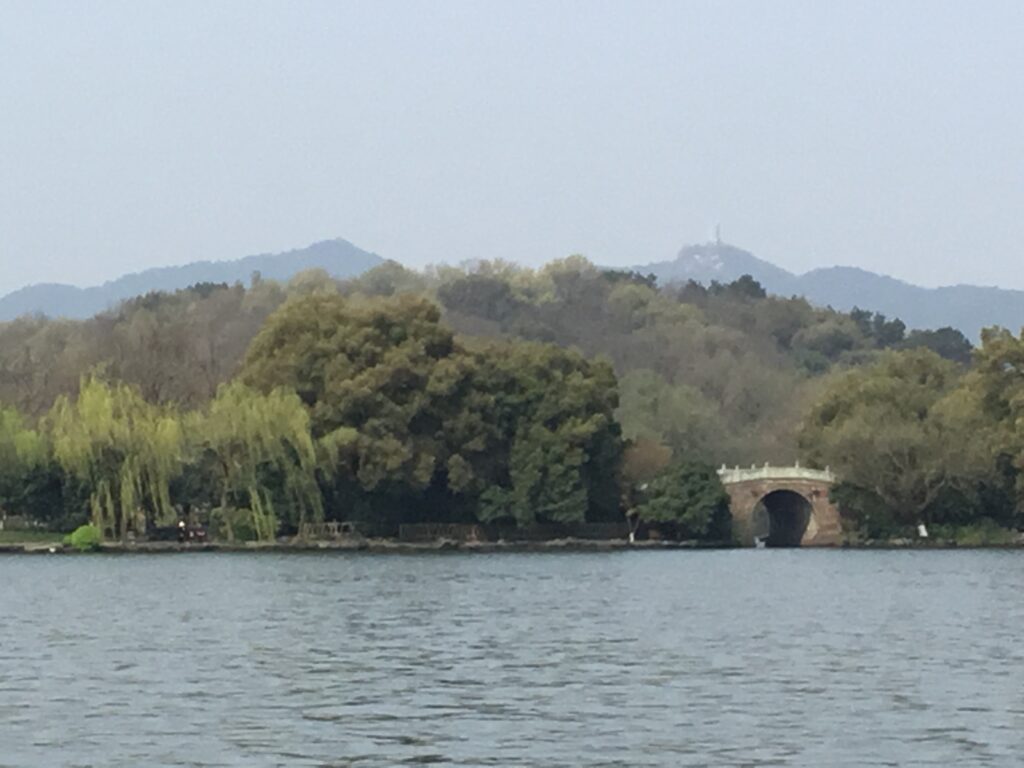
Hangzhou does not hide its lake. The city comes down to the eastern shore and then stops, as if someone had drawn a line and decided that water and hills should have the last word. In early autumn — September into October — that line is at its kindest: the air is usually less heavy than in summer, the willows are still green, and from late September the scent of osmanthus often moves through parks and tea country before you see the flowers.
This is a first visit you can actually walk: how to reach the water from Hangzhou East, how to spend one day on the causeways, whether you need a boat, and how to use a second day in the Longjing hills. If you are arriving by high-speed rail, book the mainland train on 12306 before you worry about which willow to stand under.
Why visit West Lake in September and October 2026?
In 2011 the World Heritage Committee inscribed the West Lake Cultural Landscape of Hangzhou on the World Heritage List, under criteria (ii), (iii) and (vi). UNESCO’s statement of outstanding universal value describes a lake held on three sides by hills and on the fourth by the city; a beauty celebrated by writers since the Tang dynasty; islands, causeways and lower slopes “improved” with temples, pagodas, pavilions, gardens and trees that merge with farmed land. The two causeways and three islands, it notes, were created from repeated dredgings between the ninth and twelfth centuries. From the Southern Song onwards, ten poetically named views were identified as idealised pictures of people and nature in balance.
That last point is the practical one. West Lake is composed. A walk is a sequence of pictures. The Hangzhou West Lake Scenic Area Administration holds day-to-day management. Causeways and much of the lakeshore are public walks — Hangzhou dropped a general scenic-area gate fee in 2002. Separate gardens, temples and pagodas keep their own hours and tickets. Buy those only where an official booth or notice tells you to.
September and October are the months when the composition is easiest to be in. What you get now is green, then the first turn of leaf, and osmanthus. If you are here for the moon festival itself, 25–27 September 2026, the cakes and the calendar are in Mooncakes and a Friday Night Moon.
How do I get to West Lake from Hangzhou East?
Hangzhou East Railway Station sits on Metro Line 1. Ride Line 1 toward the lake and get off at Longxiangqiao (龙翔桥) for the eastern Hubin waterfront — a short walk to the water. If you want Broken Bridge and Bai Causeway first, Fengqi Road (凤起路, Lines 1 and 2) puts you several hundred metres from the north-east corner. There is no single “West Lake station.” Decide which shore you want, then choose the stop.
Once you are on the shore, walk. The lake is about 3.2 km north to south and 2.8 km east to west, with a shoreline on the order of 15 km. Wear shoes that forgive stone.
How should I spend one day on West Lake?
Keep the first day on the water and the two famous causeways.
Morning — Broken Bridge and Bai Causeway. Start on the north-east, where Bai Causeway runs out toward Solitary Hill (Gushan). At its city end stands Broken Bridge (Duanqiao). One of the classic ten views is “lingering snow on Broken Bridge”: snow melting faster on the sunlit crown than in the shade, so that the arch can look, from a distance, as if it had come apart. The bridge is a place to stand and understand the lake’s scale — city behind you, hills ahead, water on both sides of a short causeway planted with willow. In Chinese storytelling it is the meeting place of the White Snake legend. Walk the causeway slowly to Gushan. Solitary Hill is the lake’s only natural island. Zhongshan Park sits on the hill; you do not need every interior.
Midday — Su Causeway. The longer western crossing is Su Causeway, the lake’s great horizontal. UNESCO treats the causeways as the lake’s main artificial structure, banked from dredged mud. Tradition ties this one to the poet-official Su Shi (Su Dongpo) and his dredging when he served as prefect of Hangzhou in 1089. You need an hour, or two, to walk it without treating the six bridges as a fitness course.
Pause on a bridge and look both ways: inner water on one side, the broader lake on the other, hills closing the west. That double view is the design. “Spring Dawn at Su Causeway” is a spring name. In early autumn the willows still screen the water. Leifeng Pagoda is ticketed and optional on a first day. If it rains, keep walking.
Late afternoon. Hubin’s string of small parks, or the southern willows, will do. A first day can be this walk, a bowl of tea, and nothing else of consequence.
Do I need a boat on West Lake?
No. You do not need a boat to “do” West Lake. The causeways are the design. From the bank they are paths; from the water they flatten into lines. If you want that second picture, take an official boat.
West Lake boats are a scenic-area operation, not a freelance paddle. Hangzhou’s municipal culture and tourism pages describe two families of craft: larger cruise boats (including painted boats, 画舫) that run between named piers, and smaller hand-rowed or yuloh boats (手划船 / 摇橹船) hired by time at a dock.
Practical rules, from those official notes and from a 30 April 2025 Hangzhou Daily briefing on the city government site:
- Buy at an official pier. Fares are posted there. They change.
- You need not get off at the same pier you boarded.
- Hand-rowed and yuloh boats are charged by the hour, not by the head. There is a one-hour minimum; after that, charging is in half-hour steps. Each boat carries a QR code: scan it, read the notice, start the clock.
- Boats leave the depot around 06:30. Docks generally stop taking new hand-rowed orders after about 17:40. Holiday dock lists are shorter. Night sailing, when it runs, is a warm-season operation into early October — ask the pier.
- Cruise tickets that include Lesser Yingzhou usually bundle island admission; a hand-rowed island stop is usually extra, and waiting counts as hired time.
Named piers worth knowing: Hubin (city side), Zhongshan (Solitary Hill, near Bai Causeway), Hangzhou Hotel / 杭饭 (north shore, near Yue Fei’s temple), Huagang (south-west, near Flower Pond and Leifeng). Say where you want to land when you buy. Do not pay a tout on the path.
What if I have a second day: Longjing hills and the western shore?
UNESCO’s inscribed property is not only the water. It includes the wooded hills on three sides, up to the skyline, and the farmed landscape that meets the temples and trees. West of the lake those hills are tea country. Longjing — Dragon Well — is Hangzhou’s famous green tea. The named harvest that collectors wait for is a spring event, the tender pick before Qingming. In September and October you will not see that harvest. You will see terraces, villages, and tea houses that still pour the leaf grown on these slopes.
No metro line climbs into the village. The ordinary public route is bus 27, run by Hangzhou Public Transport Group, from Yuewang Road on the north-east of the lake (a walk from the Fengqi Road / Longxiangqiao area) toward the China National Tea Museum / Longjing section. Get off at Longjing Tea Room (龙井茶室) or Longjing Village (龙井村), depending on the working of the day. A taxi or ride-hailing car from the eastern shore is the other honest option.
Walk rather than shop first. The roads climb; the rows of bushes hold the hills in even lines. Osmanthus, when it blooms from late September into October, often scents this country as strongly as it scents the city parks. Drink what you are offered, slowly. You are not required to buy a catty of “imperial grade” from a stranger at a gate. If you do buy, buy from a house you have sat in, after you have tasted.
Yanggong Causeway, the quieter western crossing, can stitch the tea hills back to Flower Pond. Lingyin Temple, through ticketed Feilai Peak, is not compulsory on a first lake day.
When should I go versus Golden Week crowds?
Go on a weekday in September, or in October after the National Day rest, if you can. The State Council’s 2026 notice sets Mid-Autumn on 25–27 September and National Day rest on 1–7 October, with makeup workdays on 20 September and 10 October. Those makeup days are ordinary working days.
This is not a Golden Week overview. It is a crowd warning, kept qualitative because a 2026 headcount does not exist yet. West Lake is one of the scenic areas that fills when China is on holiday. Broken Bridge, Hubin and the boat queues take the pressure first. If those weeks are your only window, come at first light. For a first visit, the lake is a bridge, a causeway, and — if you had the second day — tea from hills that belong to the same World Heritage landscape.
FAQ
How many days do you need for West Lake in Hangzhou?
One full day is enough for Broken Bridge, Bai Causeway, Solitary Hill and a slow walk on Su Causeway, with or without an official boat. A second day is the right length for the Longjing tea hills and the quieter western shore. You do not need a week. You need hours on foot.
Is West Lake free to visit?
The causeways and much of the lakeshore are public walks. Individual sites — Leifeng Pagoda, Yue Fei’s temple, Lingyin / Feilai Peak, some gardens and villas — still sell their own tickets at official booths. Boat fares are separate and posted at the pier. Do not pay a lake-wide “ticket” to a person on the path.
When is the best time to visit West Lake in autumn 2026?
Early autumn, September into October, is the kind season: less humid than summer, willows still green, osmanthus often in the air from late September. For fewer people, choose weekdays outside 25–27 September and 1–7 October. If you must come in those holiday blocks, go at first light. Makeup workdays on 20 September and 10 October are ordinary working days.