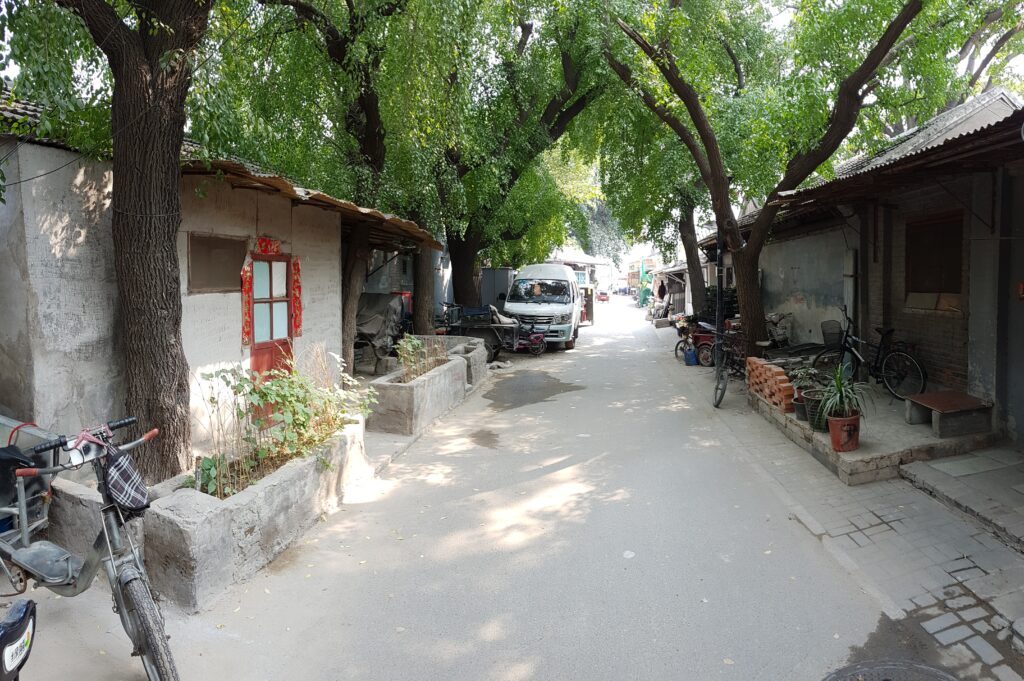
Beijing’s old lanes are not a park with grey-brick scenery. A hutong is a street that still feeds courtyards, and many of those courtyards are still homes. You can walk them. You cannot borrow them. The difference is easy to forget on Nanluoguxiang, where the main north–south strip has spent two decades learning to look like a destination. A better first walk treats that strip as a threshold, then turns into lanes where laundry, bicycles and closed gates are the point — not a backdrop for someone else’s photograph.
Arrive by subway. Stay on the public stones. Leave the gates shut. That is the whole method.
If you are coming in from another city, book the mainland train on 12306 first.
Which hutong lanes are tourist strips, and which are still residential?
A hutong is the lane. A siheyuan is the courtyard house the lane serves. From the street you may see a screen wall, a pair of stone drums, a number plate, a padlock. That is the elevation you are allowed. The interior belongs to whoever lives there.
Tourist strips are the lanes that have learned to sell themselves: a continuous shopfront, snack windows, signage in three languages, a crowd that moves at the speed of a phone screen. Nanluoguxiang’s main spine is the type specimen. Yandai Xiejie, the slanted street that runs from the Drum and Bell Towers down toward Houhai, is another. Those streets are public and legal to walk. They are no longer a reliable picture of a residential hutong.
Residential lanes still have doorbells. They have bicycles nosed into a gate, a delivery tricycle, couplets on a red door, a tree in a tin basin, wiring no ink-brush painting included. Beijing’s municipal government listed Nanluoguxiang among twenty-five Old City historic conservation areas when it drew protection boundaries in 1999 (the notice is still on the capital’s government site). The same list names Shichahai, the Guozijian district, Dongsi’s northern hutongs (东四北三条至八条) and Xisi’s northern hutongs (西四北头条至八条) as inner-city residential fabric. Do not hunt for a perfect “untouched” hutong. Inner-city Beijing is not a sealed relic. Look instead for a lane that still has doorbells.
How do I get there by subway?
You do not need a taxi. The old city sits on the metro.
- Nanluoguxiang Station (南锣鼓巷), Lines 6 and 8. The station opened to Line 6 in December 2012 and to Line 8 a year later. It sits at Di’anmen East Street, near the south end of the famous lane. Follow the signs for Nanluoguxiang. Follow current exit signs (English guides often name Exit E). The hutong runs north toward Gulou East Street.
- Shichahai Station, Line 8, and Beihai North, Line 6, put you on the water west of the Nanluoguxiang block. Useful if you want to end at Houhai rather than start there.
- Yonghegong Lama Temple Station, Lines 2 and 5, is the right stop for the Guozijian / Imperial Academy conservation area and the hutongs around the Confucius Temple. Do not confuse it with Nanluoguxiang. They are a walk apart, not the same neighbourhood.
- Dongsi Station, Lines 5 and 6, sits at the south of the Dongsi north-hutong strip (三条 to 八条) listed in that 1999 conservation plan.
- Xisi Station, Line 4, for Xisi’s northern hutongs (头条 to 八条), also on the 1999 list.
Pay the posted metro fare. Keep your passport on you if you connect onward by train.
How should I walk Nanluoguxiang without treating it as the neighbourhood?
Nanluoguxiang, in Dongcheng District, is the lane everyone names. Beijing’s 1999 conservation notice describes the district as a Yuan-dynasty layout that still keeps a “fishbone” hutong plan, the most complete of its kind in the old city, and as a typical siheyuan neighbourhood. The spine itself runs on the order of 800 metres (a 2019 Sustainability paper: 787 metres and sixteen side hutongs), from Gulou East Street to Di’anmen East Street. That plan is the heritage. The souvenir lighting is not.
Walk it once, if you wish, to see the scale of the old street. Then turn.
The quieter walk is lateral. On the west of the spine the named hutongs include Yu’er (雨儿) and Mao’er (帽儿); on the east they include Ju’er (菊儿), Qinlao (秦老) and the Yuan’en temple lanes. Their character shifts from year to year as shops open and close. What does not shift is the basic rule: the public way is the lane; the private world begins at the gate.
Ju’er Hutong is the one name worth knowing before you go, not because it is a secret — it is not — but because it shows that “residential” here is a living argument. In the late 1980s and early 1990s, a renewal led by the architect Wu Liangyong of Tsinghua University rebuilt part of the lane as new courtyard housing rather than a high-rise slab. Phase one later received a World Habitat Award. The project is now decades old. It is still a place people inhabit. Walk it as a street that was fought over, not as an open-air museum of “old Beijing.”
Which quieter hutongs can I walk instead?
These are not hidden. They are on the city’s own conservation list. They are quieter than the Nanluoguxiang spine because they still read as streets.
Beiluoguxiang, north of Gulou East Street, sits in a later batch of designated historic areas, listed by Beijing’s cultural-heritage planning as a counterpart to Nanluoguxiang, Shichahai and the Guozijian district. It is not empty. It is simply less performed.
Guozijian Street and its side hutongs. The 1999 notice describes the Guozijian area as a Yuan-founded neighbourhood organised around the Confucius Temple, the Imperial Academy and Yonghegong, with Ming paifang still standing on the main street and relatively complete courtyards as the setting. The main street takes temple traffic. The lanes off it do not. Walk those. Yonghegong Station is the door.
Dongsi Beitiao (东四北三条至八条). Same 1999 list: a Yuan hutong system, grouped with Nanluoguxiang and Xisi as inner-city fabric where the lane grid is among the most complete. Dongsi Station puts you at the south. Walk north through the numbered hutongs. You will see more doorbells than dessert shops.
Shichahai’s quieter edges, not Yandai Xiejie. Shichahai is one of the original twenty-five areas. Yandai Xiejie and Houhai’s bars are a night strip; use the water as an end to the walk, not a second spectacle.
None of these is guaranteed silent. A weekday morning is the honest bet. National Day rest in 2026 runs 1–7 October; the Nanluoguxiang spine will be hardest then. Mid-Autumn, 25–27 September, is a shorter pulse — lanterns and mooncakes, not a second Golden Week. Makeup workdays on 20 September and 10 October are ordinary working days.
What etiquette applies when courtyards are still homes?
Stay on the paved public lane. Do not step through an open gate “just to look,” even if the courtyard seems picturesque and empty. An open gate is not an invitation. It is someone coming or going. Do not part a curtain, lift a latch, or follow a resident in as if the doorway were a ticketed exhibit. Keep doorways and bicycle slots clear. Lower your voice; sound carries between walls that were built for families, not footfall.
Photographs of architecture from the street are one thing. Photographs of people, of kitchen interiors, of children, of laundry lines, of an old man on a stool, are another. Ask, and accept a refusal without negotiation. A telephoto lens pointed at a courtyard is still an intrusion. Drones have no place here.
You will see electric scooters, coal-shed conversions, air-conditioning boxes, and wiring that no ink-brush painting included. That is the neighbourhood working. It is not visual noise to crop out.
If you want a meal, choose a place that faces the street and is clearly in business. Do not invent a hunt for hidden courtyard restaurants whose names you read on a blog last year; shops turn over. Buy from a counter, sit where other customers sit, and leave when you are done.
There is no ticket for the lane itself. There is only the obligation to remember that you are between other people’s rooms.
Morning or evening: when should I walk?
Morning. That is the residential hour.
Early, the lanes are for people leaving for work, for the vegetable tricycle, for a broom. Nanluoguxiang’s spine is not empty, but it has not yet become a snack corridor. Side lanes feel like streets. Carry a layer; Beijing autumn evenings can drop sharply after a hot spell.
Evening is when the tourist strips perform. Nanluoguxiang and Yandai Xiejie fill with people who came to eat and be seen. The residential lanes go quieter, which is not your cue to linger with a camera under someone’s window. If you want night, keep to the commercial spine or to Houhai’s public waterfront, then go home.
Wear shoes that forgive uneven stone. You will have seen less of Nanluoguxiang’s shopfronts than many itineraries demand, and more of Beijing as it is still lived: a closed gate, a tree in a tin basin, a street that does not exist for your camera.
FAQ
How do I get to Nanluoguxiang by subway?
Take Line 6 or Line 8 to Nanluoguxiang Station. The station is at the south end of the lane, on Di’anmen East Street. Follow the signs for Nanluoguxiang when you exit. For the Guozijian and Confucius Temple hutongs, use Yonghegong Lama Temple Station on Lines 2 and 5 instead — that is a different conservation area, not a back door to the same strip.
Which Beijing hutongs are less touristy than Nanluoguxiang?
The quieter walk is usually one street off the famous spine: Ju’er, Yu’er and Mao’er beside Nanluoguxiang; Beiluoguxiang north of Gulou East Street; the side lanes of the Guozijian area; and the numbered hutongs of Dongsi Beitiao and Xisi Beitiao, all named in Beijing’s Old City conservation plans. None is “untouched.” All still have doorbells. Weekday mornings are kinder than weekend afternoons.
Can you walk into a siheyuan courtyard in Beijing?
Not unless you live there, are invited, or have bought a ticket for a courtyard that is openly run as a museum, hotel or restaurant. A siheyuan is a house. An open gate is not a gallery. Stay on the public lane, photograph architecture from the street if you must, and ask before you photograph people. There is no general hutong admission fee, and no licence to treat someone else’s rooms as a set.