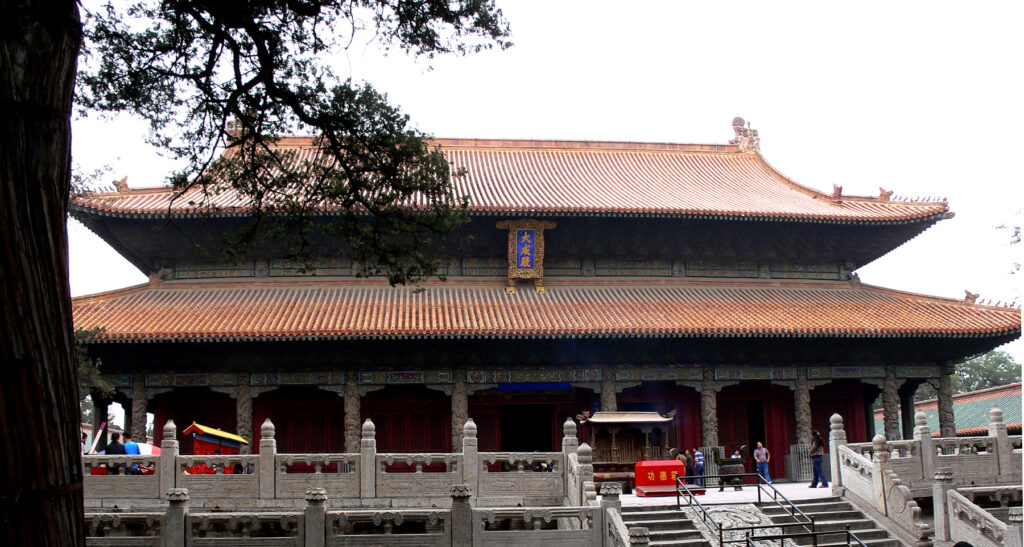
Monday 28 September 2026 sits in a curious pocket of the Chinese autumn. Mid-Autumn Festival is three days behind it. National Day is three days ahead. The moon has been eaten. The flags have not yet gone up. Qufu, in Shandong, uses the Monday for something older than either holiday: a birthday.
Confucius — Kong Qiu, Kongzi, 孔子 — is traditionally dated 551–479 BCE. Qufu was his home in the State of Lu. On 28 September the town does not treat him as a quotation on a classroom wall. It treats him as a man whose death, in the year after it happened, was already turned into a rite.
If you are an English-speaking visitor with one free day between the mooncakes and Golden Week, this is the practical guide: what the date is, what the ceremony usually looks like, how to walk the Temple, the Mansion and the Cemetery, and why the calendar in 2026 is tight.
Why Confucius’s birthday is 28 September
The Gregorian 28 September is the date now used in the People’s Republic for Confucius’s birthday, 孔诞. It is also the date of the public memorial ceremony, 祭孔, at the Temple of Confucius. Taiwan keeps the same day and calls it Teachers’ Day. The mainland put Teachers’ Day on 10 September in 1985 and left 28 September to the sage.
How a Spring-and-Autumn birth became a September morning is a story of calendars, not of a surviving birth certificate. What can be said without embroidery is that Qufu and many other Confucian temples now keep 28 September as the annual commemoration. The 2025 ceremony in Qufu was billed as the 2,576th anniversary of the birth. By that count, 2026 is the 2,577th.
The first shrine was local. In 478 BCE, the year after Confucius died, the Duke of Lu is recorded as turning the master’s house into a temple. Imperial sacrifice came later: the Han founder, Gaozu, is the first emperor named as offering a rite in Qufu. From the Eastern Han onward the school sacrifice known as the shidian, 释奠, settled on Confucius. Tang codes spread temples to prefectures. The ceremony became a state liturgy. It was never only Qufu’s business. It is still Qufu that sets the picture.
The Confucius birthday ceremony in Qufu
The modern public ceremony is held at the Temple of Confucius, 孔庙, usually as the centrepiece of the China International Confucius Cultural Festival in late September. As of 30 August 2026 the full official programme for this year’s festival had not been published. Treat any theme, guest list or special ticket rule you see online as unofficial until Qufu or Shandong posts it. The date does not wait for a press release. 28 September is the birthday on the wall.
The 2025 rite, reported by Xinhua, is a fair guide to the shape, because the sequence is inherited rather than invented each autumn.
It begins about nine in the morning. Nine bells. Participants wear yellow sashes and walk in through the Wanren Palace Wall, 万仞宫墙, for the opening of the city, the temple and the doors — 开城、开庙、启户. The procession comes to the terrace before Dacheng Hall, the Hall of Great Perfection, 大成殿. Flower baskets are laid before the image of Confucius. A senior Shandong official reads the sacrificial address, 祭文. Guests straighten their clothes and bow. In 2025 the whole public act was over by about ten. Music and dance carry the meaning that a speech cannot: li, ritual propriety, made visible.
In front of Dacheng Hall stands the Apricot Platform, 杏坛, a reminder of the story that Confucius taught under an apricot tree. The hall behind it has yellow imperial tiles, coiled-dragon columns on the façade, and a scale that was meant to look like a palace. Emperors, the guides still say, had those dragons wrapped when they visited, so as not to be outdone by a teacher. Dacheng Hall covers about 54 by 34 metres and stands just under 32 metres high, on 28 stone pillars, ten of them carved with coiled dragons on the front.
If you are not on the invitation list, you can still walk the temple. The main rite is a formal event, not a carnival. Arrive early if you want a view of the terrace. The point is stillness, then music, then a bow.
Dress as you would for a memorial, not for a hike. Hats come off in the hall courtyards if a steward asks. Do not step onto the sacrificial terrace unless you are told to. A livestream, if one is announced, is the honest way to watch the baskets being laid without pretending you were in the procession.
How to visit the Confucius Temple, Mansion and Cemetery
The temple is one of three sites that Qufu calls the San Kong, 三孔. Beside it is the Kong Family Mansion, 孔府, where the main line of descendants lived as hereditary ducal households. A few kilometres north is the Cemetery of Confucius, 孔林, a walled woodland of tombs that includes the master’s own grave and those of generations of Kongs. In 1994 UNESCO inscribed the three together as the Temple and Cemetery of Confucius and the Kong Family Mansion in Qufu, World Heritage list number 704, under cultural criteria (i), (iv) and (vi).
The temple itself has been rebuilt through fire and fashion. A Ming restoration after the blaze of 1499 gave it much of its present plan: nine courtyards on a north–south axis about 1.3 kilometres long, yellow tiles, red walls, pines. Dacheng Hall was raised again in the Qing after another fire in 1724. The sculpture of Confucius that now receives the baskets is a successor to figures damaged in 1966. Continuity here is an argument, not a miracle. The site kept being restored because the rite kept being needed.
Walk it south to north. The first courtyards are an introduction of pines and gates — Lingxing Gate, named for a star. Then the Pavilion of the Star of Literature, Kuiwen Hall, and the Thirteen Stele Pavilions, where imperial tablets sit on stone tortoises. Then Dacheng Gate, the Apricot Platform, and the hall. Side galleries hold the tablets of later Confucians. You do not need to read them all. You need to notice that a teacher’s courtyard was built to the scale of a palace.
The Mansion, next door, is a house that learned to look like a yamen. Inner courts, a garden, the rooms from which the Kong dukes managed the estate. It is the right second hour if you want to see how a family lived off a reputation. The Cemetery is a different pace: walls, old trees, a spirit way, and Confucius’s own mound among thousands of later graves. Allow time. It is several kilometres north of the temple, not a courtyard you stumble into.
Getting to Qufu and into the sites
High-speed trains stop at Qufu East, 曲阜东站, on the Beijing–Shanghai line. Beijing is typically about two to two-and-a-half hours; Shanghai about three to four; Jinan under an hour. The station sits east of the old town. City bus K01 runs toward the temple’s south gate; a taxi is the simpler option with luggage. Do not confuse Qufu East with the small conventional Qufu station closer to the centre, which sees few trains.
The scenic area has, in recent years, required real-name tickets booked ahead — the official WeChat accounts “文博曲阜” and “曲阜三孔景区,” or a major platform such as Ctrip — with passport or national ID at the gate. Combined tickets covering all three sites are the usual way to walk the set. Hours have typically started around 8:30, with last entry mid-afternoon at the temple and mansion and a little later at the cemetery. Do not treat an old blog’s yuan figure as this Monday’s price. Check the day’s notice. Bring the passport you booked with.
A full, unhurried San Kong is a long day. If you have only the morning of the 28th, take the temple and the terrace, then the Mansion if the crowd allows. Save the Cemetery for a quieter afternoon or for the 29th, which in 2026 is an ordinary Tuesday.
If you cannot reach Shandong, Beijing’s Confucius Temple and the adjacent Imperial Academy on Guozijian Street are the capital’s own Confucian pair. They will not stage Qufu’s birthday rite.
The calendar squeeze: Mid-Autumn, then the birthday, then National DayIn 2026, 28 September is a Monday. Mid-Autumn’s three-day public holiday on the mainland runs from Friday 25 to Sunday 27 September — the mooncakes, the night, and the trains that fill on the Thursday before. National Day then runs from Thursday 1 October to Wednesday 7 October, with makeup workdays on 20 September and 10 October. The Monday, Tuesday and Wednesday in between — 28, 29 and 30 September — are ordinary workdays.
Some travellers stitch the two holidays into a longer autumn break with annual leave. Some go home after the moon and come out again for the flag. Qufu’s ceremony does not move to a weekend to make that easier. It stays on the birthday.
For a visitor, that Monday is therefore both a cultural date and a logistical one. The moon-festival crowds have begun to thin. Golden Week has not yet fully begun. If you want the terrace at nine, arrive the night before. Do not count on an 8:55 dash from the station.
It is not a public holiday on the mainland. Offices elsewhere will be open. In Qufu the morning belongs to a hall with yellow tiles and a name that means great perfection. You can watch from the courtyard. You can also simply stand under the pines and let the bells do the counting. The sage does not need a long weekend. He needs, once a year, a city that still knows how to bow.
FAQ
Is Confucius’s birthday a public holiday in China in 2026?
No. 28 September 2026 is a Monday workday on the mainland, sitting between the Mid-Autumn holiday (25–27 September) and National Day (1–7 October). Taiwan marks the same date as Teachers’ Day.
Can visitors watch the Qufu ceremony?
The public rite is a formal memorial, usually mid-morning at Dacheng Hall, not a ticketed show. As of 30 August 2026 the year’s festival rundown had not been published. Arrive early, stay off the terrace unless invited, and treat a livestream as the backup.
How do I visit the Temple, Mansion and Cemetery in one day?
Book a real-name combined ticket before you go, take a high-speed train to Qufu East, and walk the temple first. The Mansion is next door; the Cemetery is a few kilometres north. Check that day’s hours. The 28th will be busier than the 29th.