The minibus rattles over the potholed stretch of road between Shenyang and Tieling, the Liao River flashing gray through the poplars. By the time the driver announces the stop near the railway station, the air smells of coal smoke and frying dough. There is no tourist office at the curb, just a row of electric bikes waiting for fares and a vendor steaming corn cobs in a dented metal drum. This is how the city introduces itself: practical, loud, and entirely unbothered by whether you have a plan.
Getting Oriented
Tieling sits on the flatlands north of Shenyang, a railway hub where the high-speed line slices through cornfields and slag heaps. The downtown core clusters around the train station and People’s Park, a grid of wide boulevards that empty into residential blocks of tile-roofed walk-ups. Most visitors arrive by fast train — twenty minutes from Shenyang North — or by long-distance bus that deposits you at the south station. Taxis cluster at both exits; a ride to the city center costs roughly the price of a bowl of beef noodles. If you prefer wheels, shared e-bikes unlock with a phone scan, though the traffic rhythm takes some decoding: trucks keep right, scooters weave left, and pedestrians claim the rest.
Longshou Mountain: Temples, Stelae, and the Long View
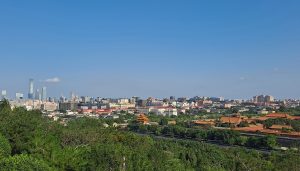
Longshou Mountain rises behind the municipal government buildings, a wooded spine crowned with pavilions. The climb starts at the south gate where a stone archway frames the characters for “Dragon Head.” Stone steps switchback past a forest of stelae — Qing emperors’ calligraphy, Republican-era land deeds, and a few modern odes to local heroes. Halfway up, Ciqing Temple holds a courtyard of ginkgo trees that drop golden fans in the tenth lunar month. The Sun Temple at the summit is a reconstruction, but the platform offers a genuine panorama: the Liao River bending like a silver ribbon, the cooling towers of the power plant exhaling steam, and the patchwork of fields that earn Tieling its “granary” nickname.
- Best time: Late autumn for ginkgo color; early morning in summer to avoid the heat haze.
- Entry: The park is free; the temple complex asks for a small incense donation.
- Footwear: Wear rubber soles — the stone stairs turn slick after rain.
- Detour: A side path leads to a Martyrs’ Cemetery with rows of pine trees and a quiet memorial hall.
Chengzishan Mountain City: Walking the Ramparts
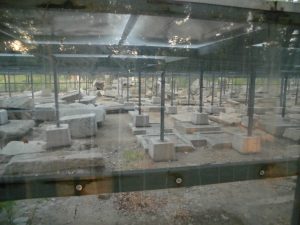
Twenty kilometers northeast, Chengzishan Mountain City sits on a ridge above the Hun River. The site dates to the Goguryeo period, its earthen walls still tracing a rough rectangle against the sky. You enter through a reconstructed gatehouse where a caretaker sells tickets from a folding table. Inside, the ground is uneven — foundations of barracks, a granary pit, a watchtower base. Information boards are in Chinese only, so bring a translation app or a patience for guessing. The real reward is the silence: wind in the sorghum stalks, a kestrel circling the valley, and the sense that you are standing where cavalry once watched for dust clouds on the horizon.
- Transport: Hire a car from the city center (about an hour round trip) or take a county bus to Kaiyuan and switch to a village minivan.
- Gear: Bring water; no vendors on site. A wide-brim hat helps in the open.
- Timing: Allow two hours to walk the full perimeter and climb the highest mound.
- Etiquette: Do not climb on fragile wall sections marked with red tape.
Folk Culture: Yangko, Errenzhuan, and the Sketch Tradition
Tieling calls itself the hometown of Chinese sketch comedy, and the claim echoes in teahouses and community centers. Errenzhuan — a two-person song-and-dance duet — plays nightly at the Tieling Grand Theater, a modern glass box on Youth Road. Tickets sell out on weekends; scalpers linger near the entrance, but the box office releases returns an hour before curtain. The humor leans bawdy, the dialect thick, and the audience participation mandatory. If you catch a village festival in the eighth lunar month, you will see Yangko troupes snaking through streets: dancers in red silk, waist drums booming, ribbons tracing arcs. Locals press steamed buns into your hands and insist you join the line. Refuse politely once, then step in — the rhythm is infectious, and nobody minds a foreigner stumbling through the steps.
- Theater: Tieling Grand Theater, Youth Road. Check the LED board for showtimes.
- Village shows: Ask your hotel front desk for “xianghui” schedules; they shift yearly.
- Language tip: Learn “hao kan” (good show) and “xie xie” — performers hear them often.
- Recording: Phones allowed, but flash distracts the drummers.
Parks, Rivers, and the Rhythm of Daily Life
People’s Park fills at dawn with tai chi circles, badminton games strung between trees, and retirees singing revolutionary operas into portable amplifiers. By noon, the lotus pond in the northeast corner attracts photographers with telephoto lenses. The Liao River promenade, a recent concrete embankment, stretches for kilometers — popular for evening strolls when the streetlights flicker on and kite sellers unspool spools of red and gold. In winter, the river freezes solid; vendors set up ice slides and roasted sweet potato carts. Join a group kicking a feathered shuttlecock (jianzi) near the west gate — they will teach you the basic heel flick if you ask.
- Morning routine: Arrive by 6:30 AM to watch the park wake up; the tea stall opens at seven.
- River walk: Rent a tandem bike at the south entrance; return it before dusk.
- Winter gear: Ice cleats for shoes sold at hardware stores near the station.
- Photo rule: Ask before pointing a lens at elders practicing calligraphy with water brushes.
Practical Mistakes Newcomers Make
First-timers often book a hotel near the high-speed rail station, only to find a desert of construction sites and chain restaurants. Stay closer to the old train station or People’s Park for walkable dinner lanes. Another error: assuming Mandarin works everywhere. The local dialect swallows tones; “Tieling” itself sounds like “Tie-lin” with a swallowed ‘g’. Carry a card with your destination written in characters. Food-wise, don’t order “spicy” expecting Sichuan heat — the chili here is dried, smoky, and used by the handful. And never decline a toast at a banquet; sip instead, and tap two fingers on the table to thank the pourer. Finally, the coal dust. It settles on windowsills and coat collars. Pack a dark scarf and a packet of wet wipes; your lungs will thank you.