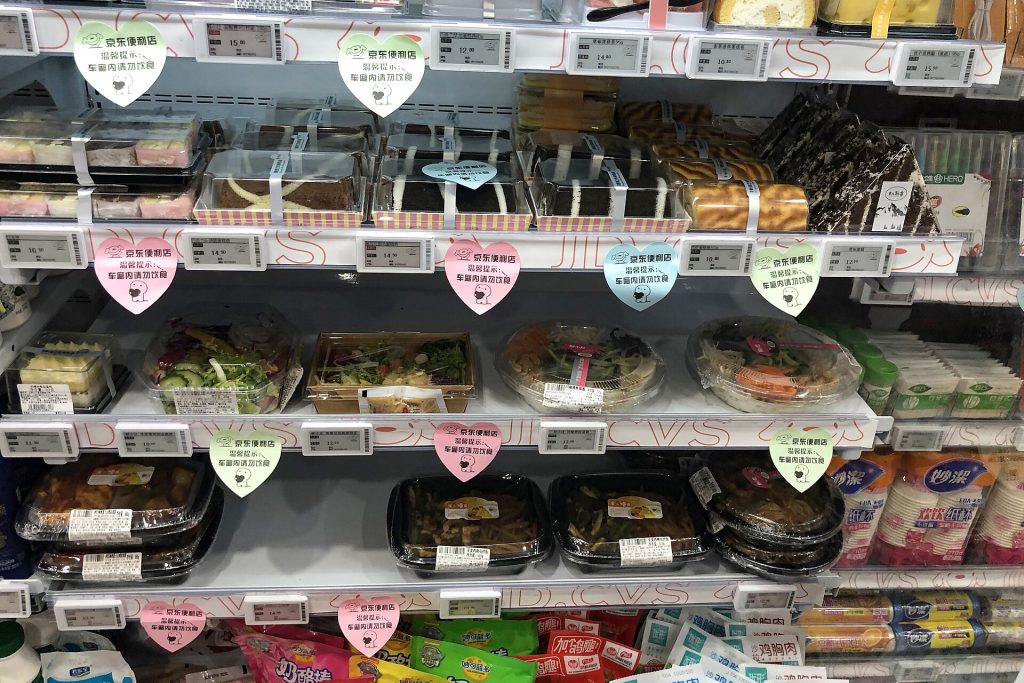
For many visitors, the convenience store is the easiest place to eat in China. There’s no menu to read, no need to speak, and you can see exactly what you are buying. A quick breakfast, a late-night snack after a train, a cold drink on a hot day, a hot bento when you’re too tired to find a restaurant — China’s chain convenience stores cover all of it.
This guide explains which chains you’ll see, what food is worth trying, how heating and paying work, and what to watch for if you have dietary needs.
How big are convenience stores in China?
Very big, and growing. The China Chain Store & Franchise Association (CCFA) reported that the country’s top 100 convenience store companies had about 196,000 stores at the end of 2024, a net increase of around 14,000 on the year before. The top three by store count were:
- Meiyijia (美宜佳) — 37,943 stores, the largest chain, strongest in Guangdong and southern China
- Easy Joy (易捷) — Sinopec’s chain, mostly at petrol stations
- Kunlun Haoke (昆仑好客) — PetroChina’s chain, also at petrol stations
Other names you’ll see often include Lawson (罗森), FamilyMart (全家), 7-Eleven (7-11), Furong Xingsheng (芙蓉兴盛) in Hunan, and Bianlifeng (便利蜂) in Beijing and northern cities. Location data company GeoQ reported that Lawson had more than 7,100 stores in China at the end of 2025, with Shanghai its largest city.
Which chain you’ll find depends on the city: in Shanghai you’ll pass Lawson and FamilyMart constantly, in Guangdong Meiyijia, in Beijing a mix of 7-Eleven, Bianlifeng, Lawson and others.
What food to buy
The joint CCFA–KPMG 2025 convenience store report highlighted “convenience dining” (便利餐饮) as one of the industry’s main growth areas — meaning more ready meals, hot food and fresh items. What’s on the shelf varies by chain, city and season, but these are the standards.
Hot food at the counter
- Oden (关东煮 guāndōng zhǔ): skewers of fish balls, tofu, radish, kelp and other items simmering in broth near the till. Point at what you want; staff put it in a cup with broth. Spicy or sweet sauce is often offered.
- Steamed buns (包子 bāozi): pork, vegetable or red bean buns from a warmer, a cheap breakfast. See our baozi guide.
- Grilled sausages (烤肠 kǎocháng) on rollers.
- Tea eggs (茶叶蛋 cháyè dàn): eggs simmered in a dark tea and soy broth.
- Seasonal extras: in cooler months some stores sell roasted sweet potatoes or corn. Our roast sweet potato guide covers the street-stall version.
Chilled meals
- Bento boxes (便当 biàndāng): rice with braised meat, chicken or vegetables, like the shelf in our cover photo. Staff will usually heat it for you.
- Rice balls (饭团 fàntuán): triangle rice balls with tuna, chicken or other fillings.
- Sandwiches and wraps, noodle salads and cold noodles in summer.
- Cut fruit cups and yoghurt.
Snacks and drinks
- Instant noodles — many stores have a hot water dispenser, so you can eat them there.
- Chips, nuts, dried meat and Chinese sweets.
- Chilled tea, juice and the famous sweetened soy and milk drinks.
- Coffee machines are common in larger chains; for café options see our coffee guide.
How heating works
When you pay for a bento or frozen meal, staff often ask 要加热吗? (yào jiārè ma?, “Do you want it heated?”). Say 要 (yào, yes) or 不用 (búyòng, no need). Some stores have a self-service microwave instead. Remove metal or foil first, and let soup cool before you carry it.
Many larger stores have a few seats or a counter by the window where you can eat. Smaller ones don’t. Clear up after yourself; bins are usually by the door.
How to pay
Almost everyone pays with Alipay or WeChat Pay by showing a payment QR code to the cashier or scanning one at self-checkout. Both apps can be linked to foreign Visa or Mastercard cards; our Alipay and WeChat Pay guide explains the setup.
Tips:
- Open your payment code (付款码 fùkuǎn mǎ) before you reach the till.
- Self-checkout machines usually have a language button; if not, scan items and then your code.
- Carry a little cash as a backup in case your phone or card has a problem.
- Membership offers: cashiers may ask if you’re a member (会员 huìyuán). A simple 不是 (bú shì, no) is fine.
Prices vary by chain and city and are shown on the shelf tags, so you won’t need to ask.
Other useful services
Convenience stores in China are also handy for:
- Buying bottled water, tissues, umbrellas, phone chargers and toiletries.
- Topping up some transport cards (varies by city).
- Picking up a quick meal when delivery apps are slow — though for real meals, see our Meituan vs Ele.me guide, since many convenience stores also deliver through those apps.
Dietary notes
- Labels are in Chinese. Use a translation app’s camera mode on the ingredients list (配料表). Our supermarket label guide lists key words.
- Allergies: China’s new labelling standard, GB 7718-2025, makes allergen declarations mandatory from 16 March 2027. Until then, allergen labelling on packaged food is voluntary. See our gluten-free China guide for wheat and soy sauce words.
- Oden broth and tea eggs usually contain soy sauce and other seasonings, so they are not wheat-free.
- Pork: many buns, sausages and bento contain pork. Look for 清真 (halal) labels, or see our halal food guide.
- Vegetarian: look for 素 (sù, vegetarian) on labels, but check for meat-based stock.
- Food safety: chilled food has a best-before time printed on the label — sometimes the same day. Check it, especially at night.
Useful phrases
- 要加热吗?/ 要,谢谢 — Heat it? / Yes, please
- 这个 / 那个 — this one / that one (pointing works)
- 关东煮,要这个、这个、这个 — Oden, this, this and this
- 要袋子吗? — Do you want a bag? (bags are usually charged)
- 不要袋子 — no bag, thanks
FAQs
Which convenience store chain is biggest in China? By store count, Meiyijia, according to CCFA’s 2024 Top 100 list.
Are Chinese convenience stores open 24 hours? Many in big cities are, but not all. Check the door sign or a map app.
Can I pay with a foreign card? Usually through Alipay or WeChat Pay linked to a foreign card. Direct card payment is less common.
Will staff heat my food? Usually yes — say 要 when they ask 要加热吗.
Is convenience store food safe? Packaged food from major chains is generally fine. Check best-before times on chilled items.
Is there halal food? Some packaged items carry 清真 labels, but most hot food is not halal.
Before you go
Set up Alipay or WeChat Pay, save 要加热 and 不要袋子 on your phone, and try one oden cup and one bento in your first week. When you land late at a hotel, step off an overnight train or just want something easy, the nearest convenience store will rarely let you down.
Sources
- China Chain Store & Franchise Association (ccfa.org.cn), “2024年中国便利店Top100发布”, 2025; China Retail Network, report on Meiyijia’s 37,943 stores, 30 May 2025.
- CCFA & KPMG China, “2025年中国便利店发展报告” (2025 China Convenience Store Development Report), 4 June 2025.
- GeoQ (智图), “2025年连锁便利店门店发展蓝皮书” (2025 blue book on chain convenience store openings), as summarised on fxbaogao.com.
- National Health Commission, GB 7718-2025 Q&A on allergen labelling, September 2025.
Lovely China was founded in 2025 to publish practical English guides for travellers and expats in China. Questions or a broken link? Email [email protected].
Cover photo: N509FZ / Wikimedia Commons (CC BY-SA 4.0).