When is Minor Snow in 2026?
**Minor Snow (小雪, Xiǎoxuě) begins on Sunday 22 November 2026 at 15:23 Beijing time.** That is the moment the sun reaches 240° of celestial longitude, according to the Hong Kong Observatory’s 2026 solar terms table. Hong Kong time and Beijing time are both UTC+8, so the time is the same across the mainland. In the Chinese calendar the day falls on the 14th day of the 10th lunar month.
Minor Snow is the 20th of the 24 solar terms and the second term of winter. It sits between:
- Start of Winter (Lidong): Saturday 7 November 2026. See our Start of Winter 2026 guide.
- Major Snow (Daxue): Monday 7 December 2026.
- Winter Solstice (Dongzhi): Tuesday 22 December 2026. See our Winter Solstice 2026 guide.
The 24 solar terms were developed from centuries of observing the sun, the seasons and farm life. In 2016 they were inscribed on UNESCO’s Representative List of the Intangible Cultural Heritage of Humanity.
What does “Minor Snow” actually mean?
The name describes the climate of the Yellow River basin, where the solar-term system took shape. Around this time the air there turns cold and dry, and the first light snow becomes possible. It is a season marker, not a forecast. On the day itself, you might see flurries in Harbin and blue skies in Beijing, while Guangzhou stays mild and green.
The Shanghai government’s Learn Chinese series sums it up simply: temperatures keep falling, and minimum temperatures in most northern regions drop to zero or below. Further south, Minor Snow usually means damp chill rather than snow.
Classical almanacs divide each solar term into three five-day “pentads” (三候). For Minor Snow they read roughly:
- Rainbows hide and are no longer seen (虹藏不见)
- The sky’s energy rises and the earth’s energy sinks (天气上升,地气下降)
- Everything closes up and winter sets in (闭塞而成冬)
The poetry is a reminder that, for farmers, this was the season to finish storing food and prepare for the long cold months.
Traditional Minor Snow customs
Customs vary a lot by region. Below are the ones described by China’s own official sources: the China Meteorological Administration (CMA), Beijing’s official tourism site Visit Beijing, and China Daily.
Pickling vegetables: “Minor Snow pickles, Major Snow cures meat”
The CMA quotes a common saying: 小雪腌菜,大雪腌肉 (“pickle vegetables at Minor Snow, cure meat at Major Snow”). In the north this traditionally meant salting xuelihong (雪里蕻, potherb mustard) and fermenting suancai (酸菜, sour cabbage). Suancai is the base of many northeastern winter dishes, which we cover in our Dongbei comfort food guide.
Curing meat and making sausages
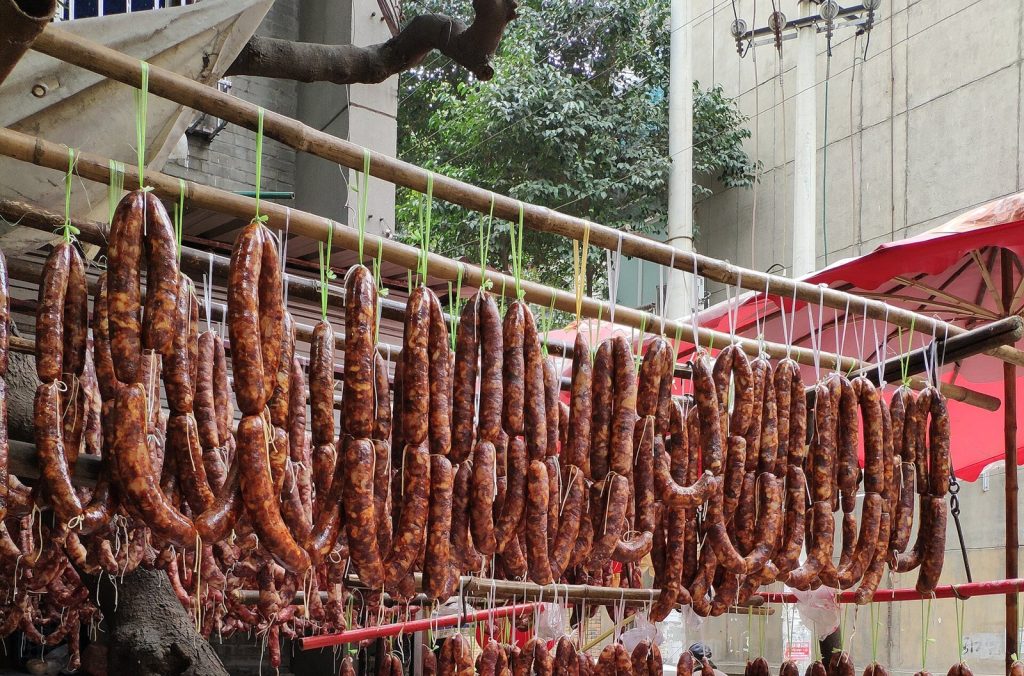
Visit Beijing notes that when Minor Snow arrives, the temperature drops sharply and the air becomes dry. For farmers that made it the best time to start preparing **sausages and cured meat (腊肉, làròu)** for Spring Festival. In Sichuan, Chongqing, Hunan, Guizhou and many southern provinces you will see meat and sausages hanging from balconies, poles and market stalls through late autumn and winter. Our guide to Chinese sausage (lap cheong / lachang) explains the main styles and how to eat them.
Eating ciba (glutinous rice cakes)
China Daily and Visit Beijing both describe the southern custom of eating ciba (糍粑) around Minor Snow and in the 10th lunar month. Ciba is made by steaming glutinous rice and pounding it into a soft, chewy dough. It was originally an offering, said to be made by farmers to the “god of cattle”. China Daily notes that Hakka communities in Guangdong and Fujian roll the dough and top it with sesame and crushed peanuts.
Tujia pig-slaughtering feasts and paotang
According to China Daily, Tujia communities in Guizhou hold their annual pig-slaughtering to welcome the new year around Minor Snow. They cook the freshest pork into a feast for neighbours and villagers, often called paotang (刨汤, “pork soup”). The CMA lists eating paotang as a Tujia Minor Snow custom.
Brewing “Minor Snow wine”
China Daily describes winter wine-making in Zhejiang. People in Anji prepare New Year wine around Minor Snow. In Pinghu a local rice wine stored in early 10th-month days is called “October White”. In Changxing, wine is traditionally made on the day of Minor Snow itself. The CMA also mentions 小雪酒, wine brewed from the new harvest after Minor Snow.
Drying fish in Taiwan
Visit Beijing records that fishermen along the coast of central and southern Taiwan start drying fish around Minor Snow, when mullet and other fish arrive in the Taiwan Strait. It quotes a Taiwanese saying about plump bluespot mullet caught in the 10th lunar month off Budai Township in Chiayi County.
Instant-boiled mutton in Beijing
Visit Beijing says that Beijingers commonly eat instant-boiled mutton (涮羊肉, shuàn yángròu) around Minor Snow. Warming foods such as mutton, beef and chicken are also traditionally recommended in this cold, grey season.
What Minor Snow means for visitors in 2026
You won’t find public events for Minor Snow. It is not a holiday, and offices and shops run as normal. 22 November 2026 is a Sunday. But the season shapes daily life in ways visitors can enjoy:
- Markets fill with cured meat. Late November to January is the best time to see larou and sausages being made and sold in Sichuan, Chongqing and Hunan, especially at local wet markets.
- Hotpot season is in full swing. In Beijing, a copper-pot mutton hotpot is the classic Minor Snow meal.
- The north is properly cold. Heating systems in many northern cities run on official start dates. Our northern China heating season guide explains what to expect indoors.
- Light changes everything. Afternoons are short and golden, which suits photography in places like Beijing’s parks. See our Beijing in November 2026 guide.
Practical tips
- Pack for two climates if you’re crossing China in late November. Northern cities can be below freezing while the south stays mild. Our autumn packing list helps.
- Cook cured meat before eating it. Larou and Chinese sausage are normally steamed, stir-fried or cooked with rice, not eaten raw.
- Think twice before packing meat home. Many countries restrict or ban imports of meat products, including vacuum-packed cured meat. Check your destination country’s customs rules before buying it as a souvenir.
- Use the term in conversation. Saying 今天小雪 (jīntiān xiǎoxuě, “it’s Minor Snow today”) to a colleague or shopkeeper is a friendly small-talk opener. Many people’s phone calendars show the solar terms.
FAQ
What date is Minor Snow 2026?
Sunday 22 November 2026, beginning at 15:23 Beijing time, according to the Hong Kong Observatory.
Does it snow on Minor Snow?
Not necessarily. The name reflects the traditional climate of northern China’s Yellow River region, where the first light snow becomes possible around now. Most of southern China sees no snow at all.
Is Minor Snow a public holiday in China?
No. It is one of the 24 solar terms, not a statutory holiday.
What do people eat on Minor Snow?
Customs vary by region: ciba (glutinous rice cakes) in parts of the south, instant-boiled mutton in Beijing, and paotang pork feasts among Tujia communities. It is also when families start curing meat, making sausages and pickling vegetables.
What comes after Minor Snow?
Major Snow (Daxue) on Monday 7 December 2026, followed by the Winter Solstice on Tuesday 22 December 2026.
Bottom line
Minor Snow 2026 arrives on Sunday 22 November at 15:23 Beijing time. It marks the point when northern China settles into real winter and kitchens across the country turn to preserving food. Look out for sausages drying on balconies, try ciba or a bowl of mutton hotpot, and use the solar term as an easy way into local conversation. Lovely China, founded in 2025, welcomes corrections at [email protected].