Why plan for Dongzhi in October
Today is the last day of the 2026 Golden Week. Tomorrow, Thursday 8 October, brings Cold Dew (Hanlu), the solar term that marks the turn from cool autumn to cold autumn. We covered it in our Cold Dew 2026 guide for travelers. After Cold Dew, the Chinese calendar heads toward the solar term many families treat as a small festival: Winter Solstice, or Dongzhi (冬至).
If you are planning a trip to China for December, or you live here and want to know why your colleagues suddenly talk about dumplings, this guide explains Winter Solstice 2026 in China: the verified date and time, the main food customs in the north and south, what changes (and what doesn’t) on the day, and some easy ways for visitors to take part.
When is Winter Solstice 2026 in China?
Winter Solstice 2026 falls on Tuesday 22 December 2026, at 04:50 Beijing time (UTC+8). That is the moment the Sun reaches ecliptic longitude 270°, according to the Hong Kong Observatory’s published table of 2026 solar terms. Hong Kong and mainland China both use UTC+8, so the time is the same.
In Europe and North America the solstice falls on the evening of 21 December. Because China is ahead of UTC, the Chinese calendar date is 22 December. Overseas Chinese communities in the Americas may therefore mark Dongzhi a day earlier than relatives in China.
The surrounding solar terms in the Hong Kong Observatory tables help you picture the season:
- Cold Dew (Hanlu): 8 October 2026, 14:29
- Frost’s Descent (Shuangjiang): 23 October 2026, 17:38
- Start of Winter (Lidong): 7 November 2026
- Light Snow (Xiaoxue): 22 November 2026
- Heavy Snow (Daxue): 7 December 2026
- Winter Solstice (Dongzhi): 22 December 2026, 04:50
- Moderate Cold (Xiaohan): 5 January 2027
- Severe Cold (Dahan): 20 January 2027
Dongzhi is not tied to the lunar calendar, so it almost always lands on 21 or 22 December. In 2026 it falls on the 14th day of the 11th lunar month, a few weeks before the Laba Festival (15 January 2027) and Chinese New Year (6 February 2027).
Is Dongzhi a public holiday?
No. China’s national holiday rules (the National Measures on Holidays for Annual Festivals and Commemorative Days, revised by the State Council in 2024) list New Year’s Day, Spring Festival, Qingming, Labour Day, Dragon Boat, Mid-Autumn and National Day. Dongzhi is not on that list. On Tuesday 22 December 2026, offices, schools, banks, trains and museums run as on any other working Tuesday.
What changes is what people eat, what restaurants sell and how they talk. Dumpling shops get busy, supermarkets stack frozen dumplings and tangyuan near the entrance, and WeChat fills with solstice greetings. In some southern communities families also visit or honour their ancestors around the day, in the same family spirit as the customs described in our piece on Qingming and Chongyang as ancestor days.
What does Dongzhi mean?
Dongzhi literally means “winter arrives” or “the extreme of winter”. It is one of the 24 solar terms, the traditional Chinese system that splits the solar year into 24 segments to guide farming and daily life. In 2016 UNESCO inscribed the 24 solar terms on its Representative List of the Intangible Cultural Heritage of Humanity. For background on the whole system, see our overview of the 24 solar terms.
The idea behind Dongzhi is simple. It is the shortest day of the year in the Northern Hemisphere. After it, the days slowly lengthen. Traditional thinking described this as the point where yin peaks and yang begins to return, which is why the day has long been treated as a turning point worth celebrating. In some regions you will hear the old saying “Dongzhi is as big as New Year” (冬至大如年), although how strongly families observe it varies a lot by region and generation.
North vs south: dumplings or tangyuan?
The best-known Dongzhi custom is food, and the north-south split is a popular topic of friendly argument.
Northern China: jiaozi (dumplings)
In much of northern China, Dongzhi means jiaozi (饺子). A folk saying warns that if you don’t eat dumplings on Dongzhi, your ears will freeze. Nobody takes this literally, but plenty of people still eat dumplings that day. Families wrap them at home, and dumpling restaurants often have queues at dinner time. If you are new to them, our first-timer’s guide to jiaozi covers fillings, dipping sauces and how to order.
The same food appears a few weeks earlier at the Start of Winter. Our Lidong 2026 guide and the story of a first Lidong dumpling lesson in a Beijing hutong show how it works at home.
Southern China: tangyuan (sweet rice balls)
In much of southern and eastern China, as well as among many overseas Chinese families, Dongzhi is a time for tangyuan (汤圆): glutinous rice balls, plain or filled, served in hot water or a light sweet soup. The round shape is linked to family reunion. Some families say that eating your solstice tangyuan means you are “one year older”. To try a famous style, read our Ningbo tangyuan guide.
Other regional customs you might see
Local traditions vary widely. These are the ones visitors are most likely to hear about, described here as customs rather than rules:
- Mutton soup: in parts of northern and eastern China, a hot bowl of lamb or mutton soup is a popular winter-solstice meal.
- Winter wine in Suzhou: Suzhou is known for a seasonal sweet rice wine, often flavoured with osmanthus, drunk on Dongzhi eve.
- Family dinners in Guangdong and Fujian: many Cantonese and Hokkien families treat the evening as a reunion meal, with ancestor offerings in some households.
- “Counting the nines” (数九): an old custom counts nine periods of nine days from the solstice, 81 days in all, to measure the coldest part of winter. Some families still hang a “nine-nines” chart and fill it in day by day.
Where visitors can feel Dongzhi in 2026
Beijing: the Summer Palace bridge glow
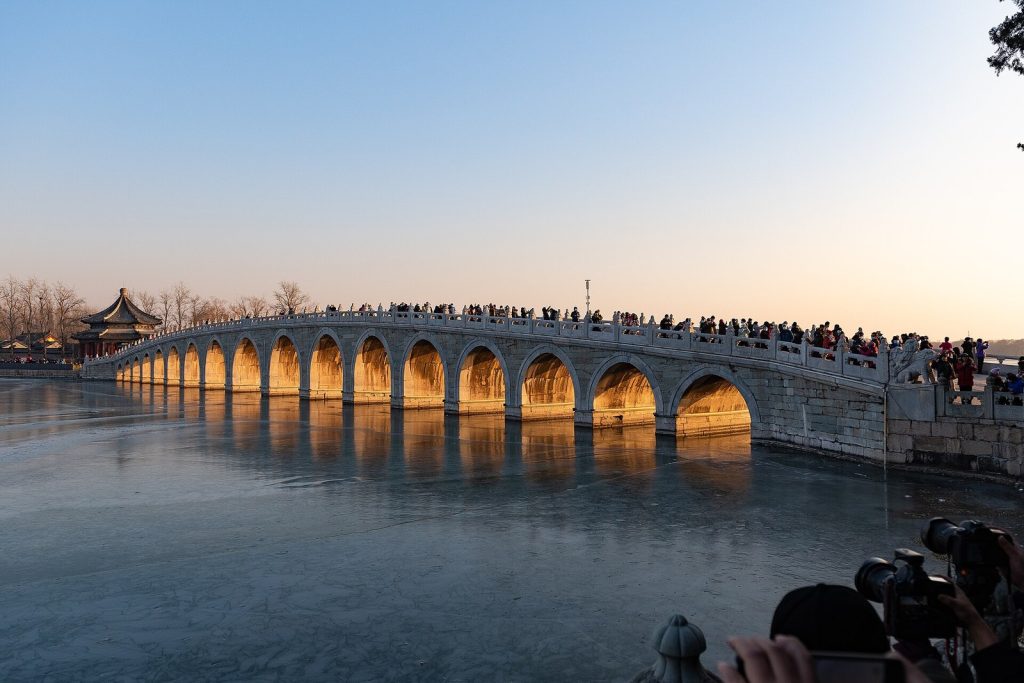
The cover photo shows a scene that has become a Beijing winter tradition for photographers. Around the winter solstice, the low setting sun can shine straight through the arches of the Seventeen-Arch Bridge at the Summer Palace and light the inside of every arch gold. On clear afternoons near the solstice, large crowds gather on the eastern shore of Kunming Lake to watch.
If you want to see it:
- Book Summer Palace entry only through the park’s official channels, and check for any crowd-control notices issued for solstice week.
- Arrive early and dress for standing still in the cold, since you will wait a long time on the shore. Our guide to buying qiuku thermal underwear helps.
- Remember that the glow depends on clear skies, and haze or cloud can cancel it.
Anywhere: eat what locals eat
The easiest way to join in is to eat. In the north, go to a busy dumpling restaurant at dinner and order a few kinds by weight or by portion, as the menu shows. In the south, look for tangyuan at dessert shops, breakfast stalls and supermarket freezers. If a colleague or neighbour invites you to wrap dumplings, say yes. Nobody expects a foreign guest’s dumplings to look perfect.
At work: a small, welcome gesture
Because Dongzhi falls on a working Tuesday, offices often mark it in a low-key way, such as dumplings in the canteen, a team lunch or a box of frozen tangyuan for each person. Sending a short greeting in your work WeChat group is a friendly touch: 冬至快乐 (Dōngzhì kuàilè, “Happy Winter Solstice”).
Practical tips for December travel around Dongzhi
- It’s a normal working day. Trains, flights and attractions run on regular schedules, so the solstice will not cause holiday-style crowds, with the possible exception of photo spots like the Seventeen-Arch Bridge.
- Northern heating is on. By late December, central heating in northern cities is normally running. Our northern China heating season 2026 guide lists official start dates by city.
- Days are short. The solstice is by definition the shortest day of the year, so plan outdoor sightseeing for the middle of the day, especially in the far north.
- The New Year build-up is starting. Chinese New Year 2027 falls on 6 February 2027. If you plan to travel then, think about bookings now. Our China public holidays 2027 guide explains what is known so far.
FAQ
What date is the Winter Solstice in China in 2026?
Tuesday 22 December 2026, at 04:50 Beijing time, according to the Hong Kong Observatory’s 2026 solar term data.
Is Dongzhi a day off in China?
No. It is not among the national public holidays, so work, school and transport run normally.
What do Chinese people eat on the Winter Solstice?
Dumplings (jiaozi) are traditional in much of the north. Tangyuan (glutinous rice balls) are common in much of the south and among overseas Chinese. Mutton soup and regional specialities appear in some places.
Why do some sources say 21 December?
In time zones behind China, such as Europe and the Americas, the astronomical solstice falls on 21 December local time. In China (UTC+8) the date is 22 December in 2026.
How do I wish someone a happy Winter Solstice in Chinese?
Say or text “冬至快乐” (Dōngzhì kuàilè).
Bottom line
Winter Solstice 2026 in China falls on Tuesday 22 December. It is a working day, but it still has a festive feel, with dumplings in the north, tangyuan in the south, and sunset crowds at Beijing’s Seventeen-Arch Bridge. Join a dumpling dinner, try a bowl of tangyuan and send a 冬至快乐 to your friends. Lovely China, founded in 2025, welcomes corrections at [email protected].