Navigating airport security in China with electronic gear requires careful attention to specific lithium battery regulations. Whether you are flying domestically between Beijing and Guangzhou or embarking on an expat holiday this November or December 2026, understanding how the Civil Aviation Administration of China (CAAC) regulates portable chargers will save you from last-minute gate confiscations. Rules concerning power banks focus strictly on safety markings, exact energy capacity, and carry-on placement. Because aviation guidelines and local interpretations can tighten, always verify current updates directly on your airline’s official portal and airport notices near your travel week.
Cabin Carriage Only: Why Checked Bags Are Banned
Every power bank, portable charger, and spare lithium-ion battery you own must travel with you in the cabin. Placing a power bank inside checked luggage is strictly prohibited across all commercial flights departing from or operating within Chinese airports.
In the cargo hold, pressure fluctuations and potential physical compression can cause lithium-ion cells to overheat, spark, or enter thermal runaway. Airport X-ray screeners inspect checked bags thoroughly during the check-in drop-off phase. If a power bank is detected inside a suitcase, security personnel will page you to return to the check-in desk, open your bag, and remove the device. To prevent unnecessary delays, pack all portable power sources directly in your backpack, handbag, or carry-on trolley. If you are also planning ground transit, note that high-speed rail security maintains different policies, which you can review in our guide on train station security and luggage.
Decoding Capacity Limits: Watt-Hours Over mAh
Chinese aviation authorities measure power bank limits using Watt-hours (Wh) rather than milliamp-hours (mAh). Checking the fine print on your device casing is essential before heading to the airport.
Under 100Wh (Standard Capacity): Most everyday power banks, including common 10,000mAh and 20,000mAh models, fall safely below this threshold. You can carry them in your cabin baggage without needing prior airline approval.
100Wh to 160Wh (High Capacity): Devices in this bracket require advance approval from your specific airline before departure. Each passenger is strictly limited to a maximum of two units in this capacity range.
Over 160Wh (Prohibited): High-capacity industrial power banks or heavy-duty external storage batteries exceeding 160Wh are completely banned from Chinese airspace under any circumstance.
If your power bank only displays mAh and voltage (usually 3.7V), calculate the Watt-hours using the standard formula: Wh = (mAh × Voltage) / 1000. For example, a 20,000mAh battery operating at 3.7V equals 74Wh, making it compliant for general carry-on use without special approval. If the label is worn, faded, or missing capacity figures entirely, security will treat the device as unverified and confiscate it.
The 3C Certification Requirement for Domestic Flights
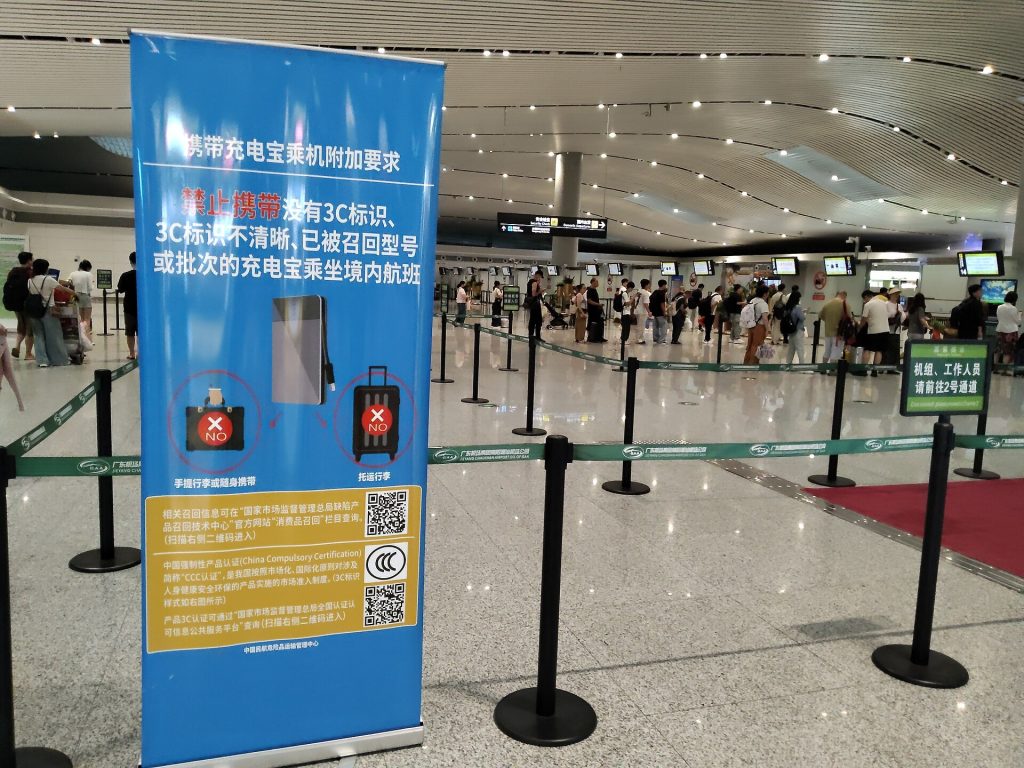
An important regulatory standard enforced by the CAAC mandates that power banks used on domestic flights within mainland China must carry a clear, legible 3C (China Compulsory Certification) mark.
While international travelers arriving directly from overseas on an international flight may not face immediate 3C inspection at customs entry, any subsequent domestic flight segment—such as a connection from Shanghai to Chengdu—triggers strict local compliance checks. Power banks purchased overseas often lack the mainland 3C logo. If you are relying on equipment bought outside China for a multi-city itinerary involving domestic legs, verify the labeling closely. Furthermore, devices included in manufacturer recall lists or those with damaged casings are entirely barred from aircraft cabins.
To streamline your preparation and ensure your digital setup runs smoothly, consult the resources listed on our China travel tools page for up-to-date travel checklists.
In-Flight Protocols and Handling Rules
Passing security is only the first step. Once you are onboard a Chinese carrier, strict behavioral rules apply to all portable chargers and lithium batteries:
Stow Safely: Keep power banks in your carry-on bag under the seat in front of you or in the designated cabin storage. Avoid placing them in overhead bins where heavy luggage might shift and crush them.
Keep Powered Off: Power banks must remain switched off throughout the entire flight.
No Charging in Flight: You are strictly prohibited from using a power bank to charge phones, tablets, or laptops during the flight, and you cannot use aircraft USB ports to charge the power bank itself.
Immediate Reporting: If a battery slips into a seat mechanism, do not attempt to adjust the seat yourself. Notify a flight attendant immediately to prevent crushing the lithium cell.
Frequently Asked Questions
Can I bring multiple power banks through China airport security?
Yes, you can carry multiple power banks as long as their individual capacities comply with regulations. For units under 100Wh, you are generally permitted a reasonable number for personal use (usually up to two or three standard devices), though carrying an excessive number may prompt security questions. For units between 100Wh and 160Wh, the strict cap is a maximum of two units per passenger, requiring prior airline clearance.
What happens if my power bank is confiscated at security?
If airport security flags a power bank for lacking a clear label, exceeding capacity limits, or missing 3C certification on a domestic route, they will require you to surrender it. In most major Chinese airports, formal storage or shipping options for confiscated batteries are extremely limited or unavailable, meaning surrendered items are usually discarded permanently. Checking your gear at home is always the best safeguard.
Do direct international flights into China enforce the 3C rule?
Direct international flights arriving from overseas destinations into China typically follow standard international aviation rules and do not enforce the mainland 3C certification check at arrival. However, if your itinerary includes a domestic transfer leg inside mainland China, security screening for that internal flight will enforce the 3C requirement.
How can I check if my power bank model has been recalled?
Related Lovely China reading
For payments, start with Alipay and WeChat Pay hub and WeChat Pay vs Alipay for tourists. For trains, keep high-speed rail first-timers guide and 12306 passport signup for foreigners handy. City hubs: Beijing first-visit guide, Shanghai first-visit guide. Connectivity: roaming vs local SIM honest guide, pocket Wi-Fi vs eSIM for China, offline maps for foreigners. Bookmark China travel tools page.
Practical checklist
- Confirm official rules on the relevant government, park, airline, or bank page near your travel week
- Screenshot bookings, tickets, and QR codes while you still have stable Wi-Fi
- Save hotel and attraction names in Chinese characters in your phone notes
- Carry passport, a backup payment method, and a small cash float (why cash is still needed)
- Test one small mobile payment before you rely on wallets at a gate or taxi
- Keep the China travel tools page page bookmarked for related Lovely China hubs
FAQ
Is this people advice official?
No. Lovely China orients travellers. Verify live rules on official pages, apps, and counters near your travel week.
Will every city behave the same?
No. Airports, stations, parks, and markets differ. Use local signage and staff instructions when they conflict with a general guide.
What should I screenshot before I lose Wi-Fi?
Bookings, tickets, hotel Chinese address, pickup pins, and payment success screens.
Notes for late 2026 travellers
November and early December bring cooler mornings, earlier sunsets, and comfortable walking weather across much of eastern and central China. Pack layers and leave extra time on clear weekends at popular sights.
This article does not invent ticket prices, opening hours, processing times, consular fees, or official statistics. When a number matters, verify it on the official site, app screen, or ticket board near your travel week.
If an official rule page disagrees with this guide, follow the official page. Lovely China orients English-speaking travellers; we are not an immigration, banking, or medical authority.