Navigating Beijing South Railway Station (Beijingnan, 北京南站) as an international visitor is remarkably smooth once you understand the facility’s bi-level layout. Serving as the primary terminus for high-speed G- and D-series trains connecting the capital to Shanghai, Tianjin, and eastern China, this mega-hub moves tens of thousands of commuters daily. If you are planning a trip during the brisk late-autumn or early-winter travel corridor of November–December 2026, knowing where to enter, which line to clear at security, and how foreign passport verification works will keep your boarding completely stress-free.
Beijing South vs. Beijing Railway Station: Avoiding the Classic Mistake
Before heading out from your hotel, double-check your booking on the official Railway 12306 platform. A surprisingly common rookie error is confusing Beijing South Railway Station (北京南站) with the historic Beijing Railway Station (北京站).
Beijing South Railway Station (Beijingnan / 北京南站): Located in Fengtai District on Subway Lines 4 and 14. This modern, oval-shaped glass dome handles the majority of high-speed trunk routes, notably the Jinghu High-Speed Railway to Shanghai Hongqiao and the intercity express to Tianjin.
Beijing Railway Station (Beijingzhan / 北京站): Located inside the central Dongcheng District on Subway Line 2. This Soviet-influenced mid-century station primarily handles conventional, slower sleeper trains and select regional routes.
Booking receipts and boarding alerts always list the exact Chinese station name. If you are assembling a broader itinerary, review our Beijing first-visit overview to ensure your accommodation base aligns with the station you will actually depart from.
Understanding the Station Layout and Floor Plan
Beijing South operates on a layered, vertical layout designed to keep arriving and departing passenger flows separated:
Level 2F (Elevated Waiting Hall / 高架候车厅): This is where nearly all passengers board departing trains. It features open-plan concourses flanked by numbered boarding gates (检票口) numbered from north to south. You will find convenience stores, bakeries, and hot water dispensers along the perimeters.
Level 1F (Platform Level / 站台层): The tracks and train platforms. You only access this level after your gate opens and your passport is scanned.
Level B1 (Arrival Concourse & Transfer Hall / 地下出站大厅): Where all passengers arrive after disembarking. It houses baggage storage desks, the taxi ranks, and underground ticket counters.
Level B2 (Subway Platforms / 地铁站台层): Boarding platforms for Beijing Subway Line 4 and Line 14.
If you arrive by taxi, ride-hail (DiDi), or drop-off car, ask the driver for the elevated drop-off zone (Gaojia luokeping, 高架落客平台). This delivers you straight to the 2F perimeter doors, allowing you to bypass subterranean escalators entirely.
Security Screening and Arrival Timing
China’s railway network enforces airport-style security at every station perimeter. To enter the 2F departures hall, you must present your travel document and place all baggage through X-ray scanners.
Recommended Arrival Windows
Standard Travel Days: Arrive 50 to 60 minutes before scheduled departure.
Peak Times and Winter Weekends (Nov–Dec 2026): Arrive 75 to 90 minutes prior. Increased bulk winter clothing, heavy coats, and weekend travel flows along the Beijing–Tianjin corridor can add wait time at perimeter body checks.
Security lanes enforce standard national railway carriage restrictions. Flammable liquids, pressurized aerosol sprays exceeding stated volume limits, pocket knives, and scissors with blades longer than standard limits will be confiscated at the scanner. Small personal battery banks (power banks) must display clear manufacturer capacity markings.
Navigating Ticketless Boarding with a Foreign Passport
China operates a paperless electronic ticketing network. Your booking is tied directly to the passport number registered on your official 12306 account or travel agency portal. Physical paper tickets are obsolete; you do not need to collect a boarding pass.
Approaching the Boarding Gates
Boarding gates typically open 15 to 20 minutes before departure and close strictly 5 minutes before the train wheels turn. For comprehensive mechanics on reader hardware, consult our walkthrough on 12306 e-ticket gates.
Locate Your Gate: Overhead LED boards cycle between English and Chinese, matching your train number (e.g., G13) to a gate number and sub-gate (e.g., Gate 8A or 8B).
Find the Manual / Assisted Lane: Automated turnstiles read mainland Chinese national ID cards via contactless pads. Most electronic gates also feature optical glass passport scanners, but throughput varies depending on system compatibility with your passport’s chip. Look for the lane on the far left or far right manned by a station attendant (Ranggong Tongdao, 人工通道).
Scan and Enter: Present your physical original passport to the attendant or place your photo page down on the glass scanner. Once verified in the 12306 database, the barrier swings open. Proceed downstairs to Platform 1F to board your car.
Subway Connections and Taxi Transfers
Arriving at Beijing South by public transport is straightforward thanks to direct integration with the municipal metro grid.
Beijing Subway Access
The station is served by Line 4 (a critical north-south line connecting to Xidan, Peking University, and the Summer Palace) and Line 14 (linking east toward Chaoyang).
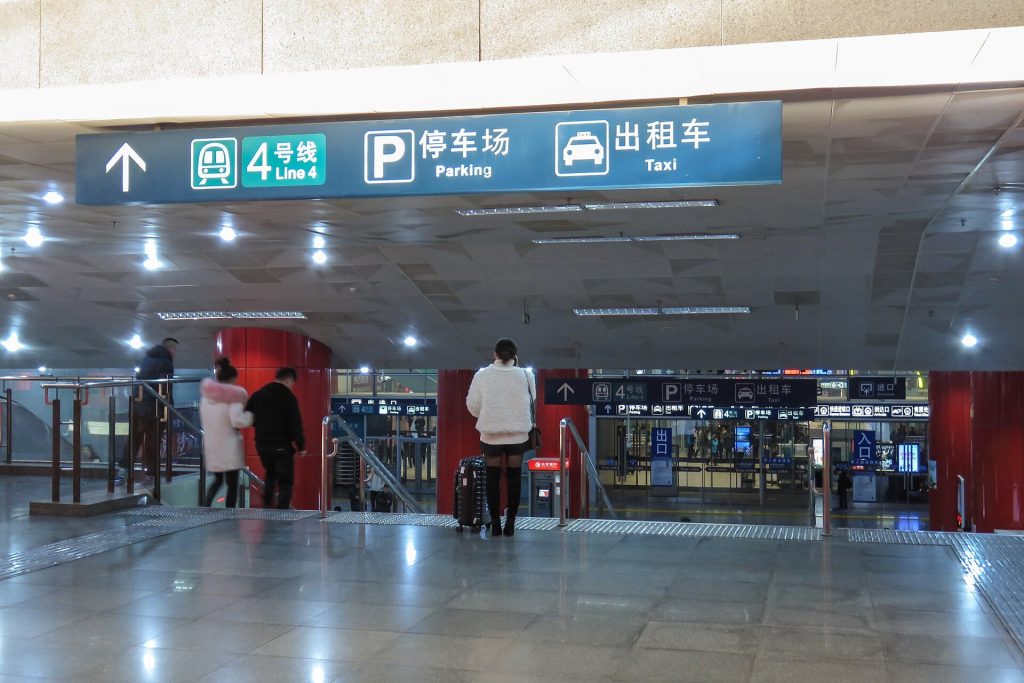
Exiting the subway brings you directly into Level B1. Follow the large bilingual overhead signage toward “Elevated Waiting Hall (2F)” via the central express escalators.
In peak rush hours, security checkpoints between the subway exit and railway entrance may perform quick document checks. Check our guide to Beijing subway transfers for payment app setups and tap-to-ride tips.
Taxi Queues and Ride-Hailing
If arriving or departing by car:
Official Taxi Ranks: Located on Level B1. Follow the overhead taxi icons to the dedicated underground staging areas. Never accept rides from unregistered drivers soliciting passengers inside the halls.
App-Based Pick-Up (DiDi): Follow signs to the designated ride-hailing parking areas located in the subterranean garages. Verify the exact pick-up pillar letter and number on your app before waiting.
Departure Day Checklist
Original Passport: Must match the exact document details entered during 12306 booking.
12306 App Active: Keep your booking itinerary open to monitor live platform assignments and delay notifications.
Related Lovely China reading
For payments, start with Alipay and WeChat Pay hub and WeChat Pay vs Alipay for tourists. For trains, keep high-speed rail first-timers guide and 12306 passport signup for foreigners handy. City hubs: Beijing first-visit guide, Shanghai first-visit guide. Connectivity: roaming vs local SIM honest guide, pocket Wi-Fi vs eSIM for China, offline maps for foreigners. Bookmark China travel tools page.
Practical checklist
- Confirm official rules on the relevant government, park, airline, or bank page near your travel week
- Screenshot bookings, tickets, and QR codes while you still have stable Wi-Fi
- Save hotel and attraction names in Chinese characters in your phone notes
- Carry passport, a backup payment method, and a small cash float (why cash is still needed)
- Test one small mobile payment before you rely on wallets at a gate or taxi
- Keep the China travel tools page page bookmarked for related Lovely China hubs
FAQ
Is this travel advice official?
No. Lovely China orients travellers. Verify live rules on official pages, apps, and counters near your travel week.
Will every city behave the same?
No. Airports, stations, parks, and markets differ. Use local signage and staff instructions when they conflict with a general guide.
What should I screenshot before I lose Wi-Fi?
Bookings, tickets, hotel Chinese address, pickup pins, and payment success screens.
Notes for late 2026 travellers
November and early December bring cooler mornings, earlier sunsets, and comfortable walking weather across much of eastern and central China. Pack layers and leave extra time on clear weekends at popular sights.
This article does not invent ticket prices, opening hours, processing times, consular fees, or official statistics. When a number matters, verify it on the official site, app screen, or ticket board near your travel week.
If an official rule page disagrees with this guide, follow the official page. Lovely China orients English-speaking travellers; we are not an immigration, banking, or medical authority.