Paying with Alipay as a foreign visitor is less about memorizing a single “correct” gesture and more about knowing which of two common motions the merchant in front of you expects. Sometimes you scan their code. Sometimes you show yours. Overseas cards add a third layer: a wallet that works at a convenience store may still throw a verification or limit screen at a restaurant table. This guide is about choosing the motion calmly and keeping backups—not about invented fee tables.
Set the wallet up before you need it at a noisy counter (Alipay setup for foreigners, Alipay tourist mode limits, Alipay and WeChat Pay hub). Compare the overall tourist experience with WeChat Pay in WeChat Pay vs Alipay for tourists. Restaurant deposits and daily spend caps are sibling problems (Alipay restaurant deposits for foreigners, Alipay daily spend limits foreign card); here the job is scan-versus-show.
Two payment motions you will meet all day
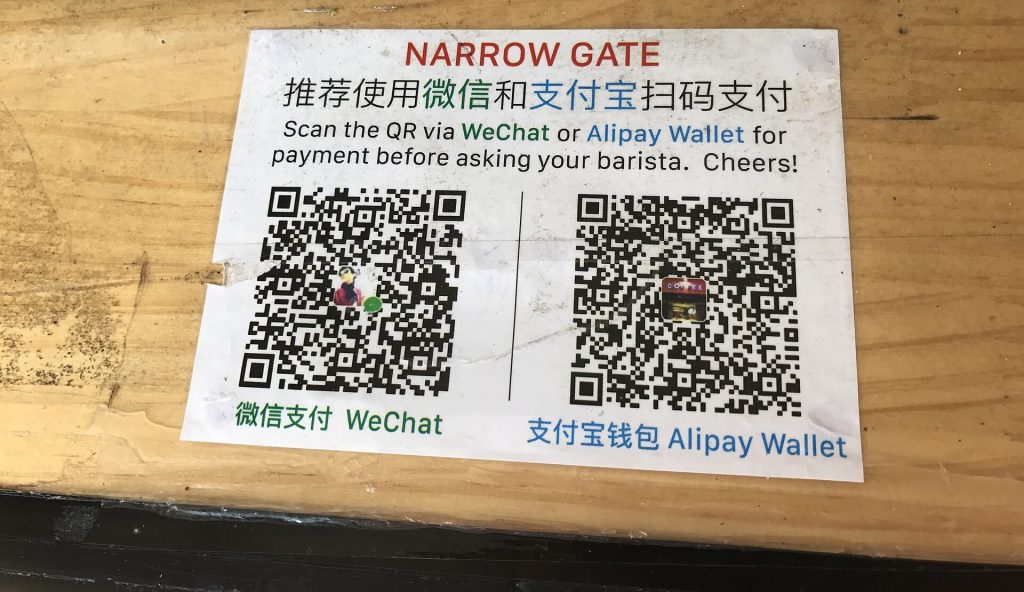
Scan the merchant’s code when you see a printed or digital QR on a table stand, a cashier’s tablet, or a wall placard. You open Alipay’s scan function, point the camera, and land on a payment page or a mini-program ordering page. Confirm the shop name and the amount before you authorize. Table codes sometimes open a menu first; the payment step comes after you (or staff) build the bill.
Show your code when the cashier waits with a scanner gun or asks you to present a payment barcode. In Alipay this is the receivable/payment code screen—the one that looks like a barcode plus QR. Hold brightness up, keep the phone unlocked, and do not lock the screen the moment the scanner beeps; some terminals need a second to return a result.
Neither motion is universally “better.” Small shops, taxis, and canteens often prefer to scan you. Restaurants with table stands often prefer that you scan them. If the first motion fails, switch before you assume the wallet is dead.
Amount confirmation and the extra-item trap
The most important habit is reading the total. A table QR can remember a previous guest’s cart, add a tea charge, or open a membership page you did not request. A cashier-entered amount can include an extra item if someone ordered after you thought the bill was closed.
Before you press pay:
- Match the shop name to the place you are standing
- Match the amount to the bill you just agreed
- Watch for a second confirmation screen that some overseas-card flows insert
- If anything looks like a tip you did not choose or an item you did not order, stop and ask staff to reset
We do not invent service-charge percentages. Look at the live screen. If you cannot read it, show it to staff and point at the number.
What usually goes wrong with an overseas card
Foreign-card Alipay products—including tourist-oriented modes—can fail for reasons that have nothing to do with your camera technique (Alipay tourist mode limits, Alipay foreign-card verification fails, Alipay International vs mainland wallet):
- The merchant category is restricted for your wallet type
- A single payment exceeds a displayed limit (Alipay daily spend limits foreign card)
- The card issuer declines a foreign transaction
- Extra verification (face, SMS, or in-app challenge) cannot complete on hotel Wi-Fi
- The terminal expects a mainland-only flow
When a red error appears, photograph it if you can do so politely. The text is more useful at a hotel desk or in a later support chat than “it didn’t work.” Then try, in order: the other motion (scan vs show), the other wallet if you set one up (WeChat Pay foreign card guide, WeChat Pay vs Alipay for tourists), a physical foreign card if the shop’s POS accepts it (foreign card tap-to-pay in stores), and cash (why cash is still needed, when you still need cash).
Do not keep hammering the same failing button. Repeated declines can look like fraud to an issuer.
A calm counter script
1. Ask—or watch—whether staff want to scan you or want you to scan the stand.
2. Open the matching Alipay screen before you reach the front of a busy line.
3. Confirm amount and shop name.
4. If it fails, switch motion once.
5. If it fails again, switch instrument (second wallet, card, cash) rather than arguing about the first wallet.
6. Take the success screen screenshot for deposits or split bills you may need to unwind later (Alipay restaurant deposits for foreigners, Alipay balance when leaving China).
Related Lovely China reading
For payments, start with Alipay and WeChat Pay hub and WeChat Pay vs Alipay for tourists. For trains, keep high-speed rail first-timers guide and 12306 passport signup for foreigners handy. City hubs: Beijing first-visit guide, Shanghai first-visit guide. Connectivity: roaming vs local SIM honest guide, pocket Wi-Fi vs eSIM for China, offline maps for foreigners. Bookmark China travel tools page.
Practical checklist
- Confirm official rules on the relevant government, park, airline, or bank page near your travel week
- Screenshot bookings, tickets, and QR codes while you still have stable Wi-Fi
- Save hotel and attraction names in Chinese characters in your phone notes
- Carry passport, a backup payment method, and a small cash float (why cash is still needed)
- Test one small mobile payment before you rely on wallets at a gate or taxi
- Keep the China travel tools page page bookmarked for related Lovely China hubs
FAQ
Which method works better with an overseas card?
It depends on the merchant terminal and your wallet product. If scan-to-pay fails, try presenting your code, then a second wallet, then card or cash. We do not invent success rates.
Why did the amount look different after I scanned?
Some table codes open an order page first; confirm the total before you authorize. If a tip or item you did not add appears, stop and ask staff to reset the bill.
What should I screenshot before I lose Wi-Fi?
A successful small test payment, any error text if a card is declined, and a backup card or cash plan.
Notes for late 2026 travellers
November and early December bring cooler mornings, earlier sunsets, and comfortable walking weather across much of eastern and central China. Pack layers and leave extra time on clear weekends at popular sights.
This article does not invent ticket prices, opening hours, processing times, consular fees, or official statistics. When a number matters, verify it on the official site, app screen, or ticket board near your travel week.
If an official rule page disagrees with this guide, follow the official page. Lovely China orients English-speaking travellers; we are not an immigration, banking, or medical authority.