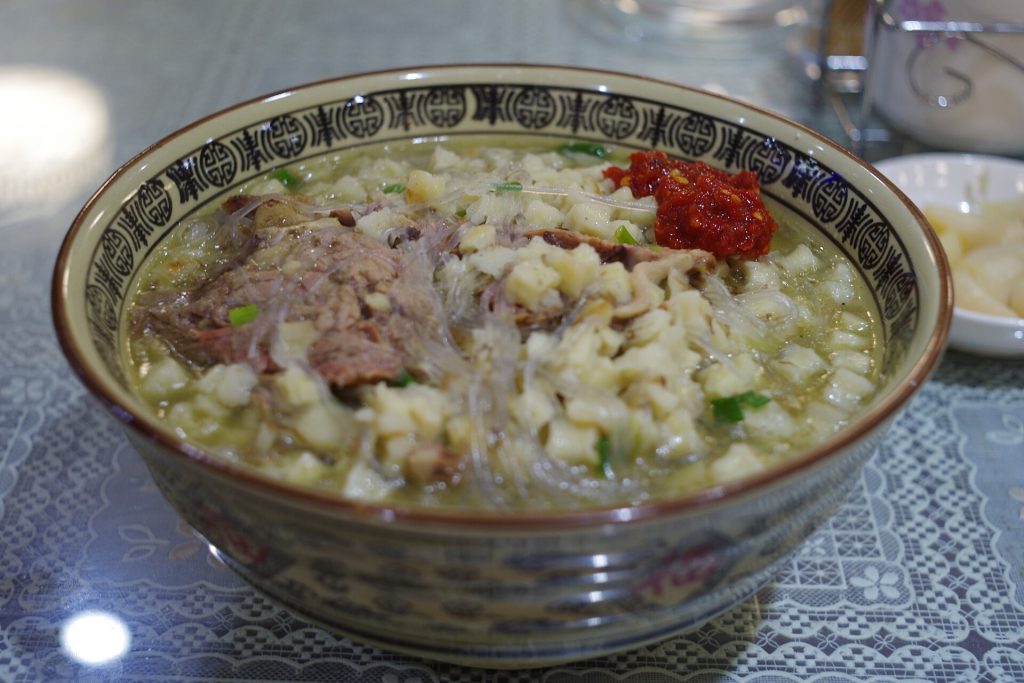
Yangrou paomo is Xi’an’s lamb soup with torn flatbread: a bowl that looks simple until you realize the diner is supposed to do part of the work. You usually tear the unleavened bread into small pieces yourself; the kitchen then adds broth, lamb, and the bits that make the bowl a meal. It is not a sandwich. It is not the same as roujiamo, the packed flatbread with meat that visitors already hunt in the Muslim Quarter.
For the sandwich version, read Xi’an roujiamo for first-timers. Evening wandering in the quarter is Xi’an Muslim Quarter evening guide. An early-December city plan is Xi’an early December first-visit planner. Another noodle-and-broth cousin from farther west is Lanzhou lamian first-timers. Chopstick habits are in chopsticks etiquette for foreigners.
What you are ordering
A typical yangrou paomo service has two parts. First, you receive a firm, pale, unleavened bread (mo) that is dense rather than fluffy. Second, after you tear it, the kitchen takes the bowl and returns it as a soup: bread pieces soaked in a lamb broth, with sliced or chopped lamb, and often a clear or slightly milky stock that smells of the meat and the spices the house uses.
Sides that often arrive or sit on the table: pickled sweet garlic, chili oil or a house chili, cilantro, maybe pickled vegetables. You add these yourself. The garlic is not a garnish for photographs; it is there to cut the richness of the lamb.
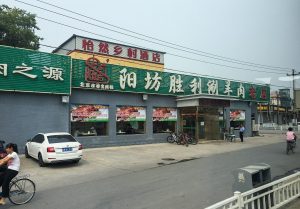
Shops vary. Some are sit-down rooms with a ritual that is almost theatrical. Some are busy canteens. The bread-tearing step is the shared skill.
Tear the bread smaller than you think
This is the first-timer mistake: leaving chunks the size of a dumpling and then wondering why the bowl feels clumsy. The usual advice from people who eat this often is to tear the mo into small, pea-to-bean-sized pieces, fairly even, so the broth can soak them and a spoon or chopsticks can lift a mixed bite.
Practical method:
- Work over the bowl you were given, not over the tablecloth
- Use clean hands; this is expected
- Tear rather than cut, unless the house has given you a tool and a sign to use it
- Take your time. Nobody is grading you, but a five-minute careful tear is kinder to the soup than a thirty-second wreckage
- When you think you are done, look for a few leftover slabs and finish those too
If your hands are not clean, wash first. If you have a companion, you each tear your own bowl. When the staff collect the bowls, you are committing to the soup; this is usually not the moment to announce you wanted something else.
Some houses offer a ready-torn or kitchen-torn option, or a “fine” versus “coarse” tear if you ask. If you are unsure, watch the next table or ask for a small gesture of help. We do not invent house rules. Follow the one in front of you.
Broth, lamb, and how to eat the bowl
When the bowl comes back, the bread should be soaking, not floating as dry islands. Taste the broth first, then add chili oil a little at a time. Pickled garlic can be eaten between bites or nibbled on the side. Cilantro, if you like it, goes in now, not after the soup is cold.
Use chopsticks and a spoon together (chopsticks etiquette for foreigners). The point is a mixed spoonful—bread, broth, a piece of lamb—not a hunt for only meat. Bones may appear in some versions; set them aside on the plate provided.
If the soup is very hot, wait. Winter air in Xi’an makes people rush the first mouthful, which is how you lose a day to a burned tongue.
Paomo is a meal. You may not need a second main dish. If you want something beside it, a small cold dish or a glass of something unsweetened is usually enough. We do not invent prices; read the wall or the menu and pay what the counter shows (Alipay and WeChat Pay hub).
How this is not roujiamo
Roujiamo is a stuffed bun or flatbread you can walk with: chopped meat packed into bread, eaten with your hands, often as a snack between other errands. Yangrou paomo is a sit-down soup that requires time, a table, and the tearing ritual. You can eat both in one Xi’an trip—many visitors do in the Muslim Quarter (Xi’an Muslim Quarter evening guide)—but ordering “the bread with lamb” without pointing at a picture is how you receive the one you did not mean.
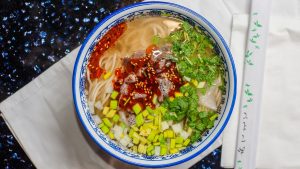
Lanzhou lamian is another different bowl: hand-pulled noodles in a clear broth, no tearing step (Lanzhou lamian first-timers). If you want noodles, say noodles. If you want paomo, say paomo, or point.
Early December is a good season for this soup: cold dry air outside, a steaming bowl inside, and enough appetite after a wall or warriors morning (Xi’an early December first-visit planner, Xi’an City Wall visit). Popular shops queue; stand where the line stands (queue etiquette). Vegetarian visitors should ask carefully—this is a lamb dish at heart, and a “meatless” version is not something to assume.
Screenshot nothing more exotic than the menu photo you pointed at and the hotel address for the walk back. Then tear smaller than your first instinct, add chili slowly, and let the garlic do its job.
Related Lovely China reading
For payments, start with Alipay and WeChat Pay hub and WeChat Pay vs Alipay for tourists. For trains, keep high-speed rail first-timers guide and 12306 passport signup for foreigners handy. City hubs: Beijing first-visit guide, Shanghai first-visit guide. Connectivity: roaming vs local SIM honest guide, pocket Wi-Fi vs eSIM for China, offline maps for foreigners. Bookmark China travel tools page.
Practical checklist
- Confirm official rules on the relevant government, park, airline, or bank page near your travel week
- Screenshot bookings, tickets, and QR codes while you still have stable Wi-Fi
- Save hotel and attraction names in Chinese characters in your phone notes
- Carry passport, a backup payment method, and a small cash float (why cash is still needed)
- Test one small mobile payment before you rely on wallets at a gate or taxi
- Keep the China travel tools page page bookmarked for related Lovely China hubs
FAQ
Is yangrou paomo the same as roujiamo?
No. Roujiamo is a stuffed flatbread you can walk with. Yangrou paomo is a sit-down lamb soup whose bread you usually tear into small pieces before the kitchen adds broth.
How small should I tear the bread?
Smaller than a first instinct—often pea-to-bean-sized, fairly even—so the broth can soak the pieces. Watch the next table if you are unsure, and follow the house in front of you.
Do shops have a fixed tourist price?
We do not invent prices. Look at the wall or the menu and pay the amount the counter shows.
Notes for late 2026 travellers
November and early December bring cooler mornings, earlier sunsets, and comfortable walking weather across much of eastern and central China. Pack layers and leave extra time on clear weekends at popular sights.
This article does not invent ticket prices, opening hours, processing times, consular fees, or official statistics. When a number matters, verify it on the official site, app screen, or ticket board near your travel week.
If an official rule page disagrees with this guide, follow the official page. Lovely China orients English-speaking travellers; we are not an immigration, banking, or medical authority.