Walk down a quiet residential alley in Beijing, peek into a leafy courtyard in Chengdu, or listen closely near the balcony of a bustling neighborhood park after a late-autumn chill settles in, and you will hear it: the hypnotic, rhythmic clack-clack-clack of bone and bamboo tiles shuffling across a felt table. For travelers taking advantage of the expanded China 30-Day Visa-Free Entry in 2026: Which Countries Qualify and the Rules, mahjong is more than just a pastime—it is the literal soundtrack of Chinese social life. Yet, for many visitors, approaching a mahjong table can feel intimidating. The tiles look abstract, the regional rule variations are legendary, and the fast-paced chatter can sound like code. If you want to understand mahjong not as a grueling competition, but as a vibrant cultural ritual—and learn how to join in without risking your wallet—this guide covers everything a foreign visitor needs to know.
—
What Mahjong Is Socially in China
In the West, board games are often played around a dining table on rainy afternoons or at specialized board game cafes. In China, mahjong is woven directly into the fabric of daily community interaction. It is a social anchor. You will see tables set up everywhere: elderly neighbors gathered under banyan trees, vendors pausing between customers in local markets, and family members bonding after a long meal. Much like sharing a communal pot of broth at Haidilao Hot Pot in China: A First-Timer’s Guide for Foreigners, a mahjong game is designed to stretch across hours. It is an excuse to talk, gossip, drink tea, and share snacks.
Crucially, mahjong is deeply egalitarian. Age, profession, and background blur away once the tiles are shuffled. For locals, inviting someone to sit at the mahjong table—even a stranger or a curious tourist—is a gesture of hospitality and inclusion.
—
Where and How Tourists Can Play (Without Gambling)
Foreigners often worry that every game of mahjong in China involves high-stakes underground gambling. While money certainly changes hands in some private dens, the vast majority of casual, tourist-friendly mahjong is played for very low stakes, or purely for fun. If you want to try your hand at the tiles, several welcoming avenues are available:
1. Boutique Hotels and Cultural Guesthouses: Many modern boutique hotels—especially those catering to international travelers navigating Hotel Registration for Foreigners in China 2026: What Happens at Check-In—now feature traditional tea rooms equipped with automatic mahjong tables. Staff are usually delighted to teach guests the basics.
2. Teaching Cafes and Community Centers: In major cultural hubs like Chengdu, Hangzhou, and Shanghai, experiential teahouses and cultural centers offer introductory mahjong workshops designed explicitly for tourists and expats.
3. Local Friends and Hosts: If you are invited by Chinese friends, colleagues, or neighbors to play, don’t hesitate. Simply establish the boundary upfront with a lighthearted smile: “Wo bu hui du bo, women wan le zi de!” (I don’t gamble, let’s play just for fun!). Hosts will instantly accommodate you, often swapping cash points for matchsticks, dried fruit, or simply bragging rights.
Navigation Tip: If you are looking to pin down a local community center, tea house, or social club hosting beginner-friendly game nights, open up your mapping app. Using How to Use Amap (Gaode Maps) in China as a Foreigner: 2026 English Guide allows you to search for local “茶馆” (chaguan / teahouses) or recreational spaces where tables are frequently open to the public.
—
A Beginner’s Step-by-Step Gameplay Walkthrough
If you have secured a seat at a table, understanding the physical flow of a match will save you from awkward hesitation. Mahjong flows in predictable cycles, driven by tactile actions rather than mental calculations.
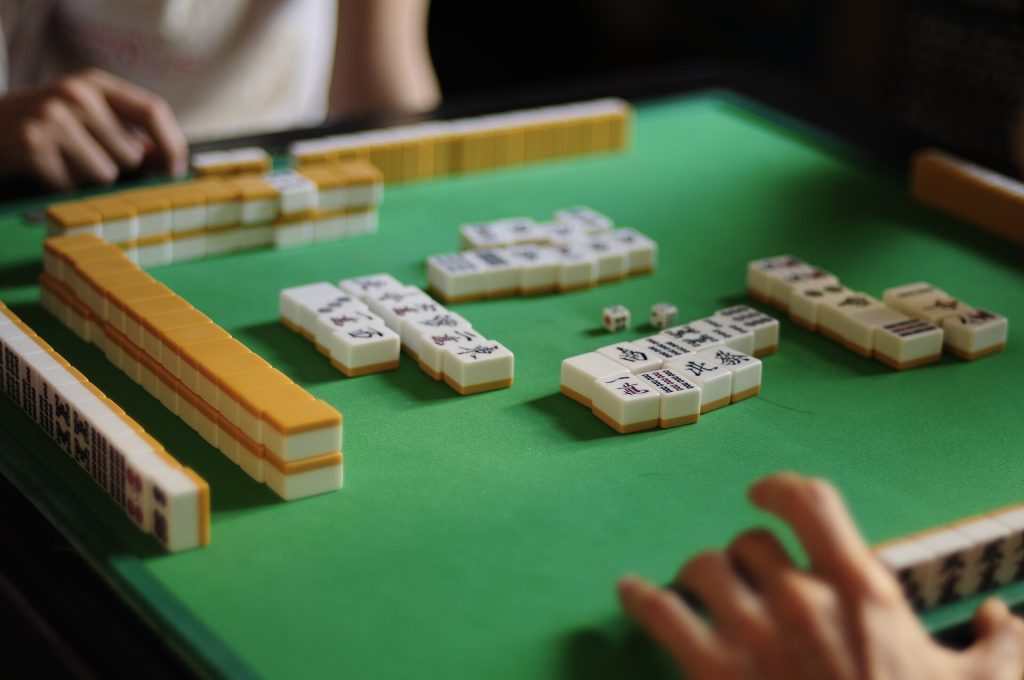
* The Deal and the Wall: In modern automated tables, all 144 tiles are hidden inside the table mechanism, which automatically rises pre-built into four clean walls. Each player takes their designated wall section.
* The Draw and Discard Loop: Play moves counterclockwise. On your turn, you draw a tile from the wall, inspect it, and decide whether it improves your hand. If not, you place a tile face-up in the central discard pool.
* Claiming Tiles: Unlike Western games where you must wait entirely for your turn, mahjong allows you to claim discarded tiles under specific conditions:
Pong: If you hold two identical tiles and someone discards the third, you can shout “Pong!”* to claim it, revealing all three face-up.
* Chow: In some variants, you can claim a sequential tile from the player immediately to your left to form a run.
Hu: If any discard completes your winning hand of four sets and a pair, you claim it to win the round by shouting “Hu!”*
—
The Basic Idea: Tiles and Rounds Without a Full Rules Manual
Trying to master regional rules on day one is a recipe for a headache. Mahjong varies wildly by province—Sichuan mahjong has different scoring dynamics than Shanghai or Cantonese versions. However, the foundational objective remains universal.
The Tile Families
A standard mahjong set contains 144 tiles split into three main suits, plus honor tiles:
* Dots (Bings): Circles representing copper coins.
* Bamboos (Soos): Vertical sticks representing strings of cash (the “1” bamboo is often styled as a delightful bird).
* Characters (Wans): Chinese numerals written in traditional calligraphy.
* Honors: Four Winds (East, South, West, North) and three Dragons (Red, Green, White).
The Core Objective
Think of mahjong as a distant cousin of Rummy. Each player starts with a hand of tiles (usually 13), and players take turns drawing and discarding tiles. The goal is to build a winning hand consisting of four sets (either a pong—three of a kind, or a chow—a sequential run of three suit tiles) and one pair (two identical tiles). When you complete this pattern, you declare “Hu!” (Win!). You don’t need to memorize complex scoring charts on your first outing. Focus instead on the tactile rhythm: drawing a tile, inspecting it, deciding what to discard, and sliding it neatly into the rack.
—
Etiquette: Noise, Smoke, and Money Games
Mahjong culture comes with unwritten rules. Respecting these norms ensures a harmonious and enjoyable experience for everyone at the table:
* Embrace the Noise: Mahjong is not a library game. Expect loud chatter, laughing, lighthearted trash-talking, and the thunderous rattle of the automatic shuffling table. Lean into the energy rather than shushing others.
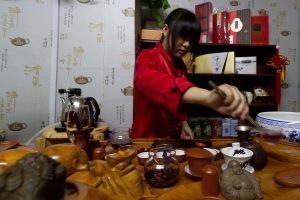
* Mind the Smoking and Tea Etiquette: Traditional mahjong rooms can sometimes be hazy if older locals are smoking. If you are sensitive to smoke, look for modern teahouses or hotel lounges with strict non-smoking policies. Also, keep your teacup filled—it is polite for hosts or guests to pour tea for their neighbors.
Handling Money Games: If money is* casually involved, keep your emotions in check. Stakes in neighborhood games are typically nominal (meant to keep the game engaging rather than ruin anyone financially). If you are uncomfortable playing with cash, politely decline the monetary aspect before the first tile is dealt; no one will think less of you.
—
How to Decline Invitations Politely
Because hospitality in China is so warm, you may find yourself invited to join a lively, marathon mahjong session when you are jet-lagged or simply pressed for time. Declining without causing offense is all about tone and appreciation.
To let someone down gently, acknowledge the warmth of the invitation first, express genuine interest, and provide a logistical reason for leaving:
“Tai xiexie ni le! Wo zhen de hen xiang xue, dan wo xia ge xingcheng you shi yao gan.”* (Thank you so much! I’d really love to learn, but I have places to be for my next itinerary.)
“Jin tian tili you dian touzhi, xia ci you jiangHui lai!”* (My energy is a bit tapped out today, let’s definitely play next time!)
By approaching mahjong with curiosity, cultural humility, and a willingness to laugh at your own mistakes, you will unlock one of the most authentic, joyful social experiences China has to offer.
—
Frequently Asked Questions (FAQ)
Can I play mahjong in China if I don’t speak Mandarin?
Yes! Mahjong is largely visual and tactile. While knowing numbers one through nine helps you identify suit tiles, friendly players will often help you sort your tiles and gesture your turns. A warm smile and an open attitude bridge any language barrier.
Do I need to buy my own set to practice?
Not at all. Physical mahjong sets can be heavy and bulky to pack in luggage. Most major cities have cafes, hotel lounges, or public parks where tables are freely available or rented out by the hour with tiles provided.
Are electronic or app versions worth trying before my trip?
Definitely. Downloading a mobile mahjong app before arriving in China allows you to familiarize yourself with the tile layout, the drawing-and-discarding loop, and basic winning hand structures without any social pressure.