As late October 2026 brings that unmistakable crisp, Siberian autumn chill to Beijing’s morning air, the city’s street food scene shifts into high gear. While shivering commuters, students, and delivery riders rush toward the subway, dodging electric scooters and scanning QR codes, there is one glorious beacon of warmth they all gravitate toward: the neighborhood breakfast window.
If you have done your research on Chinese street food, you probably already know about traditional jianbing. But walking the hutongs and major thoroughfares of Beijing today, you might notice locals walking away with something much larger—a massive, burrito-like cylinder bulging at the seams, steaming in the morning air.
Welcome to the world of jianbingbao (煎饼包), the stuffed jianbing wrap. This is not just a snack; it is a heavy-duty, hand-held feast designed to fuel the city’s relentless pace. Here is everything a first-time visitor needs to know about ordering, eating, and surviving this colossal Chinese breakfast.
Jianbing vs. Jianbingbao: What is the Difference?
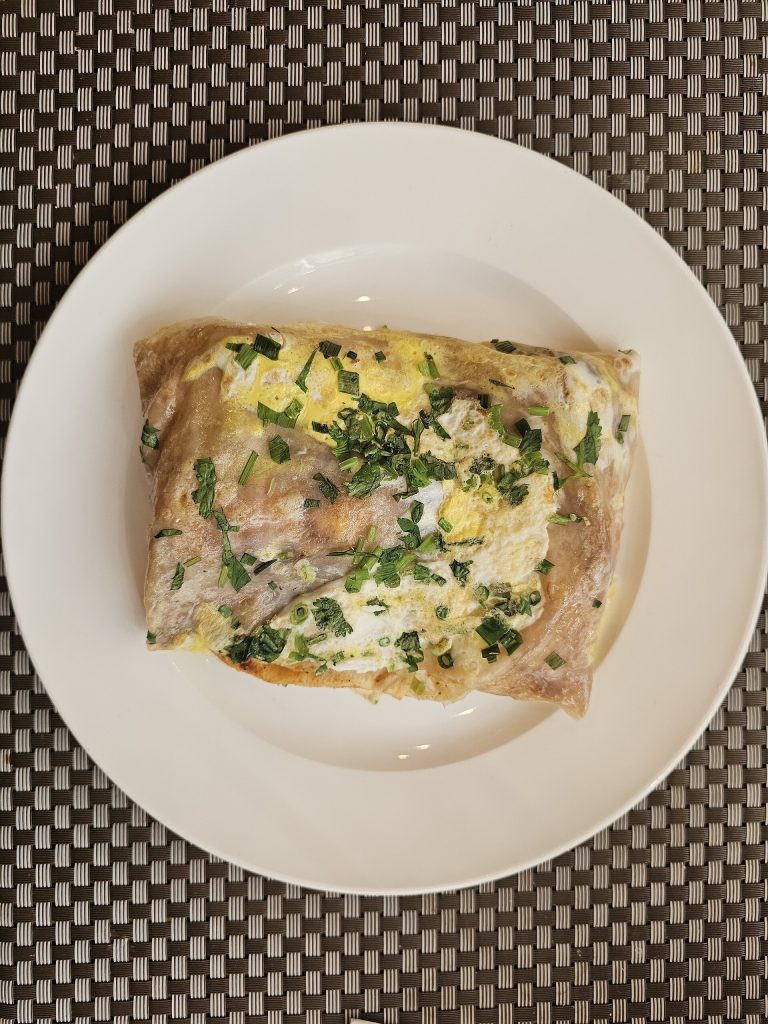
To understand jianbingbao, you must first understand its predecessor. If you read our guide on Mastering Beijing Jianbing: The Ultimate First-Timer’s Guide to China’s King of Street Breakfasts, you know that a classic jianbing is a relatively flat, refined affair originating from Tianjin. It consists of a thin mung-bean or wheat crepe, a cracked egg, sweet bean sauce, scallions, cilantro, and a crispy cracker (baocui), folded into a neat, envelope-like square.
Jianbingbao, however, translates literally to “jianbing wrap” or “jianbing bun,” and the name does not lie. Born out of the necessity of modern city life where workers need a cheap, massive caloric intake to last them until a late lunch, the bao version breaks all the traditional rules.
Instead of being folded flat, the freshly cooked crepe is used as a sprawling, flexible canvas to hold a mountain of hot, stir-fried fillings. The vendor will pile on vinegary shredded potatoes, enoki mushrooms, spicy kelp, lettuce, tofu strips, hot dogs, deep-fried chicken fillets, or even sizzling bacon. It is then carefully rolled up into a fat, heavy pocket.
If standard jianbing is a polite breakfast sandwich, jianbingbao is a two-handed breakfast burrito. It is heavier, messier, infinitely more customizable, and arguably exactly what you need to survive a freezing morning at the Great Wall or a full day navigating the Forbidden City.
The Anatomy of the Perfect Bite
What makes jianbingbao so globally addictive—especially on a chilly November morning in the capital—is the sheer textural contrast engineered into every layer. A perfectly executed wrap is a masterclass in culinary architecture:
The Foundation: The exterior is warm and soft from the freshly spread batter (usually a wheat and grain mix) and the freshly cooked egg spread evenly across the top.
The Aromatics: A generous scattering of black sesame seeds, chopped scallions, and fresh cilantro (xiangcai) is pressed into the cooking egg.
The Sauce Layer: As you bite through the soft exterior, you hit the savory, umami-rich slick of tianmianjiang (sweet bean paste), often mixed with a touch of fermented tofu sauce and house-made roasted chili oil.
The Hot Fillings: This is where the bulk of the weight comes from. The steaming, savory mixture of your chosen meats and vegetables provides a hearty, chewy, and juicy core.
The Crucial Crunch: Despite being stuffed with hot, wet vegetables and meats, a proper vendor will always sneak a piece of baocui (deep-fried wonton cracker) right into the center.
The result is a bite that is simultaneously soft, crunchy, savory, spicy, and steaming hot.
Master Menu: Top Filling Combinations to Try
Because jianbingbao is entirely customizable, standing in front of twenty different metal trays of fillings can be incredibly intimidating. If you are worried about slowing down the queue, memorize one of these fail-safe combinations to point at:
The Local Classic (The Carb-on-Carb)
Point to the tudousi (stir-fried shredded potatoes), a handful of fresh lettuce, and the crispy baocui. The vinegar-spiked potatoes add an incredible tangy crunch that cuts through the rich sweet bean sauce perfectly. It sounds heavy to put potatoes inside a crepe, but it is the undisputed local favorite.
The Carnivore’s Dream
Point to the jiliu (deep-fried chicken tenders), a split roasted hot dog (kaochang), and a fried egg (jian jidan). Add some lettuce to pretend it’s healthy. This is the ultimate hangover cure after a late night exploring Beijing’s cocktail bars.
The Plant-Based Powerhouse
Ask for haidaisi (shredded kelp), jin zhen gu (enoki mushrooms), doufu pi (shredded tofu skin), and extra scallions. The mix of the earthy mushrooms, the slightly spicy kelp, and the chewy tofu skins makes for a complex, deeply savory vegetarian breakfast that won’t leave you feeling sluggish.
Navigating the Street Stall: Tips, Timing, and Tech
Timing is everything in the Beijing breakfast game. Genuine breakfast stalls operating out of tiny neighborhood windows or street-side carts are highly strictly regulated in 2026. They usually fire up their cast-iron griddles in the dark around 5:30 AM to 6:00 AM, hit their absolute peak rush at 8:00 AM, and are completely sold out or scrubbed clean by 10:00 AM. If you show up at 10:30 AM looking for jianbingbao, you will likely find a closed metal shutter.
How to find them: You won’t always find these tiny vendors on standard English tourist maps, and relying on serendipity can leave you hungry. To track down the best local spots near your hotel, you will want to use local tech. Check out our guide on How to Use Amap (Gaode Maps) in China as a Foreigner: 2026 English Guide to search for “煎饼” (jianbing) or “早餐” (breakfast) in your immediate vicinity. Look for the clusters of high ratings.
How to pay: Cash is almost non-existent at street food stalls. The vendor will not have a cash register, nor will they have time to count coins. Instead, they will have a laminated QR code printed and taped to the glass window or cart.
You simply scan the code, type in the amount the vendor shouts out to you (usually between 8 to 18 RMB depending on how many premium fillings you piled on), and complete the payment. Crucial etiquette: Always hold your phone up to show the vendor the green “payment successful” screen before you walk away. Make sure your digital wallet is topped up and ready by reviewing Alipay and WeChat Pay for Foreign Visitors in China 2026.
What Foreigners Usually Find Confusing
Ordering jianbingbao can feel like a high-speed pop quiz. The vendor’s wooden scraper blurs across the griddle, and the line of commuters behind you will be relentlessly impatient. Here is exactly what trips most foreigners up, and how to handle it smoothly:
Options Paralysis
Unlike traditional jianbing where you just hold up one finger and say “one please,” a jianbingbao stall requires participation. You will face a buffet-style spread of metal trays. The vendor will spread the egg, slap on the sauce, look at you expectantly, and likely bark, “Jia shenme?” (Add what?).
The Fix: If you don’t speak Mandarin, the point-and-nod method works perfectly. Just gesture clearly to 3 or 4 trays. Alternatively, hold your hands apart to indicate “a lot,” gesture widely across all the vegetable trays, and give a thumbs up. This translates universally to “give me a little bit of everything.”
The Cilantro Warning
Cilantro is a highly divisive herb, and Beijing vendors use it aggressively. As they reach for the green garnish, they might just toss it on by default.
The Fix: If you have the soap-tasting genetic aversion to cilantro, you must be proactive. Say loudly and clearly, “Bu yao xiangcai!” (No cilantro!) right after they crack the egg. If you love it, say, “Duo fang xiangcai” (Put extra cilantro).
The Spice Question
Right before folding the massive wrap together, the vendor’s hand will hover over a stainless steel pot of dark, menacing chili oil. They will inevitably ask: “La bu la?” (Spicy or not spicy?) or “Yao lajiao ma?” (Do you want chili?).
The Fix: The chili oil used in Beijing street food packs a serious punch—it is deeply roasted, savory, and builds heat quickly. If you want it spicy, say “Yao” (want) or “La de” (spicy). If you want just a tiny kick, pinch your fingers together and say “Yi dian dian” (A little bit). If you cannot handle the heat, wave your hands frantically and say “Bu yao la” (don’t want spicy).
The Steamy Packaging
Your massive wrap will be chopped in half with a metal bench scraper, shoved into a thin plastic bag, and handed to you screaming hot. Foreigners often try to eat it directly out of the bag while walking. Because of the boiling hot fillings, the inside of the bag creates condensation rapidly.
The Fix: Roll the plastic bag down tightly as you eat, peeling it back like a banana, rather than keeping the wrap buried deep inside the plastic. This lets the steam escape upward and prevents your crispy cracker and soft crepe from turning into a soggy, disintegrating mess before you reach the subway station.
Frequently Asked Questions (FAQ)
Is jianbingbao safe for foreigners to eat?
Absolutely. Street food hygiene in Beijing has improved astronomically over the last decade, and high-turnover breakfast stalls are generally very safe. Because you watch the crepe and egg cooked right in front of you on a 400-degree griddle, the risk of foodborne illness is incredibly low. Just look for the stalls with the longest lines of locals—high turnover means fresh ingredients.
Can I get a vegetarian or vegan jianbingbao?
Vegetarian is incredibly easy—just skip the hot dogs, bacon, and chicken, and load up on potatoes, tofu, and mushrooms. Making it vegan is trickier. You must tell the vendor to skip the egg (“Bu yao jidan”). However, be aware that the crepe batter itself sometimes contains a small amount of egg or dairy depending on the vendor’s secret recipe, and the grill is shared with meats.
Is it available all day?
Rarely. While traditional jianbing has slowly made its way into all-day mall kiosks, authentic street-side jianbingbao remains strictly a morning affair. Plan to grab one between 6:30 AM and 9:30 AM.
How much does it usually cost?
A basic jianbingbao with an egg, crispy cracker, and basic vegetables usually starts around 8 RMB (about $1.10 USD). Adding premium meats like chicken fillets or sausages will bump the price up by 2 to 4 RMB per item. A fully loaded, massive wrap rarely exceeds 15 to 18 RMB ($2.50 USD).
Grab a hot, subtly sweet cup of fresh soy milk (doujiang) from the same window, bundle up in your autumn coat, and bite into your first jianbingbao. It won’t take long to realize why this heavy-duty street wrap is the undisputed, heavyweight champion of Beijing mornings.
Related Lovely China guides
- Haidilao Hot Pot in China: A First-Timer’s Guide for Foreigners
- Sichuan Peppercorn (Huajiao) Explained: Why Your Mouth Goes Numb
- China Convenience Store Food: What to Buy and How to Pay (2026)
FAQ
Is this guide current for late 2026?
It reflects commonly reported practice as of October 2026. Always re-check official sources before you travel, because rules, ticket platforms and seasons change.
Where can I verify details?
Use the official website, WeChat account or ticket platform named for this topic. For payments and maps, see Lovely China’s practical visitor guides linked above.
What if my situation is unusual?
Ask your hotel, airline, park ticket office or embassy/consulate for case-specific advice rather than relying only on a blog post.