As the dense, clinging subtropical heat of Guangzhou finally gives way to the crisper, breezy evenings of late October and November, the city’s dining habits undergo a visible shift. Pavement tables fill up earlier, steam billows thicker from curbside aluminum vats, and the rhythmic clatter of porcelain bowls echoing down narrow alleys signals the arrival of supper. In this vibrant culinary capital, one comfort food reigns supreme: yuntun mian, or Cantonese wonton noodles.
The literal translation of yuntun is “cloud swallow,” a deeply poetic nod to how these delicate dumplings float in their golden broth, their incredibly thin wrappers trailing behind them like wispy clouds in a summer sky. If you are visiting Guangzhou, dropping your bags in your hotel, and looking for an immediate, soul-warming, and authentic taste of the city, this is exactly where you start.
Here is what first-timers need to know about navigating Guangzhou’s most iconic bowl, from understanding the alkaline crunch of the noodles to mastering the local etiquette of condiments and ordering.
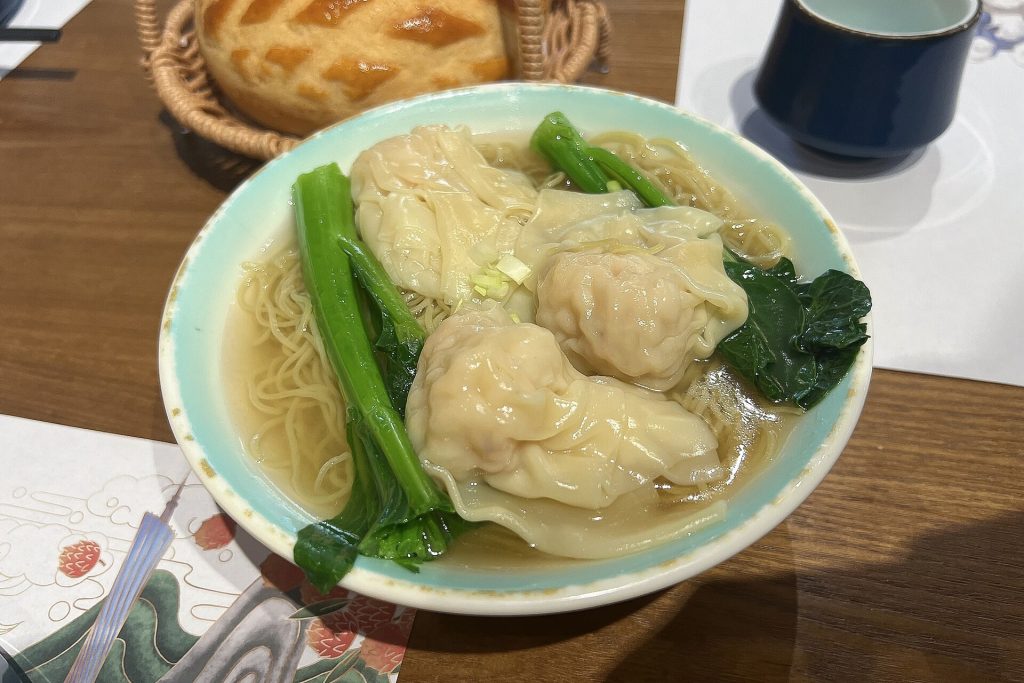
Traditional Cantonese Wonton Noodle Soup. Source: Asian Inspirations
Cloud Swallows vs. Northern Dumplings
If your primary experience with Chinese dumplings involves thick, doughy wrappers and heavy pork fillings—the kind of hearty northern dumplings you heavily dip in black vinegar, raw garlic, and chili oil—Cantonese wontons will be an absolute revelation.
Northern-style jiaozi or even northern morning huntun are built for harsh winters and agricultural sustenance. They are meant to be filling and rustic. A Cantonese wonton, by contrast, is an exercise in structural delicacy and refinement. The wrapper is incredibly thin, almost translucent once cooked, encasing a highly specific filling. A traditional Guangzhou wonton demands a precise ratio of roughly chopped, fresh shrimp (often river shrimp) to fatty minced pork—usually a 70/30 or 60/40 split in favor of the shrimp.
The shrimp provides a distinct “snap” when bitten, a textural hallmark of high-quality Cantonese seafood preparation, while the pork fat melts during the boiling process to create a rich, juicy interior. The dumplings are pleated loosely, purposefully leaving excess wrapper at the top to fan out and create that signature “cloud swallow tail” effect as it cooks.
The Soup Style (Tang Mian)
In a traditional bowl of soup wonton noodles, aesthetics and culinary physics matter. When your bowl arrives, you will often notice a specific architecture: the porcelain soup spoon is placed at the very bottom of the bowl, cradling the wontons, with the wiry noodles meticulously folded on top, crowning slightly above the surface of the broth.
This isn’t just for Instagram aesthetics; it serves a crucial purpose. Elevating the noodles prevents them from sitting too deeply in the hot liquid and turning mushy, preserving their signature bite.
The broth itself is the hidden star, separating the average neighborhood joints from the legendary institutions. A proper Guangzhou wonton broth takes hours of simmering. It is brewed from roasted dried flounder powder (which imparts a distinct, smoky seafood depth), massive pork bones, dried shrimp roe, and sometimes a hint of monkfruit (luohan guo) for a subtle, earthy sweetness that rounds out the salt.
A note on MSG: Let’s be honest—MSG (monosodium glutamate) is heavily used in casual Chinese dining. Many neighborhood wonton joints rely on it for a quick umami boost. However, prestigious, multi-generational noodle houses in Guangzhou pride themselves on making broths so rich with dried seafood and bones that synthetic MSG is entirely unnecessary. If you are highly sensitive, look for higher-end traditional shops, but for most visitors, that savory punch is just part of the local street food DNA.
The Dry-Tossed Style (Lo Mian)
If you prefer a more concentrated flavor profile, or if the Guangzhou weather is simply too hot for soup, order your noodles “lo” (dry-tossed).
In this preparation, the noodles are boiled rapidly, drained thoroughly, and vigorously tossed in rendered pork lard, premium light soy sauce, and rich oyster sauce. The wontons usually sit on the side of the plate, and you are served a small, separate bowl of that golden flounder broth to sip between bites to cleanse your palate.
A highly popular upgrade to the dry style is topping it with braised beef brisket (ngau lam). The brisket is stewed for hours in chu hou paste, star anise, and tangerine peel, resulting in a thick, fragrant gravy that coats the alkaline noodles perfectly. Alternatively, you might find ha tzi lo mian—dry noodles generously dusted with dried, roasted shrimp roe that clings to every strand, offering an intense, concentrated burst of oceanic umami.
The Secret is in the Bamboo (Jook-sing)
You simply cannot talk about Guangzhou wonton noodles without discussing the texture of the noodles themselves. If you are expecting the soft, slippery texture of Japanese ramen or Italian pasta, you are in for a surprise. They are radically different from standard wheat noodles.
Traditional jook-sing noodles are made without a drop of water. The dough relies entirely on duck eggs (which have richer, fattier yolks than chicken eggs) and a highly alkaline lye water mixture (kansui). This alkaline solution is what gives the noodles their distinct yellowish hue and a stiff, slightly chewy, rubber-band-like snap. What Italians call al dente, the Cantonese call song (refreshing and bouncy).
Alkaline Jook-sing Noodles. Source: Wikipedia
Historically, the tough dough was kneaded by a chef straddling and bouncing on a massive bamboo pole to compress it paper-thin. This rhythmic bouncing forces the gluten networks to align tightly without adding heat, creating that signature springiness. While mechanical rollers do the heavy lifting in many modern shops to meet demand, the artisanal bamboo-pressed method is still highly prized. The best local vendors will proudly advertise “traditional bamboo-pressed noodles” on their signage to draw in purists.
Essential Condiments: The Ritual of Red Vinegar and Chili
Walking into a noodle shop and eating the bowl exactly as it arrives is perfectly fine, but mastering the table condiments elevates you from a tourist to a seasoned diner. On every table in a Guangzhou noodle shop, you will find a small caddy of additions.
Red Vinegar (Zhejiang Vinegar): This is non-negotiable for the wontons. Chinese red vinegar is mild, slightly sweet, and lacks the harsh acidity of white vinegar. Pour a small splash into your soup spoon, and dip your wonton into it before taking a bite. The acidity cuts through the rich pork fat and highlights the sweetness of the shrimp.
White Pepper Powder: A light dusting of finely ground white pepper over the noodles before you mix them adds a floral, creeping warmth to the broth without overpowering the delicate flounder flavor.
Chili Oil/Paste: Cantonese cuisine is famously mild, so the chili oil here is usually more fragrant than scorching. A tiny dab mixed into your dry noodles or placed on the edge of your spoon adds a wonderful, roasted-garlic and chili kick.
Pickled Daikon: Some older shops still provide a small communal jar of sweet-and-sour pickled daikon radish. Eat a cube between bites of the rich wontons to reset your palate.
Morning Fuel or Late-Night Comfort? Both.
In Guangzhou, there is no wrong time for wonton noodles. They serve as the city’s great culinary equalizer, bridging the gap between dawn and dusk.
In the morning, noodle shops are chaotic, utilitarian spaces. Locals crowd around small, communal tables for a fast, affordable bowl before commuting to the office. It is a completely different vibe from the lingering, tea-pouring elegance of understanding traditional Cantonese dim sum. Here, the rhythm is fast: you sit, you order, you eat, you leave.
But wonton noodles truly shine as siu yeh (late-night supper). After a few drinks, or when stepping out of a humid, bustling night market, the neon glow of a corner noodle shop beckons like a lighthouse. Sucking down a hot, restorative bowl of flounder-infused broth at 1:00 AM, sitting on a plastic stool while the city finally quiets down, is a quintessential Guangzhou experience. It is the ultimate local hangover preventative and comfort food rolled into one.
Practical Steps: How to Find and Order
Navigating a local, hole-in-the-wall noodle shop can feel intimidating for a first-timer, particularly if you don’t speak Cantonese or Mandarin, but the process is highly standardized.
Find the Shop: Don’t rely exclusively on Western map apps, which often have severely outdated business listings in China. Instead, ensure you are set up for navigating China with local digital tools by downloading Amap (Gaode Maps) or Baidu Maps. Search for “云吞面” (Yuntun Mian) and look for places clustered in the historic western districts like Liwan, Yuexiu, or Haizhu. Look for user photos featuring bright yellow noodles and translucent dumplings.
Order at the Register: Most small, traditional shops operate on a fast-casual model. You are expected to order and pay at the front register before you sit down. You will be given a paper receipt or a numbered plastic token to place on your table.
The Ordering Phrase: To order the classic soup version, say: “Yat wun yuntun mian” (One bowl of wonton noodles – Cantonese) or “Yi wan huntun mian” (Mandarin). If you want the dry version, ask for “Lo mian”.
Payment: Cash is rarely used. Make sure your WeChat Pay or Alipay is set up and linked to your foreign credit card before you arrive. You will simply scan the QR code on the cashier’s desk.
Seating and Tissues: Seating is almost always communal. Don’t be surprised if strangers sit across from you at a four-top table; just give a polite nod and focus on your food. Also, bring your own pocket tissues! Local street-level joints rarely provide napkins for free, though some may sell small tissue packets for 1 RMB at the counter.
FAQ: Guangzhou Wonton Noodles for First-Timers
Are Cantonese wonton noodles spicy?
No. Traditional Cantonese cuisine prioritizes the natural, fresh flavors of the ingredients. The broth is savory, slightly sweet, and deeply oceanic. If you want spice, you must add the table chili oil yourself.
Can I get vegetarian wontons?
It is extremely rare at traditional shops. The DNA of the dish relies on pork fat and shrimp, and the broth itself is heavily based on pork bones and dried fish. Vegetarians will have better luck seeking out dedicated Buddhist vegetarian restaurants in Guangzhou.
What if I am allergic to shellfish?
You should avoid this dish entirely. Even if you order a bowl of noodles without the wontons, the foundational broth is brewed with dried shrimp roe and dried flounder, making cross-contamination a guarantee.
Why do the noodles smell slightly like ammonia?
That is the kansui (alkaline lye water) used to give the noodles their signature bouncy texture. High-quality shops will boil the noodles and aggressively rinse them to remove the harsh edge of the alkaline water, but a faint, distinct scent is normal and safe.
How much should a bowl cost?
In late 2026, a standard bowl of wonton noodles in a local Guangzhou neighborhood shop will cost anywhere from 15 to 25 RMB (roughly $2.00 – $3.50 USD), making it one of the most accessible and delicious culinary experiences in the city.
Related Lovely China guides
- Haidilao Hot Pot in China: A First-Timer’s Guide for Foreigners
- Sichuan Peppercorn (Huajiao) Explained: Why Your Mouth Goes Numb
- China Convenience Store Food: What to Buy and How to Pay (2026)
FAQ
Is this guide current for late 2026?
It reflects commonly reported practice as of October 2026. Always re-check official sources before you travel, because rules, ticket platforms and seasons change.
Where can I verify details?
Use the official website, WeChat account or ticket platform named for this topic. For payments and maps, see Lovely China’s practical visitor guides linked above.
What if my situation is unusual?
Ask your hotel, airline, park ticket office or embassy/consulate for case-specific advice rather than relying only on a blog post.