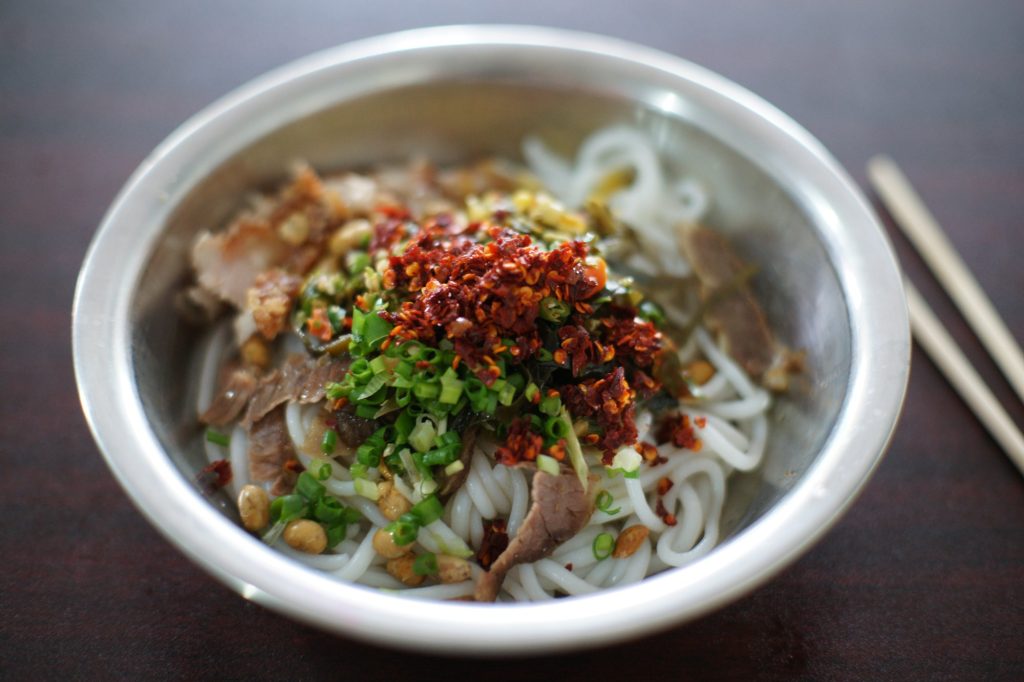
What Guilin rice noodles actually are
Guilin rice noodles—桂林米粉 (Guìlín mǐfěn)—are a Guangxi classic that traveled far beyond the karst city on China’s tourist posters. The dish is built on soft, round rice noodles in a clear, savory broth, finished with a pile of toppings you choose at the counter. Think of it as a customizable noodle bowl: base noodles, broth (or sometimes a “dry” mix), then meat, pickles, peanuts, chili, and herbs.
It is breakfast fuel in Guilin and a comfort lunch in many Chinese cities. Chains and independent shops both exist. English menus may say “Guilin rice noodle,” “Guilin mifen,” or simply “rice noodles.” The Chinese characters 米粉 matter more than the English line—point or photograph them if you are unsure. For phone-camera help, see reading Chinese menus with photo translation apps.
This guide is for English-speaking travelers and expats who want a calm first bowl: how the shop flow works, what “sour” and “spicy” mean here, how to ask for less chili, what to pair it with, and how payment usually works.
Why it feels different from wheat noodles
Rice noodles here are typically round and soft, closer to a gentle chew than the elastic pull of hand-pulled wheat noodles. They warm quickly in broth and keep absorbing liquid, so texture changes if you linger over photos. Guilin-style broth aims for clean savoriness—often pork-bone based—rather than the heavy mala oil of Sichuan bowls or the dense wheat gravy of some northern dishes.
If you arrived in China via Chongqing or Chengdu noodle culture, reset expectations. Guilin mifen is usually lighter in the bowl and more about toppings and pickle brightness than about numbing spice. Save Chongqing small noodles (xiaomian) for a separate spice-forward day.
How a typical shop works
Many Guilin-style shops use a counter assembly line:
1. You order (or take a number) and choose noodle style and toppings.
2. Staff dunk or portion noodles, ladle broth, and add your toppings.
3. You carry the bowl to a table, or staff bring it in quieter rooms.
4. Condiments sit on the table or counter: chili oil, vinegar, pickled greens, crushed peanuts, sometimes garlic water.
Busy breakfast shops move fast. Have your order ready before you reach the cashier. If the shop uses a QR order screen, the same topping logic applies—see Chinese restaurant QR menus for foreigners.
Street-adjacent shops are common in tourist towns and residential blocks. For general hygiene habits on your first month in China, skim our street food safety notes. Guilin mifen itself is usually a hot, freshly assembled bowl rather than long-sitting raw snacks, which is one reason it works well as a first-week breakfast.
Broth, dry style, and noodle texture
Classic Guilin mifen uses a light, meaty broth that tastes savory and clean rather than creamy. Some shops offer 干捞 (gān lāo, “dry mixed”) versions where sauce coats the noodles and broth comes on the side—or is skipped. Ask if both appear on the board.
Noodles should be soft but springy, not mush. Rice noodles thicken as they sit; eat sooner rather than later. If you get leftovers to go, expect texture to drop. Reheating is possible but never as good as the first ten minutes.
When the bowl arrives, taste the broth before you doctor it. Many first-timers drown a delicate broth in chili oil and then blame the shop.
Toppings you will actually see
Menus vary by city, but first-timers often meet:
- Braised pork, beef slices, or other 卤味-style meats
- 酸豆角 — pickled long beans (bright, sour crunch)
- 花生米 — fried peanuts
- 葱花 / 香菜 — scallion / cilantro (say 不要香菜 if you dislike cilantro)
- Chili oil or fresh chili — heat level is largely yours to control
- Sometimes egg, offal, or regional meats in Guilin proper
You do not need every topping. A simple “standard set” (套餐 or the shop’s default combo photo) is the easiest first order. Fancy add-ons can wait until you know what you like.
In Guilin itself you may see specialty proteins on local boards. Treat those as optional exploration, not homework for your first bowl in Beijing, Shanghai, or Shenzhen.
Spice, sour, and how to customize
Guilin mifen is not automatically “Sichuan-spicy.” Heat usually comes from chili oil or paste you add—or that staff add if you request spicy. Sour notes come from pickles and vinegar. Many locals build a personal balance at the table after tasting.
Useful phrases:
- 不要辣 (bú yào là) — no spicy
- 微辣 (wēi là) — mild
- 少放辣椒 — less chili
- 不要香菜 — no cilantro
- 多放酸豆角 — extra pickled long beans
- 清淡一点 (qīngdàn yìdiǎn) — make it lighter / milder overall
If chili oil is already in the bowl, ask before they ladle next time. Vinegar is easier to add than to remove.
A calm first-timer ordering script
1. Point at 桂林米粉 or the shop’s photo of a standard bowl.
2. Say 一份桂林米粉 (“one serving of Guilin rice noodles”).
3. Add 不要辣 or 微辣 if you want control.
4. If choosing toppings, pick one meat and accept the default pickle/peanut set.
5. Sit, taste broth first, then add vinegar or chili in small amounts.
6. Pay at the counter or scan the code—keep Alipay and WeChat Pay ready; some small shops are effectively cash-light for visitors.
Pocket line: 来一份桂林米粉,微辣,不要香菜。
If the cashier asks whether you want a set (套餐), saying 要 usually gets noodles plus a default topping package and sometimes a drink. Listen for the price confirmation on the screen before you tap pay.
What to pair with it
Mifen is already a full bowl. Optional sides:
- Soy milk or plain tea for breakfast
- A simple fried dough stick or egg if the shop sells breakfast extras
- Water—chili oil sneaks up after the third bite of pickle-and-peanut mix
It is not usually paired with heavy Sichuan mains at the same sitting. If you are noodle-hopping cities, keep Xinjiang laghman for a wheat-noodle day and Guilin mifen for a lighter rice-noodle morning.
Guilin vs “Guilin-style” elsewhere
In Guilin and wider Guangxi: Expect local broth character, morning queues, and sometimes regional meats. Tourist-street shops near major attractions can be fine; residential breakfast counters are often calmer and more consistent.
In other Chinese cities: “Guilin mifen” shops adapt. Broth may be milder or sweeter; topping boards look familiar. Quality varies more than the brand name suggests—busy local breakfast spots often beat empty tourist fronts with English-only chalkboards.
Compared with other rice-noodle traditions: Yunnan crossing-bridge styles and Guilin mifen share rice noodles but different broth and topping cultures. Order by the Chinese name you want, not by the English word “rice noodle” alone.
Etiquette and practical tips
- Slurping is fine; this is casual food.
- Do not tip—see tipping in Chinese restaurants.
- Shared condiment spoons: use the spoon, not your chopsticks, to scoop chili from communal jars when provided.
- Leaving a little broth is normal; leaving a mountain of uneaten toppings is wasteful but not a social crisis.
- Peak times: early morning and lunch. Some shops stay open late; hours vary by neighborhood.
- Solo diners are completely normal at breakfast counters—no need to wait for a group.
Common first-timer mistakes
- Adding a large scoop of chili oil before tasting the broth.
- Expecting hand-pulled wheat noodles when the sign clearly says 米粉.
- Waiting for table service in a pure counter shop—order first.
- Assuming every shop labeled “米粉” is Guilin-style; check for 桂林.
- Taking the bowl to go and expecting restaurant texture an hour later.
Allergies and diet notes
Classic bowls are not vegetarian: broth is often meat-based even when toppings look plant-heavy. If you need vegetarian food, ask explicitly whether the broth is meat-based (汤是肉汤吗?) and be prepared for many shops to say yes. Peanut toppings are common—say 不要花生 if you have a peanut allergy. Cilantro, chili, and pickled vegetables are easy to refuse; broth composition is harder to change.
Bottom line
Order a standard Guilin mifen, keep chili optional, taste the broth, then customize with pickles and peanuts. Learn the counter rhythm once and you can repeat it in almost any Chinese city that hosts a Guilin-style breakfast shop. It is one of the friendliest first bowls you can learn—hot, customizable, and finished before your coffee would have cooled in a slower café.