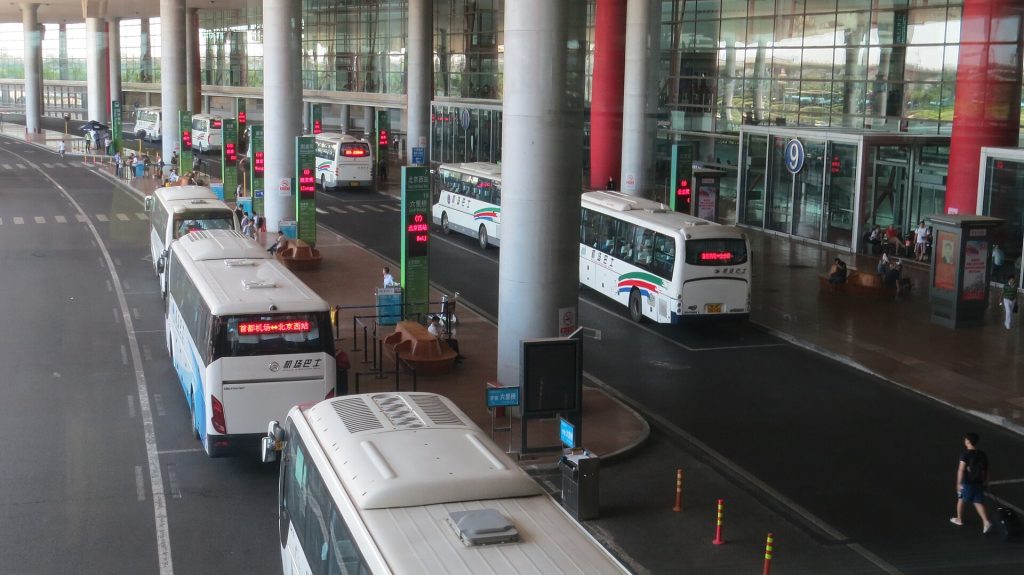
Arriving in China and opening Didi is only half the ride. The other half is standing in the correct pickup zone so the driver can legally and physically reach you. Airports separate taxis, buses, private cars, and ride-hailing for a reason, and curbside improvisation is how travellers and drivers earn cancellation fees they did not want. This guide is about reading signs, setting the pin, and using a calm backup—not about drawing one map that pretends to fit every terminal in the country.
For app setup and payment, use Didi ride-hailing for foreigners and add foreign payment to Didi. For meeting-point language, Didi airport pickup meeting points is the sibling explainer. Cancellation and no-show mechanics are covered in Didi cancellation and no-show fees. Shanghai’s two-airport geography lives in Shanghai Pudong vs Hongqiao.
Follow the pictograms, not a generic blog sketch
After you clear customs and baggage claim, look up. Airports write 网约车, Ride-hailing, Online car-hailing, or a branded pickup name on overhead signs. They also write 出租车 for the official taxi queue and 机场巴士 for buses. Those are different places.
Walk to the ride-hailing zone that matches your terminal and arrival level. Do not wait at the inner door because it “looks close on the map.” Drivers cannot always stop at the closest-looking curb, and traffic police will move them on.
Because terminals are rebuilt and pickup islands migrate, we will not publish a universal “Door 12, Level 2” rule. Verify your arrival terminal’s current map on the airport’s official page or the pictogram in front of you near travel week. What transfers between Beijing Capital and Daxing (Beijing Capital vs Daxing airport), or between Pudong and Hongqiao (Shanghai Pudong vs Hongqiao), will not transfer to Guangzhou Baiyun (Guangzhou Baiyun airport transfers) without another set of signs.
Set the pin where cars are allowed to stop
Open Didi only when you know which island or parking lane you can actually stand in. If the app’s default pin sits on the departures viaduct while you are on arrivals, the driver will hunt the wrong level. Move the pin to the official pickup point, confirm the terminal number, and add a short note if the app allows it—terminal, door letter, or “ride-hailing area.”
Then:
- Compare the plate and color with the app before you get in
- Use in-app chat or a call if you cannot see each other; a photo of the nearest sign helps more than a paragraph of English
- Do not ask the driver to enter a taxi-only lane
- If the wait becomes chaotic, cancel according to the app’s rules rather than vanishing (Didi cancellation and no-show fees)
A licensed airport taxi queue remains a perfectly respectable plan B (taxi cash vs QR for foreigners). The staffed queue is slower to understand emotionally and faster to enter physically when ride-hailing lanes are saturated.
Terminal-specific habits that travel well
- Note whether you arrived at T1, T2, or another building before you request the car
- If your flight used a satellite concourse, finish the train or walk to the main arrival hall before you set a pin
- Large bags are easier at a designated island than on a narrow crosswalk
- Families should nominate one person to watch the pin and one to watch luggage
- Night arrivals make signage harder to read; pause under a light and match Chinese characters, not only an English word you hope is right
Airport rail and metro alternatives—when they are still running—remove the pickup problem entirely (PVG Metro Line 2 arrival, Guangzhou airport metro vs Didi, Beijing Airport Express vs Didi, Beijing Capital Airport Express vs subway). Use them when luggage and the clock allow.
When the driver and the app disagree
Sometimes the app says the car has arrived and you see nothing. Walk the length of the official zone once, check that you did not filter yourself into a different parking annex, and send the driver the Chinese name of the pickup area printed on the nearest sign. If the driver asks you to leave the official zone and meet on a shoulder road, weigh safety and airport rules; the official island exists to prevent that improvisation.
Payment failures are a separate layer (add foreign payment to Didi). Have a backup card or a sense of how cash taxis work before you land (why cash is still needed).
Screenshot kit for a tired arrival
- Hotel Chinese address and a nearby landmark
- The terminal pickup pictogram
- Driver plate and color
- A live Didi quote so you notice if a curb hawker’s number is fantasy
- Last-train information if you might switch to metro
Related Lovely China reading
For payments, start with Alipay and WeChat Pay hub and WeChat Pay vs Alipay for tourists. For trains, keep high-speed rail first-timers guide and 12306 passport signup for foreigners handy. City hubs: Beijing first-visit guide, Shanghai first-visit guide. Connectivity: roaming vs local SIM honest guide, pocket Wi-Fi vs eSIM for China, offline maps for foreigners. Bookmark China travel tools page.
Practical checklist
- Confirm official rules on the relevant government, park, airline, or bank page near your travel week
- Screenshot bookings, tickets, and QR codes while you still have stable Wi-Fi
- Save hotel and attraction names in Chinese characters in your phone notes
- Carry passport, a backup payment method, and a small cash float (why cash is still needed)
- Test one small mobile payment before you rely on wallets at a gate or taxi
- Keep the China travel tools page page bookmarked for related Lovely China hubs
FAQ
Is there one pickup map that works at every China airport?
No. Terminals label ride-hailing zones differently. Follow 网约车 or Ride-hailing signs for your arrival terminal rather than a generic blog map.
What if the driver and I cannot find each other?
Check that your pin is in the official pickup zone, send a landmark photo, and use in-app chat or a call. Do not wander into a taxi-only curb and expect the car to follow.
What should I screenshot before I lose Wi-Fi?
The terminal’s pickup pictogram, your pin, the plate number, and the hotel Chinese address.
Notes for late 2026 travellers
November and early December bring cooler mornings, earlier sunsets, and comfortable walking weather across much of eastern and central China. Pack layers and leave extra time on clear weekends at popular sights.
This article does not invent ticket prices, opening hours, processing times, consular fees, or official statistics. When a number matters, verify it on the official site, app screen, or ticket board near your travel week.
If an official rule page disagrees with this guide, follow the official page. Lovely China orients English-speaking travellers; we are not an immigration, banking, or medical authority.