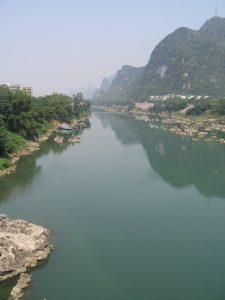
The minibus shuddered to a halt on a dusty shoulder of the G75 expressway, the driver shouting something about “Wansheng” over the roar of passing trucks. I grabbed my pack, stepped out into air that smelled of wet limestone and diesel, and watched the taillights disappear around a hairpin bend. That was my welcome to Qijiang — no fanfare, just the immediate sense that the city ends here and the hills begin.
Two Towns, One District
Qijiang wears its administrative history on its sleeve. The district seat sits in Gunan and Wenlong subdistricts, a sprawl of gray tile roofs and concrete towers clustered where the Qijiang River makes a sharp elbow turn. Twenty kilometers south, Wansheng feels like a different province. It grew up around a state steel mill that has largely gone quiet, leaving behind wide boulevards, Soviet-era apartment blocks, and a separate bus numbering system that still confuses newcomers. The merger in 2011 joined them on paper; the minibus ride joins them in practice. Stay in the north if you want hotpot delivery at midnight. Base yourself in Wansheng if you plan to be on a trail before dawn.
Getting There Without a Private Car
Chongqing Jiangbei International Airport remains the only real gateway for flyers. From the airport’s long-distance bus station, coaches labeled “Qijiang” or “Wansheng” leave every forty minutes or so; the ride takes two and a half hours if traffic cooperates. High-speed rail is faster on paper — trains from Chongqing West to Qijiang Station run in fifty minutes — but the station sits ten kilometers outside the urban core, requiring a taxi or a local bus that runs on a schedule only the driver seems to know. I have missed that bus twice. Now I budget for the taxi.
If you are already in central Chongqing, the long-distance buses from Chenjiaping or Nanping hubs are the least friction. Buy a ticket at the window, not the app; the QR codes on the platform often lead to a “sold out” page even when seats remain. The bus drops you at the Qijiang Passenger Transport Center, a chaotic square where motorcycle taxis swarm. Negotiate the fare before you straddle the seat. Twenty yuan to a downtown hotel is standard; thirty if the driver claims “night surcharge” after six.
Black Mountain Valley: The Reason Most People Come
Heishan Valley (黑山谷) sits at the southern edge of Wansheng, a limestone gorge where a boardwalk clings to cliffs above a river the color of jade tea. The full loop takes four hours at a steady pace, longer if you stop at every waterfall pool to dip your fingers. The park opens at eight; arrive at seven-thirty to beat the tour groups that pour out of Chongqing on weekend mornings. Wear shoes with grip — the wooden planks stay slick from mist, and the “easy” exit staircase near the end is a relentless climb of uneven stone steps that has turned back more than one visitor in sandals.
- Enter at the main gate, take the sightseeing bus (included in ticket) to the trailhead.
- Follow the boardwalk upstream past the “Dragon Pool” waterfall — best light for photos before ten.
- At the fork, choose the high road for views or the riverside path for shade; they rejoin at the suspension bridge.
- Cross the bridge, then descend the stone staircase to the lower gate where your return bus waits.
Mistakes I made: carrying a heavy daypack instead of a waist pack; forgetting a rain shell because the forecast said “partly cloudy”; assuming the park’s bottled water stalls would be cheap — they charge triple the convenience store price at the gate.
Beyond the Gorge: Quieter Corners
North of the city, the Qijiang River widens into a series of reservoirs. Locals fish from bamboo rafts near Sanjiang Town; you can rent one for an hour if you speak enough Mandarin to haggle with the boatman. East toward the Guizhou border, the karst peaks sharpen into the “Stone Forest of Qijiang” — not the famous one near Kunming, but a cluster of pinnacles you can scramble through in half a day without seeing another foreign face. In late spring, the hills around Donglin bloom with yellow rapeseed; photographers set up tripods along the county roads at first light. Ask your guesthouse owner which village holds the market that week — the rotating “ji” (集) fairs sell smoked toad, cured pork, and hand-woven bamboo baskets, and they move on a lunar cycle no printed schedule explains.
Eating and Sleeping: What the Guidebooks Skip
Qijiang city has a night market lane behind the People’s Hospital where stalls serve grilled fish on charcoal, the skin blistered black, flesh steaming white. Order “la jiao yu” (spicy pepper fish) and specify “bu yao tai la” if you want to taste the river sweetness beneath the chili oil. In Wansheng, the old steelworkers’ canteen near the former factory gate still serves a lunch set: rice, pickled mustard greens, braised pork belly, and a bowl of clear soybean soup for under fifteen yuan. It closes at one; arrive at twelve-thirty or the pork runs out.
Accommodation splits cleanly. In the north, chain hotels (Home Inn, Jinjiang Inn) cluster near the transport center — clean, predictable, 150 to 200 yuan. In Wansheng, family guesthouses in converted worker dorms offer rooms with shared bathrooms for sixty yuan; the mattresses are firm, the hosts wake you with tea, and they know which minibus goes to the valley gate at six forty-five. Book the latter by WeChat; few appear on international platforms.
Seasonal Rhythms and Local Expectations
Summer brings the heaviest rain; the valley boardwalk can close for flash-flood risk. Autumn, after the Mid-Autumn Festival, offers crisp air and fewer domestic tourists — the sweet spot. Winter is cold and damp; few heaters in budget rooms, so pack a down jacket for indoor evenings. Spring sees the rapeseed bloom and the “March 3rd” festival (the third day of the third lunar month) when Miao and Buyi villagers from the southern townships gather in Wansheng’s central square for lusheng pipe dances and antiphonal singing. If you stumble into it, stand at the edge, don’t step into the circle unless invited, and never point a camera at an elder’s face without a nod.
Locals move at a different clock. Shops shut for a long lunch from twelve to two. Bus drivers smoke at the terminus and leave when the ashtray is full, not when the timetable says. If you ask “how long to the valley?” the answer is often “kuai le” (fast) or “man le” (slow) — relative to the driver’s mood, not the clock. Learn to read the sky instead: low clouds over the karst mean rain within the hour; clear ridges mean the boardwalk will be dry.
Practical Checklist Before You Go
- Offline map tiles for the Wansheng–Heishan Valley corridor (cell signal drops in the gorge).
- Cash in small denominations — many guesthouses and market stalls don’t take mobile pay from foreign cards.
- Sturdy hiking shoes, light rain shell, headlamp (power cuts in rural guesthouses).
- A printed Chinese address for your accommodation; taxi drivers rarely read pinyin.
- Patience for the “Wansheng bus system” — routes 101, 201, 301 look identical on the pole but go opposite directions.
Qijiang does not perform for visitors. It offers a river, a gorge, a few good meals, and the quiet satisfaction of navigating a place that still runs on its own rhythm. Show up with flexible time, decent shoes, and a willingness to miss the last bus once — you’ll remember the walk back under the stars longer than any viewpoint.