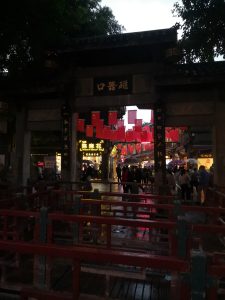
The high-speed train slides into Rizhao West Station just as the morning light hits the platform, pale and wide over the tracks. Outside, the air already carries salt and diesel, a mix that tells you the port is close. I stepped onto the forecourt with a backpack and a phone full of screenshots, expecting a smaller Qingdao. What I found was a city that moves at its own tide — wide boulevards lined with plane trees, fishermen mending nets on the seawall at dusk, and a breakfast culture that starts before the sun clears the horizon.
Getting There and Getting Around
Most first-timers arrive on the high-speed line from Qingdao (forty minutes) or Jinan (two and a half hours). The station sits west of the urban core, so you will need a ride to the coast. Taxis queue in a covered bay; a trip to the Wanpingkou scenic area costs roughly fifty yuan and takes twenty minutes if traffic is light. Didi works the same way it does everywhere else — enter the destination in pinyin if your Chinese characters are shaky.
Inside the city, the bus network is surprisingly legible. Routes 32, 33, and K33 run along the main coastal road, linking the train station, the university district, and the major beaches. Fares are two yuan cash or a tap of your transport QR code. I bought a secondhand bicycle from a stall near the university’s east gate for one hundred fifty yuan — single-speed, basket included — and it became the best money I spent. The terrain is flat, the bike lanes are separated from traffic on the main arteries, and you can ride the entire fifteen-kilometer seaside greenway without once sharing asphalt with a truck.
Where to Sleep: Sea View or City Pulse
Accommodation clusters in two zones. The first hugs Wanpingkou and the Third Bathing Beach: rows of mid-range hotels with balconies that face the Yellow Sea. Book a room on the sixth floor or higher; lower floors catch the early-morning foghorn from the pilot boats. The second zone sits around Renmin Road and the old railway station. Here you find family-run guesthouses above noodle shops, cheaper by a third, and a five-minute walk to the night market that wakes up at seven in the evening. I stayed in a courtyard-style homestay down a lane behind the Catholic church — blue-tiled roof, shared kitchen, landlady who slipped me a jar of her own pickled garlic scapes. No English at the front desk, but the WeChat QR code on the wall translated everything I needed.
Eating: What Arrives on the Table
Rizhao cuisine is Shandong coastal at its most direct — salt, heat, and the sweetness of very fresh seafood. Breakfast is non-negotiable. Look for a stall with a steamer the size of a truck tire. You want jianbing folded around a crisp youtiao stick, brushed with fermented bean paste and chili oil, or a bowl of xiaolongbao-style soup dumplings stuffed with minced pork and crab roe. The dumplings arrive eight to a bamboo basket, skins so thin you see the amber broth trembling inside. Lift one gently with your spoon, nip the corner, sip the liquor, then dip the rest in black vinegar laced with julienned ginger.
- Seafood pancake (haixian jianbing) — batter stretched thin on a cast-iron griddle, scattered with chopped squid, shrimp, scallions, and a cracked egg. Folded into a quarter, served on wax paper. Crisp edges, custardy center.
- Braised sea cucumber with scallions (congshao haishen) — the local banquet dish. Thick slices of rehydrated sea cucumber, glossy with dark soy glaze, piled under a mountain of flash-fried scallion whites. Texture should bounce like a firm jelly, not dissolve.
- Stir-fried clams (chao huage) — razor clams or venus clams, shells gaping, tossed in garlic, fermented black bean, and a splash of Shaoxing. Eat with your fingers; suck the juice from the hinge.
- Millet congee (xiaomi zhou) — golden, viscous, served in a ceramic pot with a side of salted radish and steamed corn bun. The breakfast of fishermen before the pre-dawn departure.
Home method for seafood pancake:
- Mix 200 g all-purpose flour, 300 ml cold water, pinch of salt, one beaten egg. Rest fifteen minutes.
- Heat a well-seasoned cast-iron pan over medium-high. Brush thin layer of peanut oil.
- Pour batter, swirl to a twenty-centimeter circle. Scatter 50 g chopped raw shrimp, 30 g diced squid, handful of scallion greens.
- Crack one egg on top, spread yolk with spatula. Cook two minutes until edges lift.
- Flip confidently. Press flat. Cook ninety seconds. Slide onto plate. Drizzle with chili-garlic sauce.
In a restaurant, point to the live tanks. Pick your weight, ask for qingzheng (steamed with ginger and scallion) or jiuyu (wine-sautéed). Avoid “spicy hot pot” menus aimed at tour groups — they drown the catch in mala oil. A common beginner mistake: ordering one of everything. Two people need three dishes max — one steamed fish, one stir-fry, one cold plate of jellyfish threads tossed in sesame vinegar. Leave room for the millet congee at the end; it settles the salt.
Beaches, Cliffs, and the Rhythm of the Tide
Wanpingkou is the postcard beach — golden arc, rental umbrellas, parasailing kites. Go at low tide in the tenth lunar month; the water retreats two hundred meters, exposing tide pools full of hermit crabs and baby abalone. Locals bring small rakes and buckets. If you join them, wear rubber-soled shoes; the rocks are slick with green algae. Third Bathing Beach is narrower, steeper, favored by university students playing volleyball until the mosquitos drive them inland.
For quiet, ride north past the lighthouse to the old military pier. The concrete structure juts four hundred meters into the bay. No railings on the last fifty meters. Fishermen cast handlines for sea bass in the shadow of the pilings. I sat there one autumn afternoon, wind drying the sweat on my neck, watching a cargo ship glide toward Lanshan Port like a illuminated apartment block. No tourists. Just an old man peeling an orange, segments falling into the water.
Markets and the Art of the Morning Walk
Dongyi Market wakes at five. By six, the aisles are ankle-deep in crushed ice and melted seawater. Stalls display fish I had no names for — black-spotted croaker, threadfin bream, the ugly but delicious monkfish. Vendors shout prices per jin (five hundred grams). If you buy, they will gut and scale on a wooden block in thirty seconds. Carry a reusable bag; plastic ones tear under the weight of a two-kilo yellow croaker.
Walk the perimeter of the market and you find the dry-goods lane: jars of dried shrimp the size of fingernails, bundles of kelp tied with straw, bricks of fermented soybean paste wrapped in lotus leaves. An auntie pressed a sample of xiangchun (Chinese toon) paste into my palm — bitter, floral, addictive. I bought two hundred grams. It lasted three weeks on steamed eggs.
What Locals Expect and What Trips You Up
Rizhao people rise early and eat loud. Slurping noodles is not rude; it cools the broth. Toasting at dinner follows hierarchy — youngest raises glass lower than eldest, taps the table twice with fingertips if the boss is too far to clink. Refusing a toast outright can freeze the room. Instead, sip tea and say wo ganbei, ni suiyi — “I’ll finish mine, you do as you wish.” It works.
Queueing is theoretical at bus stops and ticket windows. Bodies press forward; elbows create space. Stand your ground without aggression. On the beach, do not set up a tent before nine in the morning — the cleaning crew runs tractors through the sand at dawn, and they will run over your guy lines. I watched a couple argue with a driver in the mist; their canopy ended up wrapped around the axle.
Language: the local dialect swallows finals. Rizhao sounds like “Rizao.” Haixian becomes “Haian.” Learn four phrases in standard Mandarin and you will survive: duoshao qian (how much), bu yao la (no chili), fapiao (receipt), and xiexie. Smile when you say the last one. It softens the transaction.
The city does not perform for visitors. It loads coal, lands fish, steams buns, and sleeps when the tide turns. Stay long enough to learn the rhythm — two nights minimum, three if you can — and you leave with salt in your cuffs and the taste of millet congee on your fingers. That is the souvenir.