The minibus rattles over the last switchback before the valley floor opens up, and the Min River suddenly widens, its water the color of cold jade. To the left, a low stone levee splits the current like a blade; to the right, a narrow channel disappears into a forested gorge. There is no concrete dam, no towering spillway — just water doing what it has done for more than two thousand years. You step out onto the damp flagstones of the Fish Mouth and feel the vibration of the river through your soles. That hum is the sound of a system that has never stopped working.
Getting there without a tour bus
From Chengdu’s Xipu station, the high-speed rail covers the distance in thirty minutes. Trains leave every twenty minutes from early morning until late evening. A second-class seat costs roughly the price of a bowl of beef noodles. If you prefer the road, green buses numbered 301 or 302 depart from Chadianzi Bus Station and follow the old highway along the river; the ride takes about ninety minutes and lets you watch the valley walls close in. Taxis and ride-hailing apps will quote a flat rate for the sixty-kilometer trip — negotiate before you climb in. Once you arrive at the Dujiangyan passenger station, local bus 1 or 101 runs straight to the scenic area’s main gate. The stop is marked by a stone archway and a cluster of vendors selling bamboo hats.
Tickets, gates, and the quiet hours
The park operates on a single-entry ticket that covers the irrigation complex, the Erwang Temple, and the cable car to the hilltop pavilion. Adults pay around ninety yuan; students and seniors with valid ID get a discount. The cable car is an extra thirty yuan each way — worth it if your knees protest at stone stairs, unnecessary if you want the full walk. The main gate opens at eight in the morning and closes at six, but the irrigation works themselves are visible from the riverbank path outside the ticket line, so early risers can watch the first light hit the Flying Sand Weir without queuing. In the seventh lunar month the site swells with domestic tourists; if you can time your visit for the weeks after the Mid-Autumn Festival, the crowds thin and the water runs clear.
Walking the three pillars
Start at the Fish Mouth Levee, the wedge-shaped dyke that divides the Min River into the outer and inner streams. Stand on the viewing platform and watch the outer stream carry silt and floodwater straight downstream while the inner stream slips calmly into the Bottle-Neck Channel. From there, follow the paved path upstream to the Flying Sand Weir, a low overflow dam where excess water spills over a curved lip, taking sand and debris with it. The roar here is deeper, a constant hiss rather than a crash. Cross the Anlan Suspension Bridge — its bamboo cables replaced by steel in the last century — and you reach the Bottle-Neck Channel, a narrow gorge carved through the mountain. The water accelerates, turning turquoise as it squeezes through. A steep stairway climbs the left bank to the Fulong Temple, where a stone statue of Li Bing watches the flow. Allow two hours for the full loop if you pause to read the plaques; three if you sit on a riverside bench and eat a peach from a vendor’s basket.
Beyond the waterworks: temples, tea, and the panda valley
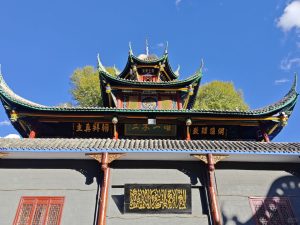
Erwang Temple sits on the hill above the Bottle-Neck, reached by a shaded staircase of three hundred steps. The hall smells of sandalwood and candle wax. Locals come to burn incense for Li Bing and his son, Erlang, tying red ribbons to the ancient ginkgo in the courtyard. Behind the temple, a narrow trail leads to the Dragon-Taming Pavilion, where a Qing-dynasty stele records water levels from centuries past. If you have another half day, take bus 102 from the main gate to the Dujiangyan Panda Valley, a quieter sister to the Chengdu Research Base. Here you can watch sub-adult pandas wrestle in enclosures that back onto bamboo forest. The valley also runs a volunteer program — book a week ahead through their WeChat mini-program — where you clean enclosures and prepare bamboo shoots under keeper supervision.
Eating where the irrigation water ends up
The Chengdu Plain’s fertility lands on the table in Dujiangyan’s riverside alleys. Order a bowl of *zhajiangmian* — hand-pulled wheat noodles topped with fermented soybean paste, minced pork, and julienned cucumber — at the stall beside the south gate; the broth remembers every hand that stirred it. For something hotter, ask for *shuizhu yu*, fish fillets poached in a cauldron of chili oil, Sichuan peppercorns, and pickled mustard greens. The fish should slide apart at the touch of chopsticks, the heat blooming slow rather than sharp. Vegetarians can seek out *qingzheng caihua*, steamed cauliflower heads drizzled with garlic-infused soy sauce and scattered with toasted sesame. Wash it down with a cup of *zhuyeqing* green tea, grown on the misty slopes above the Bottle-Neck. Most stalls accept mobile payment; keep small change for the peanut-seller who walks the bridge at dusk.
Mistakes that turn a day sour
- Arriving at ten in the morning during Golden Week and expecting to photograph the Fish Mouth without a crowd of selfie sticks.
- Wearing flip-flops on the Anlan Bridge — the gaps between planks swallow toes.
- Skipping the riverbank path outside the ticket gate; it gives the best panoramic view of the whole system for free.
- Buying “ancient” coins from the souvenir vendors near Erwang Temple — they are cast last month in a factory outside Chengdu.
- Assuming the cable car runs in heavy rain; it shuts down when wind exceeds level six.
When the light slants low across the valley in the tenth lunar month, the water turns the color of hammered copper. You stand on the same stones where Li Bing’s engineers once stood, feeling the same current press against the levee. The system asks nothing of you — no offering, no prayer — only that you watch and understand how water can be guided without being conquered. That lesson stays with you long after the train pulls back into Chengdu.