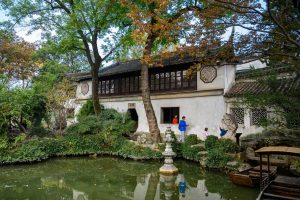
The minibus shuddered to a halt on a hairpin bend above Wuyuan, the driver killing the engine to let a flock of ducks waddle across the asphalt. Below us, the Hui-style rooftops of Likeng village curled like ink brushstrokes into the morning mist, white walls and black tiles mirrored perfectly in the canal. No tour groups yet, just an old woman rinsing bok choy on a stone slab and the smell of woodsmoke rising from a courtyard kitchen. That quiet hour, before the ticket booths open and the loudspeakers crackle to life, is the Jiangxi most guidebooks miss.
Finding your footing in the province
Jiangxi sits squarely between the Yangtze Delta and the Pearl River Delta, a green hinge of mountains and rice paddies that most travelers cross en route to somewhere else. Stay a week and the rhythm shifts. Trains now stitch the major nodes together in two to three hours, but the real texture lives on the county roads that climb into the Wuyi and Luoxiao ranges. Rent a car in Nanchang if you want the freedom to chase rapeseed blooms in spring or red maples in late autumn; otherwise, the high-speed rail spine—Nanchang to Jiujiang to Shangrao—gets you to the trailheads fast. Buses still reach the last villages, though schedules evaporate after sundown.
Cities that earn a night or three
Nanchang feels like a working capital first, tourist stop second. The Tengwang Pavilion draws the crowds, but the neighborhood behind Bayi Square—where vendors steam rice noodles in bamboo tubes at 6 a.m.—shows the city’s actual pulse. Give it an evening for the Gan River lights and a morning for the provincial museum’s bronze bells, then move on.
Jingdezhen smells of wet clay and pine ash. The Ancient Kiln Folklore Expo Area is polished for cameras, but the back lanes of the Taoxichuan Creative District hold studios where potters still hand-throw celadon the way their grandfathers did. Visit during the autumn ceramic fair (usually the eighth lunar month) when the whole city turns into a market; prices drop and the kilns fire through the night.
Jiujiang is the gateway to Lushan. The mountain deserves a full day—cable car up, hike the Immortal Cave loop, tea at a cliffside monastery—but the lakeside promenade at sunset, where retirees dance to erhu recordings, is free and better than any show.
Ganzhou wears its revolutionary history on its sleeve. The Ruijin sites are solemn, yet the old city walls beside the Zhang River come alive at night with skewers and cold beer. It’s a gritty, generous place where strangers will wave you into a hot-pot circle.
Wuyuan isn’t a single town but a constellation of villages—Likeng, Xiaoqi, Jiangwan—linked by narrow roads. Base yourself in a riverside guesthouse in Ziyang township; walk the stone paths at dawn, cycle the rice terraces at noon, sip chrysanthemum tea on a covered bridge when the tour buses roll past.
Mountains that demand legs, not just eyes
Lushan and Sanqingshan both carry UNESCO tags, but they ask different things of you. Lushan’s trails are broad, paved in parts, friendly to sneakers and a light pack. Sanqingshan’s granite spines require gloves for the iron-chain sections and a head for exposure. On both, the cable cars stop running an hour before sunset—plan your descent or book a summit guesthouse early. Mingyueshan near Yichun is quieter; its sunrise hike from the mid-mountain hotel rewards you with a sea of clouds that often traps the valleys until noon.
Seasonal windows and local calendars
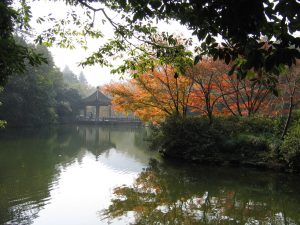
Spring arrives with the rapeseed flowers, a yellow flood across Wuyuan’s hills that peaks around the third lunar month. Summer brings heat and the plum rains; escape to the high meadows of Sanqingshan or the bamboo forests of Jinggangshan. Autumn, the ninth lunar month, paints the maple corridors of Lingyan red and gold—photographers camp tripods on the bridges before first light. Winter is mild in the south, biting on the peaks; the hot springs at the foot of Lushan fill with locals soaking away the chill.
What newcomers get wrong
- Treating Jiangxi as a day-trip extension of Huangshan. The distances look short on a map; mountain roads eat hours.
- Booking a single night in Wuyuan and trying to hit five villages. Pick two, walk slow, eat in a farmhouse kitchen.
- Assuming English signage exists beyond the major scenic gates. Download offline maps, learn the characters for “entrance,” “exit,” and “toilet.”
- Skipping the food. Gan cuisine—spicy, fermented, heavy on preserved bean curd and lotus root—is reason enough to linger.
- Ignoring the lunar calendar. Festival closures and transport surges hit hard during Qingming, Dragon Boat, and Mid-Autumn.
Small courtesies that open doors
In a village ancestral hall, step over the threshold, never on it. At a shared table, wait for the host to lift their chopsticks first. If a potter in Jingdezhen offers you a cup of tea from their own kiln, hold it with two hands and sip slow—they’re showing you the glaze, not just the drink. On the mountain trails, yield to porters carrying gas canisters and building materials on bamboo poles; their load has right of way. And when the evening firecrackers pop at a wedding in a Wuyuan courtyard, smile and wave. You’re not a spectator. For a few hours, you’re part of the noise.