The driver killed the engine at the foot of the hill, and the smell of damp earth and diesel drifted through the open window. Ahead, the grey tiles of Shijing Temple curled against the morning mist, while a few hundred meters down the road, the red lanterns of Luodai Ancient Town were already swaying above a crowd buying sticky rice cakes from a wooden cart. This is Longquanyi: one minute you are tracing the fingers of a Ming dynasty prince in an underground palace, the next you are dodging scooters on a street where Hakka grandmothers still hand-roll dough for fermented bean paste. The district sits on Chengdu’s eastern shoulder, close enough for a half-day escape but deep enough to swallow a whole weekend if you let it.
Getting Oriented
Longquanyi stretches along the Longquan Mountains, a low spine separating the Chengdu Plain from the hills that roll toward Ziyang. Most visitors cluster around three nodes: the temple complex near the university town, the Hakka streets of Luodai ten kilometers south, and the peach orchards that turn the hills pink every spring. Metro Line 2 terminates at Longquanyi Station, dropping you straight into the district’s modern core — wide boulevards, auto showrooms, and the occasional construction crane. From there, the 850 bus runs up the mountain to Shijing Temple, while the 801 heads south to Luodai. Taxis cluster at the station exit; a ride to the temple costs about thirty yuan, to Luodai fifty. If you drive, the Chengdu–Longquan Expressway cuts the commute to twenty minutes from downtown, but weekend traffic backs up at the toll plaza when the blossoms are out.
Shijing Temple and the Underground Palace
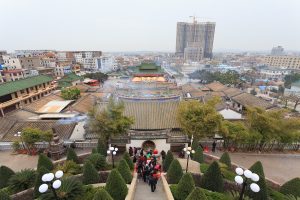
Shijing Temple sits halfway up the mountain, its halls rebuilt after fire but its layout faithful to the Tang footprint. The real draw lies beneath the main courtyard: the underground palace of Zhu Chun, the King of Ming Shu. Discovered in the 1980s, the vaulted chamber still holds the stone coffin, a jade belt, and a stack of blue-and-white porcelain that survived centuries of damp. Light filters through narrow shafts cut into the hillside, painting the walls in thin gold bars. You descend a steep stone stair, duck under a low lintel, and stand in air that tastes of mineral and incense. The guide — usually a retired schoolteacher volunteering for the season — points out the dragon motifs on the coffin lid, explaining how the prince’s rank dictated five claws instead of four. Allow forty minutes for the descent, the viewing, and the climb back to the bell tower, where you can strike the bronze once for a small donation.
Luodai Ancient Town: Hakka Roots on a Tourist Strip
Luodai markets itself as the “Hakka Capital of the West,” and the claim holds water: the guildhalls of the Guangdong, Jiangxi, and Hunan associations still face the central square, their carved beams blackened by centuries of kitchen smoke. But the main lane now sells the same silicone phone cases and neon hair clips you find in Lijiang or Fenghuang. To see the living culture, step behind the stage of the Guangdong Guildhall. There, a circle of women in indigo headscarves folds dumplings stuffed with preserved radish and minced pork — ban — while a radio crackles Hakka mountain songs. They’ll press a steaming one into your hand if you linger. The real meal happens at the family-run stalls down the alley toward the river: Hakka stuffed tofu, braised pork belly with pickled mustard greens, and a bowl of rice wine lees soup that warms the fingers. Order by pointing; the menu is a chalkboard in dialect. Eat standing at a plastic table, and wipe your hands on the paper towel roll bolted to the wall.
Peach Blossom Season and the Orchard Loop
From the second lunar month through the third, the hills erupt in pink. The “International Peach Blossom Festival” draws tour buses from Chengdu proper, but the orchards are large enough to absorb them. Rent a shared electric scooter — twenty yuan an hour — at the visitor kiosk near the Longquan Mountain Forest Park gate. Follow the paved loop road past rows of trees tagged with varietal names: “Yulu,” “Baifeng,” “Shuimi.” Stop at a farmer’s shed where an old man slices fruit onto a wooden board; the juice runs down your wrist, sweet and slightly tart. Picnic blankets dot the grass between the trunks. Families fly kites shaped like centipedes, their tails snapping in the valley wind. If you stay until late afternoon, the light turns the petals translucent, and the crowd thins as the buses load up for the return trip. Weekdays are quieter; the first weekend after the Lantern Festival is the peak.
Food Stops Beyond the Tourist Menu
Longquanyi’s everyday eating happens in the strip malls behind the metro station and in the villages along the mountain road. Three dishes define the local table:
- Longquan Roast Duck — skin lacquered with honey and soy, meat pink at the bone, served with steamed buns, cucumber matchsticks, and a jar of fermented bean paste.
- Spicy Rabbit Head — split down the middle, tossed in dried chili, Sichuan pepper, and ginger; you gnaw the skull for the brain and the cheeks. Order a cold beer to cut the heat.
- Hakka Lei Cha — a slurry of ground tea leaves, peanuts, sesame, and herbs poured over rice with pickled vegetables, tofu cubes, and a spoonful of chili oil. Stir fast; the texture should stay grainy, not turn to paste.
For roast duck, walk into the smoke-stained dining room of Lao Zhang’s on Longchuan Road — no English sign, just a red lantern and a row of ducks hanging in the window. For rabbit head, the night market stalls near the university town light up after dark; look for the longest queue. Lei Cha is best at the Hakka Cultural Center in Luodai, where a grandmother grinds the paste in a stone mortar while you wait.
Practical Rhythms and Common Missteps
Arrive early. The temple opens at eight, and the first bus from the metro station leaves at seven-thirty. By nine, the underground palace queue snakes into the courtyard. Luodai fills by ten; the guildhall courtyards empty out after lunch when the tour groups herd toward the souvenir shops. If you want the orchards to yourself, be on the mountain road by seven on a weekday — the mist still clings to the branches, and the farmers are just setting out their cutting boards. Cash is king in the alleys; WeChat Pay works at the temple ticket window and the park gate, but the dumpling ladies and the roast duck counter prefer notes. Wear shoes with grip: the temple stairs are polished smooth by centuries of soles, and the orchard paths turn to red mud after a spring shower. Finally, don’t treat Luodai as a museum. The guildhalls are still used for clan gatherings during the seventh lunar month; if you wander in during a ceremony, step back, stay quiet, and let the elders pass. They’ve been keeping this place alive longer than any guidebook has existed.