When the first real autumn air comes down the Yangtze, people in Jiangnan wait for a wind, not an app. The saying is 秋风起,蟹脚痒: when the autumn wind rises, the crab’s claws itch. The season has begun.
The crab is Eriocheir sinensis, the Chinese mitten crab, 中华绒螯蟹. On menus along the lower Yangtze it is 大闸蟹, da zha xie — “big sluice crab.” English notices the fur on the claws. Chinese remembers a tool. Around Suzhou and Kunshan, fishermen used to set bamboo sluice-gates, 闸, and hang lamps at night. Crabs climbed the light. You picked them off.
If you are in Shanghai, Suzhou, Kunshan or Hangzhou between late September and November, this is the season to learn it properly: live, steamed, with ginger-vinegar, and without paying a Yangcheng Lake premium for an animal that never saw the lake.
When does hairy crab season start in 2026?
Hairy crabs live in fresh water and walk downstream to brackish water to breed. By the time they are heavy enough for a steamer, the kitchen follows a lunar rule: 九雌十雄 — females in the ninth lunar month, when the orange roe, 蟹黄, is full; males in the tenth, when the cream, 蟹膏, has caught up.
Those are lunar months. Mid-Autumn Festival falls on Friday 25 September 2026, the fifteenth day of the eighth lunar month. The mainland public holiday runs 25–27 September. The ninth lunar month then begins around 10 October, so the old rule still points to mid-October as the female peak and November as the male one. Quality, in the usual telling, holds into December and then drops.
Crab tables follow the moon more often than they sit under it. The festival is a gift deadline. The eating season is the weeks after. Mooncakes belong to the night itself; we have already written that Friday’s moon and the pastry that goes with it. Hairy crab is what Jiangnan puts on the table once the tins have been opened.
There is no official 2026 Yangcheng opening day yet
As of 30 August 2026, Suzhou has not published an official opening-harvest date, 开捕, for Yangcheng Lake. That date is set each year from growth, the last moult, and the weather. It usually lands in late September. Last year’s catch opened on 26 September 2025. In late August 2026, official monitoring noted that the crabs had finished their last shell and were fattening, with a late-September listing still the expected window. That is a growth update, not a gazetted opening day.
Treat early “Yangcheng” boxes in August and early September with the scepticism the local association asks for. Other producing areas often list earlier. The famous lake is slower, on purpose. Mid-Autumn on 25 September does not mean genuine Yangcheng Lake crabs will be on every counter by the 25th. National Day rest then runs from 1 to 7 October. The days between those two holidays — and the quieter weeks after Golden Week — are when many family tables finally see a steamer.
Yangcheng Lake vs Taihu vs Changdang crabs
Yangcheng Lake, 阳澄湖, sits in Jiangsu between Suzhou and Shanghai, with Kunshan’s Bacheng town on its shore. Crabs from the designated lake district are a national agricultural-product geographical indication. A 2020 ministry announcement names the protected shore — including Kunshan’s Bacheng, Changshu’s Shajiabang, Xiangcheng’s Taiping and Yangchenghu Town, and Suzhou Industrial Park’s Weiting. The usual sales pitch is four traits: a blue-green back, a white belly, yellow hair on the legs, golden claws — 青背、白肚、黄毛、金爪.
Taihu, 太湖, is the larger neighbour, shared by Jiangsu and Zhejiang. In Song and Yuan writing it was already a crab name people knew. Enclosure nets went in from the 1980s and were gone by the end of 2019. Much of what is sold as Taihu crab now comes from ponds beside the lake. Both waters fatten the same species.
Changdang Lake, 长荡湖, in Jintan, Changzhou, is the quieter cousin. If a Yangcheng tag does not scan, a named lesser lake is often the honest buy.
How not to get a faked ‘Yangcheng’ crab
“Bathing crabs,” 洗澡蟹, are animals sourced elsewhere, dunked briefly in the famous lake, and sold as locals. In years when only a few thousand tonnes come out of Yangcheng Lake, many times that tonnage has been sold under the name. Do not treat old harvest figures as this year’s numbers; the pattern is what matters. The Suzhou Yangcheng Lake Hairy Crab Industry Association exists because the name is worth stealing.
What actually works, in the association’s guidance and in Suzhou market-regulator notices:
- Wait for the official opening. A “Yangcheng Lake” listing in August is almost certainly not this year’s lake catch.
- Scan this year’s crab buckle. Genuine GI crabs carry an association anti-counterfeit buckle, 蟹扣 — one crab, one buckle. The design changes every year. In 2025 the set added a box sticker, 一箱一贴, and used two colours for lake-enclosure versus pond culture. Do not memorise last year’s colours as this year’s proof. Open WeChat, scan this year’s code, and read the farm page that comes back. A buckle that will not scan, or that shows another year, is a warning.
- Check the seller. Look for a current-year geographical-indication authorisation. “Yangcheng Town hairy crab” and “shipped from Yangcheng” are not the GI product.
- Weight is part of the name. Association rules have required a male of at least 150 grams and a female of at least 125 grams before the GI mark may be used.
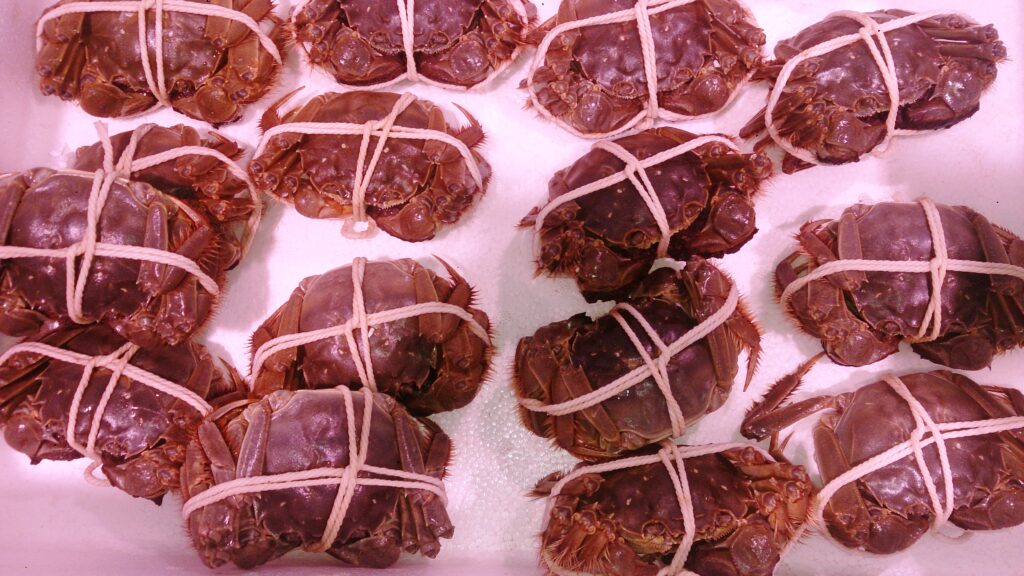
- Live or nothing. Claws are bound with string or reed so the animals cannot tear each other. If a crab does not move when you press a leg, do not steam it.
How to order hairy crab in China
A restaurant that will steam them at the table is the easiest first time. Autumn menus in Shanghai and Suzhou put live crabs in a tank or basket and price them by the liang (50 grams) or by the animal. You choose sex and size; they steam; you work. Ask for 清蒸大闸蟹. You do not need a famous lake name. You need a kitchen that starts from live animals and a ginger-vinegar dip that is not an afterthought. If the server cannot tell you female or male, you are in the wrong room.
A wet market or supermarket seafood counter stacks them from late September, bound, on ice or damp cloth. Pick animals that feel heavy for their size, with intact legs and moist shells. Females have a rounded apron on the underside; males a pointed one. An even number is the polite count. Take them home the same day. Keep them cool and damp, not in a sealed bag, and steam them while they are still lively.
A crab card, 蟹卡 or 蟹券, is the modern gift: a voucher redeemed once the lake is open. Cards travel better than live cargo. They also attract autumn frauds. Do not treat a voucher sold in August as proof that Yangcheng Lake has already been harvested. Redeem through the issuer named on the card, and match the buckle on the animals you receive to this year’s scan. Buy from a named, authorised seller, and give it with the understanding that delivery follows the opening date, not the Mid-Autumn deadline.
A string of live crabs in a box is a seasonal letter around Mid-Autumn and National Day. Even numbers are polite; the animals must still be alive at the door. If your trip is only the Mid-Autumn weekend, buy mooncakes for the night and wait for crab until the opening is published — or eat a named Taihu or Changdang animal already honestly in season.
You do not need to go to the lakeshore unless you want the walk. The lake is reeds and still water. The eating happens in kitchens.
Ginger-vinegar, and how to eat a hairy crab
Steam the crabs on their backs so the juices stay in the shell, often with ginger and a few leaves of perilla, 紫苏. They come out scarlet and should be eaten hot. A cold hairy crab is a wasted one. Steam until the shells have turned and steam has gone through; large animals take longer. Do not drown them in sauce in the pot. The dip belongs on the table.
The dip is Zhenjiang vinegar with shredded ginger, sometimes a pinch of sugar. Traditional medicine treats crab as “cooling.” Ginger and warm yellow wine, 黄酒, are the old answer. Chrysanthemum or osmanthus tea will also clear the palate. The meat is sweet and the roe is rich; vinegar cuts, ginger warms, wine keeps you at the table.
Opening a crab is a craft, not a race.
- Break the binding. Twist off the claws and legs and set them aside.
- Lift the apron on the underside and pull. Then lift off the top shell in one piece.
- In a female you want the orange roe packed against the shell and in the body. In a male you want the cream. Eat those first, with ginger-vinegar, while they are hot.
- Discard the feathery gills — they are not meat — and the small grey-green sac toward the head.
- Split the body down the middle. Pick the white meat from each chamber with a wooden pick or a chopstick.
- Crack the claws. The large pincer holds a lump of meat worth the work. Legs are sucked more than they are carved.
Jiangnan households used to keep a set of eight small tools, 蟹八件. Most city diners now use fingers, a pick, and patience. Send them to the table in small rounds so each one is still hot. Restaurants will also serve crab-roe tofu or soup dumplings; those are extensions. The centre of the season remains a steamer and ginger-vinegar.
FAQ
When should I eat hairy crab in China in 2026? After Mid-Autumn (25–27 September), into November. Females are traditionally best in the ninth lunar month (from around 10 October); males in the tenth. There is no official 2026 Yangcheng opening date as of 30 August. Late September is the usual window, not a promise.
How do I eat hairy crab if I have never done it? Order them steamed and live. Use ginger-vinegar. Lift the apron, take off the top shell, eat the roe or cream, discard the gills, then pick the body and crack the claws. Tea or yellow wine helps.
How can I tell a real Yangcheng Lake crab from a fake? Do not trust the box. Wait for the official opening, buy from an authorised seller, and scan this year’s association crab buckle in WeChat. A “Yangcheng” crab in August, or a buckle that will not scan, is the usual fraud.