On Sunday 18 October 2026, the Chinese calendar lands on a double nine: the ninth day of the ninth lunar month. That is Chongyang, 重阳节, the Double Ninth Festival. Nine is a yang number in the old reading of the I Ching; two nines in a row were taken as a day of extra brightness, and of danger that needed to be climbed away from. The customs that stuck are still the ones you can do with your feet and your hands: go up high, pin a sprig of dogwood, look at chrysanthemums, think of the people who are older than you.
It is a real date. It is not, on the mainland, a paid public holiday.
When is Double Ninth Festival 2026?
Timeanddate lists Sunday 18 October 2026 as an observance, not a holiday. Travel China Guide’s festival table gives the same Gregorian date, as does the English Wikipedia entry for the Chongyang Festival. The lunar date does not move: it is always the ninth of the ninth. This year it sits eleven days after National Day ends on 7 October. Do not treat Chongyang as a second Golden Week. This day is a Sunday walk.
Hong Kong treats Chung Yeung differently. The SAR’s gazetted 2026 general-holiday list names Monday 19 October as “the day following Chung Yeung Festival,” because the festival itself lands on a Sunday. Macao lists Sunday 18 October as Chong Yeung Festival among the year’s public holidays, and Monday 19 October as the compensatory rest day for public employees. If you need a counter open, ask which clock the office uses.
Is Double Ninth a public holiday in mainland China?
No. The State Council’s notice on 2026 holidays (国办发明电〔2025〕7号, 4 November 2025) names New Year, Spring Festival, Qingming, Labour Day, Dragon Boat, Mid-Autumn and National Day. Chongyang is not on that list. Timeanddate is explicit: even though the festival falls on a Sunday, “it is a working day” in the holiday-type sense — most businesses keep ordinary hours, and the Monday is an ordinary Monday. Had the ninth of the ninth fallen on a Wednesday, the Wednesday would have been a normal office Wednesday with extra flowers in a park.
The legal language on the mainland is about elders, not about shutting the office. In 1989 the ninth of the ninth was designated a day for the elderly. The revised Law on the Protection of the Rights and Interests of the Elderly, in force from 1 July 2013, put it in statute. Article 12 is a single sentence: the ninth day of the ninth lunar month is 老年节, Seniors’ Day. That is a duty of respect, not a statutory rest day. In 2006 the festival went onto China’s first national intangible cultural heritage list. Heritage is not the same as a day off.
Why do people climb high, and what are chrysanthemums and dogwood for?
The oldest written layer is Han. The Miscellaneous Records of the Western Capital has a palace woman, Jia Peilan, saying that on the ninth of the ninth people wore zhuyu, ate a kind of cake, and drank chrysanthemum wine, “said to make one live long.” A later story, collected in the Six Dynasties Xu Qixie Ji and still retold in festival handbooks, sends the Han figure Huan Jing up a mountain with his family, carrying dogwood and chrysanthemum wine, on the advice of his teacher Fei Changfang. When they come down, the livestock at home are dead. Climb high, the tale says, or misfortune finds you on the flat.
Zhuyu, 茱萸, is not the North American flowering dogwood. The plant meant here is Cornus officinalis, worn as a sprig or sewn into a small pouch. If you cannot find it, you have not failed the day. Chrysanthemums are for looking at, and for putting in wine or tea. Cities often stage chrysanthemum shows in late October — Beijing’s Temple of Heaven and Beihai have done so; Shanghai has used Gongqing Forest Park — but 2026’s dates are the parks’ own notices. Check the week before.
Chongyang cake, 重阳糕, is a steamed rice cake; gao, cake, sounds like gao, height. You eat the homophone. There is no single national recipe. A bakery steamed cake labelled for the day is enough. Children still learn the Tang poem Wang Wei wrote when he was young and far from home, 《九月九日忆山东兄弟》: alone, a stranger in a strange place; at every festival, homesickness doubles.
Nine also sounds like 久, long-lasting. That is why the day could be turned, without much strain, into a day for people who have already lasted. The climb and the respect are the same gesture seen from two sides: stay high, stay long.
In Hong Kong the day is also a grave-sweeping day, the autumn counterpart to Ching Ming. Families go to cemeteries with incense, fruit and paper offerings. If you are a visitor, do not treat a cemetery as a viewpoint and do not photograph other people’s rites. The public holiday is a family one. Your part, if you have no grave to visit, is a hill or a long staircase.
Where can you hike or find a high park in a city that day?
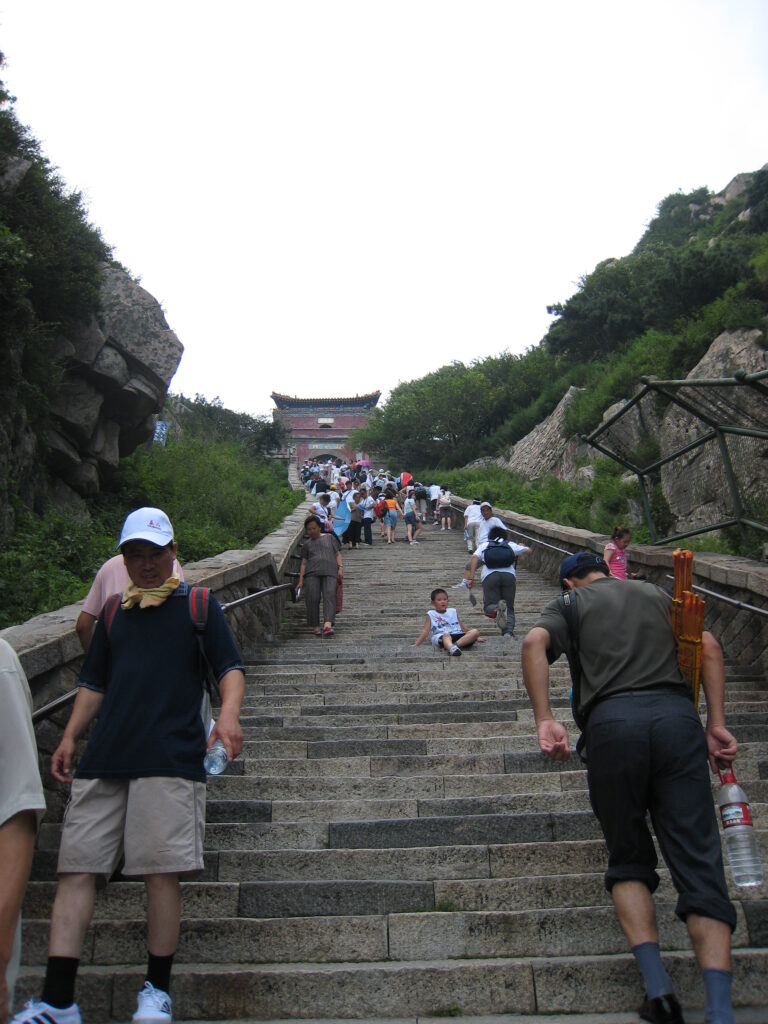
You do not need a holy mountain. The custom is “go up,” 登高, not “summit a UNESCO peak.” A city hill with stone steps is the authentic modern version. Sunday 18 October 2026 will fill the famous ones. Go early. Take the metro. Carry water. If you are walking with someone older, choose the hill that has a railing and a way down that is not a queue.
Beijing. Jingshan Park is the simplest climb that still counts: an artificial hill north of the Forbidden City. It takes a ticket; it does not take a day. Fragrant Hills, 香山, will be packed if the smoke trees have turned, and timed reservations have been required in recent red-leaf seasons. Book the park’s own channel. Temple of Heaven is better for chrysanthemums than for a climb.
Shanghai. Sheshan, 佘山, in Songjiang, is the city’s actual hill. Metro Line 9. West Hill has the basilica and a steeper pull; East Hill is gentler forest. That is a Chongyang walk a visitor can do without a guide. The Bund is not a climb. Gongqing Forest Park is where Shanghai has staged its chrysanthemum show; go there for flowers, not for altitude.
Hangzhou. Baoshi Hill, 宝石山, is free, close to West Lake, and steep enough to qualify. Wushan, with the City God Pavilion, is the old in-town height. You can smell osmanthus in the same weeks in Manjuelong, but that valley is a scent walk, not a Chongyang climb. If you want tea in the hills, that is a Longjing errand for another morning.
Nanjing. Purple Mountain is the civic answer: Linggu Temple, the Ming Xiaoling approaches, the long steps at Sun Yat-sen Mausoleum. Pick one staircase, not all three. Linggu will still have osmanthus if October is kind.
Guangzhou. Baiyun Mountain is the city’s habit. Cable cars exist for knees that have already done their share of years. Shenzhen. Lianhua Hill, with the Deng Xiaoping statue at the top, is a city-park climb you can finish before lunch.
Hong Kong. On Sunday 18 October the cemeteries will be busy; on Monday 19 October many people are off work. Country-park trails are the visitor’s version. Do not follow a family into a grave terrace.
Mount Tai is the picture of stone stairs and incense. It is not a casual city park. If you are not already in Tai’an, do not make the day about getting there.
How do people respect elders on Chongyang?
The law named a Seniors’ Day. The practice is smaller and better. Adult children go home if they can, or they video-call if they cannot. They bring fruit, a steamed cake, a pot of chrysanthemum tea. They walk slowly up a hill that the older person can actually manage, which may be Jingshan and not Xiangshan. Communities run dumpling-making mornings, health talks, free or discounted park entry for people over sixty. None of this requires a spectator ticket.
If you are an expat with Chinese in-laws, the useful gift is time on the Sunday, not an expensive box. If you have no elders in the country, climb anyway. Wang Wei’s poem is about absence. The hill still works.
Offices on the mainland open as usual on Monday 19 October. Hong Kong and Macao civil-service clocks do not. Plan the Monday for the city you are actually in.
FAQ
When is Double Ninth Festival in 2026?
Sunday 18 October 2026, the ninth day of the ninth lunar month. Hong Kong observes Monday 19 October as the general holiday that follows Chung Yeung. Macao marks the Sunday as Chong Yeung and gives public employees the Monday as compensatory rest.
Is Double Ninth a nationwide paid holiday in China?
Not on the mainland. It is Seniors’ Day under Article 12 of the Law on the Protection of the Rights and Interests of the Elderly, and a national intangible-cultural-heritage festival, but it is not in the State Council’s 2026 holiday notice. Businesses keep ordinary hours.
Where should a visitor go that day without joining a tour?
A city hill with steps: Jingshan in Beijing, Sheshan in Shanghai, Baoshi Hill in Hangzhou, Purple Mountain in Nanjing, Baiyun Mountain in Guangzhou, Lianhua Hill in Shenzhen. Go early on the Sunday. Eat a piece of Chongyang cake. Call someone older than you.