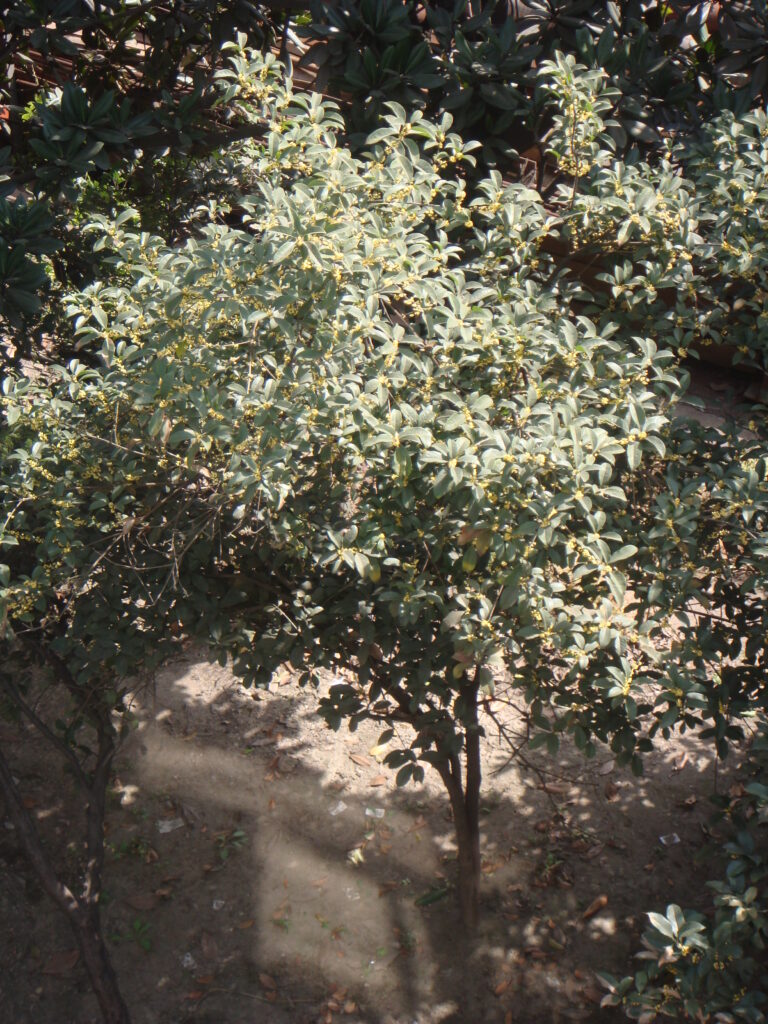
You do not need a calendar for this one. In much of southern and eastern China, September announces itself through the nose. Tiny four-petalled flowers, cream to gold, open on evergreen trees that have stood in the same courtyards all year. Then, one morning, the air turns sweet. People stop under a tree they walked past in July without noticing, and they look up.
The plant is Osmanthus fragrans. In Chinese it is 桂花, guihua. English names pile up — sweet osmanthus, sweet olive, tea olive — because the scent is easier to recognise than to classify. Garden writers often reach for ripe peach or apricot. The Greek in the genus name is simpler: osma, smell; anthos, flower.
Mid-Autumn Festival 2026 is Friday 25 September, and osmanthus wine does sit on some reunion tables that night. For the pastry and the three-day holiday, read Mooncakes and a Friday Night Moon. This piece is the flower: where you smell it, what to eat and drink, and how to join without a tour.
When does osmanthus bloom in China?
The main flush is autumn. In the lower Yangtze and across much of the south, buds wait for cooler nights. Late September into October is the usual window. Hangzhou’s municipal English service has treated the first silver osmanthus on Manjuelong Road as the city’s unofficial starting gun. There is no gazetted opening day. Put your face near a tree. If the air is empty, come back in three days.
Four garden groups keep coming up in local planting lists. Golden osmanthus, 金桂, is denser and sweeter. Silver osmanthus, 银桂, is paler and cooler in the nose. Orange-red dan gui, 丹桂, colours the branch. Four-season osmanthus, 四季桂, holds a quieter scent when the others fade. Hangzhou gardeners often name silver osmanthus for scenting Longjing tea. Golden osmanthus more often goes into sugar. That is horticulture talking, not a kitchen law.
The flower is prominent along and south of the Yangtze, and in cities that planted it as a civic tree. You will smell it on a Shanghai side street in a good week. You may not smell it on a Beijing boulevard in the same week.
Where can you actually smell osmanthus in September?
Start with Hangzhou, whose city flower — chosen in 1983 — is osmanthus. The place people name is Manjuelong, 满觉陇, a valley south-west of West Lake, between Southern Peak and Baihe Peak. A monastery here took the name Manjue, “complete awakening,” in 1065. From the Ming dynasty, villagers grew osmanthus for a living. Ming writer Gao Lian already sent people into the valley by nose: several li out, he wrote, the fragrance met you. The scene later entered the New Top Ten Views of West Lake, chosen in 1985, as 满陇桂雨, “osmanthus rain at Manlong”: on a dewy morning the flowers fall so thickly they feel like weather. Hangzhou’s own notes still speak of more than seven thousand trees in the valley.
You do not need a ticket for the village road. You need a weekday if you can manage one. Mid-Autumn 2026 sits inside the bloom window, so 25–27 September can be both moon night and flower night. After that, ordinary October weekdays are kinder.
How to get there without a tour: ride Hangzhou Metro toward the south of West Lake, then a bus. In ordinary weeks, routes such as the 87 have served Manjuelong, Shiwu Cave and the zoo corridor. In peak blossom the city has sometimes held cars off Manjuelong Road at weekends and run extra shuttles. Treat the bus number as something to check the week you go. Shiwu Cave, 石屋洞, is the postcard stop. Lower Manjuelong is where the snack stalls sit. The scent is strongest in the morning and after a light rain.
If Manjuelong is a crush — it will be, on a Saturday after the moon — stay in the city. Hangzhou planted osmanthus along ordinary streets. The 19th Asian Games, in 2023, put bunches of the flower in the opening ceremony on 23 September and in medal bouquets. The older legend is lunar: Wu Gang, condemned to chop an osmanthus tree on the moon that grows back as fast as he cuts. You do not have to believe it to understand why the smell still feels like more than a garden.
Guilin is the other name English visitors ask about, because the first character of the city is the osmanthus character. 桂林 is commonly read as “osmanthus forest.” In autumn the streets really do smell of it. You do not need a karst cruise. Walk Zhengyang Pedestrian Street in the evening. Walk a city park. Buy osmanthus wine, 桂花酒, from a shop that sells it as a local product, and a square of 桂花糕. That is the visitor’s version of joining: you smell it, you eat it, you do not book an “osmanthus experience.”
Suzhou named osmanthus its city flower in March 1982. The municipal archive is blunt: there is hardly a park without the tree. Liu Yuan, the Lingering Garden, keeps several cultivars and a pavilion whose couplet is about osmanthus moving autumn through the mountains. If you are already in Suzhou for gardens, you do not need a second itinerary.
Nanjing’s Linggu Temple, 灵谷寺, on Purple Mountain, is the Jiangnan stop locals name without being asked. The grounds are planted with osmanthus in large numbers, including a well-known old golden osmanthus north of Wuliang Hall. Combine it with a walk, not a photo-stop bus. The same mountain is a Double Ninth climb later; that is a different day, Sunday 18 October 2026.
In Shanghai, go to Guilin Park, 桂林公园, at 128 Guilin Road in Xuhui. It was a private garden; the city planted golden, silver and red osmanthus — more than twenty cultivars, more than a thousand trees in the park’s own counting. The tea room has, in season, served osmanthus tea and sugared taro. Ordinary days have often been free; during the park’s own osmanthus days a small ticket has been charged in past years. Check the gate.
What do people eat and drink — tea, cake and wine?
Osmanthus is a food as much as a tree. Dried flowers are brewed on their own, or used to scent real tea: osmanthus Longjing around Hangzhou, osmanthus oolong from Anxi in Fujian. A scented cup is not a substitute for a West Lake spring picking. It is a different drink, and a good one in September, when the hills above the lake are no longer in harvest.
Candied osmanthus, 糖桂花, is flowers layered with sugar, to be spooned over lotus root stuffed with glutinous rice, over chestnut paste, over fermented rice. A state-banquet cold plate has included that lotus-root dish. The home version is simpler: buy a small jar and put a spoon of it on something steamed.
Osmanthus cake, 桂花糕, is a soft steamed square of rice flour that should taste of the flower first, not of sugar. The World of Chinese traces a Southern Song ancestor in Lin Hong’s Simple Foods of the Mountain Folk. Manjuelong stalls still sell chestnut-and-osmanthus sweet soup, 桂花栗子羹. Eat it hot. Do not confuse the cake with a mooncake. The mooncake is dense and shared. This square is lighter.
Osmanthus wine is the old “reunion wine” of Mid-Autumn in some Jiangnan households. Qu Yuan’s Nine Songs already mention 桂浆, “osmanthus liquid.” A small glass is enough. It is sweet. It is not a cocktail.
What matters in a cup of the tea is that the flower is dry and the water is not boiling-angry. The infusion should smell of apricot and wood, not of perfume. If it smells like a bathroom spray, the flowers were old or the flavouring was not flowers.
How does a visitor join without a tour?
You walk. That is the whole method.
Pick a city that planted the tree. Hangzhou, Suzhou, Nanjing, Shanghai and Guilin are the easy five. Go in late September or the first half of October. Do not treat a festival poster as a bloom forecast.
Do not join a shopping-stop garden tour. Do not buy a kilo of “wild mountain osmanthus” from a person who found you at the metro. A small bag of dried flowers from a tea shop with a scale, or a slice of cake you eat on the spot, is the honest purchase. In Manjuelong, taste the chestnut soup before you bag the sugar. In Shanghai, ride Metro Line 9 to Guilin Road and walk.
Osmanthus is not a holiday. Offices stay open. Stand under a tree. Eat a square of cake that is not a mooncake. The street will smell of apricots either way.
FAQ
When is osmanthus season in China in 2026?
There is no gazetted opening day. The main bloom in Jiangnan and the south is late September into October. Hangzhou’s Manjuelong valley is the place the city itself names. Weather moves the week; the calendar does not freeze it. Mid-Autumn on 25 September 2026 sits inside that window but does not define it.
Can visitors smell osmanthus without going to Hangzhou or Guilin?
Yes. Suzhou’s gardens, Nanjing’s Linggu Temple, and Shanghai’s Guilin Park are ordinary public places with the tree. Many southern residential streets are planted with it. Beijing is a weaker bet in the same week. You do not need a tour in any of these cities.
Is osmanthus wine only for Mid-Autumn Festival?
No. It is a traditional reunion drink for the moon night in some families, which is why it sits next to mooncakes, but shops sell it through the autumn. A small glass with cake is enough. It is not a ceremony you can fail.