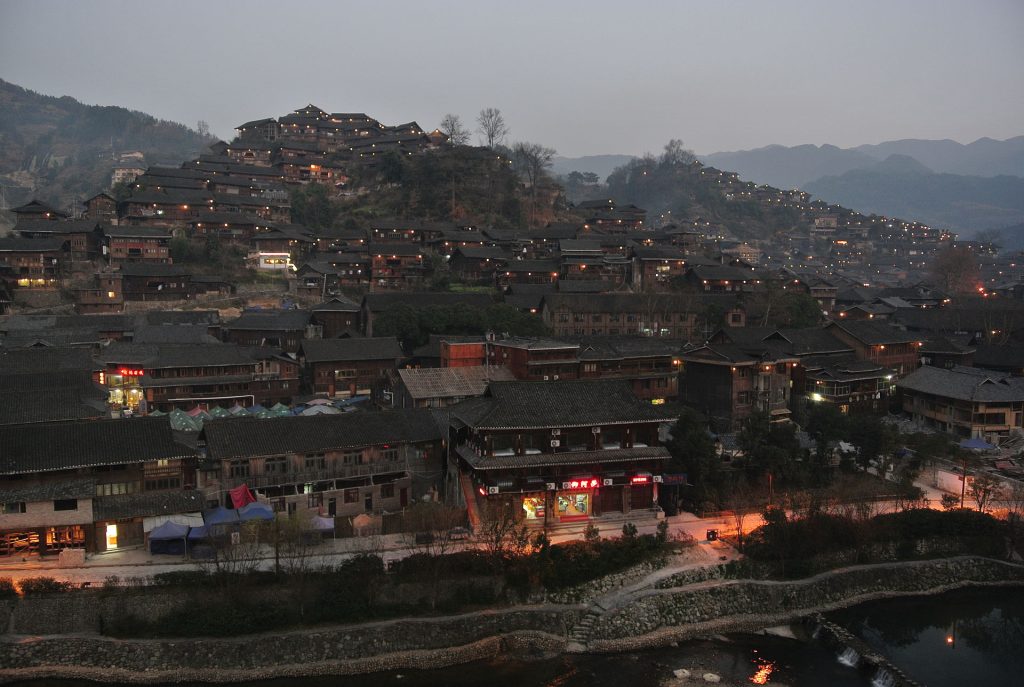
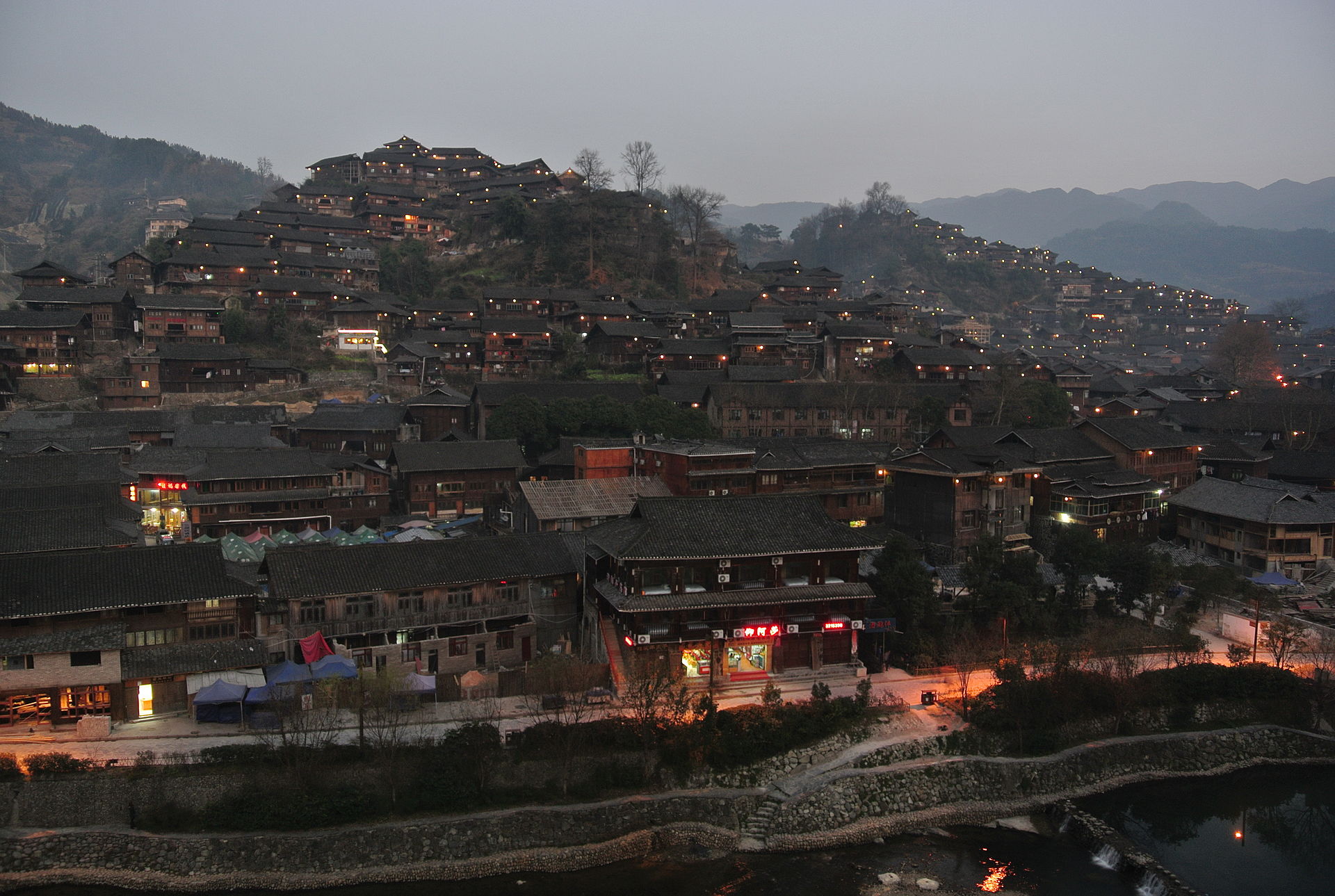
The minibus coughed to a halt on the ridge road just as the valley lifted its morning mist. Below, a river curled like a silver ribbon around the foot of two green spurs, and on those spurs sat row after row of dark timber houses, their roofs layered in grey tile and their balconies hung with indigo cloth drying in the breeze. I stood at the viewing platform, the ticket stub still warm in my hand, and watched smoke rise from a hundred chimneys into air that smelled of wet pine and woodsmoke. This was Xijiang, the “thousand-household village,” waking up.
When the Valley Shows Its Best Face
Spring arrives early in eastern Guizhou. By the third lunar month, the rice terraces flooding the valley floor turn into mirrors that double the village lights at night. The air is cool, the tourist tide thin, and the Miao women still wear their festival silver headdresses from the New Year celebrations. Autumn, around the ninth lunar month, brings the harvest. The hills glow gold, and the “New Rice Festival” fills the lanes with the scent of roasted glutinous rice and rice wine. Summer is green and loud — cicadas, tour groups, sudden downpours that turn the stone lanes slick. Winter is quiet, sometimes frosty, and many guesthouses close their doors after the twelfth lunar month. If you want the village to yourself, aim for a weekday in late spring or early autumn, just after a rain has washed the dust off the tiles.
Choosing a Bed: Riverside Noise or Hillside Quiet
The village splits naturally into two zones. Down by the river, the main street — renovated in the last few years — runs straight and wide. Guesthouses here have plate-glass windows facing the water. You fall asleep to the murmur of the river and wake to the clatter of breakfast carts and the first tour buses unloading around eight. Rooms are newer, bathrooms modern, Wi-Fi reliable. Up on the spurs, the lanes narrow to shoulder-width alleys that climb in switchbacks. The houses here are older, their wooden frames blackened by decades of hearth smoke. A family-run courtyard guesthouse on the upper spur costs less, creaks more, and puts you inside the rhythm of daily life: the neighbor pounding chili paste at dawn, the grandmother singing lullabies on the balcony. I chose the upper spur. The climb back up after dinner burned my calves, but the view of lanterns lighting the valley floor was mine alone.
Feet on Stone: Walks That Reveal the Place
Xijiang rewards walking. The main loop — entrance gate, viewing platform, wind-and-rain bridge, main street, performance square, back up to the gate — takes two hours at a dawdle. But the real texture lives on the side paths.
- Rice terrace stairway. Behind the performance square, a stone stair climbs into the terraces. Thirty minutes up, you reach a saddle where an old farmer tends a vegetable patch. He waves. The village spreads below like a model.
- Leigongshan forest trail. From the west gate, a marked path enters the national park. Two hours round-trip to a waterfall that drops into a fern-filled pool. Leeches love the damp; tuck your trousers into your socks.
- Silversmith alley. A lane parallel to the main street, one terrace up. Tiny workshops where men hammer silver into phoenix crowns and butterfly pins. No hard sell. You watch, you point, you pay cash.
- Night lantern walk. After the last dance show ends (usually nine thirty), the day-trippers vanish. Lanterns glow amber in the eaves. The river reflects them double. Walk slow. Listen to the Miao dialect drifting from open doors.
Festival Time: When the Village Swells
The big gatherings cluster around the lunar new year — the “Miao New Year” falls between the tenth and twelfth lunar months, dates shifting each year by the harvest calendar. Villages from three valleys pour in. Women wear towers of silver: horns, chains, bells, combs, weighing kilos. Men play the lusheng, a bamboo reed pipe, and lead circle dances that snake through the lanes. Strangers are pulled in. I stood awkward at the edge, hands in pockets, until an old man grabbed my wrist, laughed, and spun me into the ring. No refusal allowed. Rice wine flows from communal jars. If you visit then, book a bed three months ahead. Bring waterproof boots — the lanes turn to mud. And accept that you will not sleep much; drums and firecrackers pound until dawn.
What Locals Expect (And What Trips Up Newcomers)
Xijiang is a living village, not a theme park. A few habits smooth the stay:
- Ask before you point a lens. An elderly woman adjusting her silver headdress on the balcony is not a prop. Raise your camera, make eye contact, nod. Most smile and pose. Some turn away. Respect the turn.
- Shoes off at the threshold. Every guesthouse, every home. Wooden floors, generations of polish. Leave boots on the stone step.
- Rice wine etiquette. If a host pours, you drink. A sip is polite; a refusal reads as rejection of hospitality. Touch the cup to your lips, say “gela” (thank you in Miao), set it down.
- Cash is king. The silversmiths, the noodle stall, the ferry across the river — none take mobile pay. The nearest ATM is at the visitor center, and it often runs dry by afternoon. Bring enough yuan for two days.
- Don’t chase the “authentic” show. The staged dance at the square is fine, but the real music happens after dark in a courtyard where an uncle teaches his nephew the lusheng. Ask your host. They know.
Getting There and the Last Stretch
Most travelers land in Kaili, the prefecture capital. From Kaili’s west bus station, minibuses leave when full — about ninety minutes on the mountain highway. The driver drops you at the village ticket gate. You pay the entry fee, then walk or take the electric cart (included) down the winding road to the river crossing. If you carry a heavy pack, hire a porter at the gate; the stone lanes eat wheeled luggage. The walk from gate to the upper spur guesthouses is twenty minutes uphill with steps. I watched a couple drag a spinner suitcase up, arguing the whole way. Don’t be them. Pack a backpack. Wear shoes with grip. And when you finally drop your bag on the balcony rail, look down at the river catching the last light — that moment is why you came.