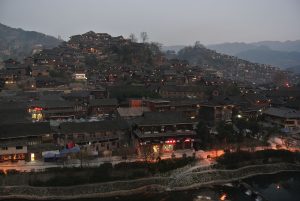
The minivan from Deqin drops you at a dusty pullout where the road hairpins down toward the Mekong. A few guesthouse owners wait beside a stack of plastic chairs, calling out room prices in Tibetan-accented Mandarin. Below, the river cuts a brown slash through cliffs dusted with pine. You shoulder your pack and follow the concrete lane past drying chilies and a pen of yak calves toward the cluster of stone houses that make up Xidang.
Getting There Without Losing a Morning
The public bus leaves Deqin’s small station at 3 p.m. sharp, rattling down the gorge for about ninety minutes. Seats fill with villagers carrying sacks of barley and the occasional trekker headed for Yubeng. Fare is a handful of yuan; have exact change ready. If you miss that window, a shared minivan parks near the Deqin taxi stand — drivers shout “Xidang” when they have four passengers. Cost splits to roughly forty yuan a head. The ride is faster but the suspension tests your spine on the switchbacks.
Coming from Feilaisi, you can hike the high trail that contours above the Mekong. It takes three to four hours depending on how often you stop for the view. The path is marked by prayer flags tied to juniper branches. Carry water; there are no shops until the village. In winter the bus runs less often, so confirm the schedule the night before at your Deqin guesthouse.
Moving Around the Village and Beyond
Xidang spreads along a single slope. Every alley ends at a terrace wall or a chicken coop. You walk. That’s it. An elderly woman may press a wrinkled apple into your palm as you pass her courtyard. A monk from Bajiu Temple might motion you toward a butter‑tea kettle steaming on a wood stove. Accept the cup, sip slowly, and hand it back with both hands.
To reach the hot springs where the Yubeng trek begins, ask your guesthouse to call a driver. A battered SUV climbs the steep dirt track in twenty minutes. Price varies with the season and how many passengers share the ride — usually a few dozen yuan per person. If you’re fit and the weather holds, you can walk the same track in about an hour, passing terraced barley fields and a shrine draped in khata scarves.
Bajiu Temple and the River Beach
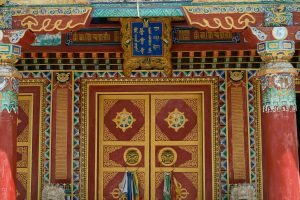
A fifteen‑minute descent from the main lane brings you to Bajiu Temple, its whitewashed walls glowing against the cliff face. Two large chortens flank the entrance, each crowned with a gilt spire. Behind them, a row of 108 smaller stupas marches down the slope like a frozen procession. Inside, the air smells of yak butter lamps and juniper incense. An old lama sweeps the flagstones; he nods but does not speak.
From the temple courtyard a narrow footpath drops through sea‑buckthorn thickets to a pebble beach on the Mekong. The current roars against boulders the size of motorbikes. In autumn the water clears to a startling teal. Locals spread picnic blankets and grill yak meat on portable grills. If you sit long enough, a golden eagle may ride the updraft above the opposite cliff. The return climb is steeper than it looks — budget thirty minutes.
The Yubeng Permit Trick
Officially, the Yubeng scenic area charges an entrance fee. The ticket booth sits at the hot‑springs trailhead. Many trekkers buy the ticket, hike up, and spend nights in Yubeng. But if your plan is only to sleep in Xidang and day‑hike the lower valleys, keep your receipt. On the way out, show the stub at the booth and ask for a refund. The staff honor it without fuss, returning the full amount. This only works if you never pass the checkpoint into the upper valley, so decide your itinerary before you hand over cash.
Where to Sleep and Eat
Half a dozen family guesthouses line the village lane. Rooms are simple: wooden bed frames, thick quilts, a shared squat toilet at the end of the corridor. Hot water comes from a solar tank on the roof — test the tap before you undress. Dinner appears on a communal table: steamed barley buns, stir‑fried wild greens with garlic, a bowl of yak‑bone broth with hand‑pulled noodles. The hostess refills your rice bowl without asking. Breakfast is butter tea and tsampa dough you knead yourself in a wooden bowl.
Bring snacks for the trail — chocolate, dried mango, electrolyte powder. The village shop stocks instant noodles, cigarettes, and batteries, but fresh fruit is rare above 2,300 meters. Cash only. No ATM within thirty kilometers.
What Trips Up First‑Timers
- Assuming the 3 p.m. bus runs every day. In low season it may run only on market days.
- Leaving the Yubeng ticket in a backpack pocket and forgetting to claim the refund before the booth closes at dusk.
- Wearing city sneakers on the cliff path to the river beach; loose shale turns ankles fast.
- Refusing butter tea outright. A polite sip keeps the conversation open; a flat refusal can seem cold.
- Expecting phone signal. One bar of 4G flickers near the temple; the rest of the village is offline.
When the sun drops behind the western ridge, the temperature plunges. Light a stick of incense at the temple’s outer altar, watch the smoke drift toward the Mekong, and listen for the first bell from Bajiu. That sound carries farther than any road.