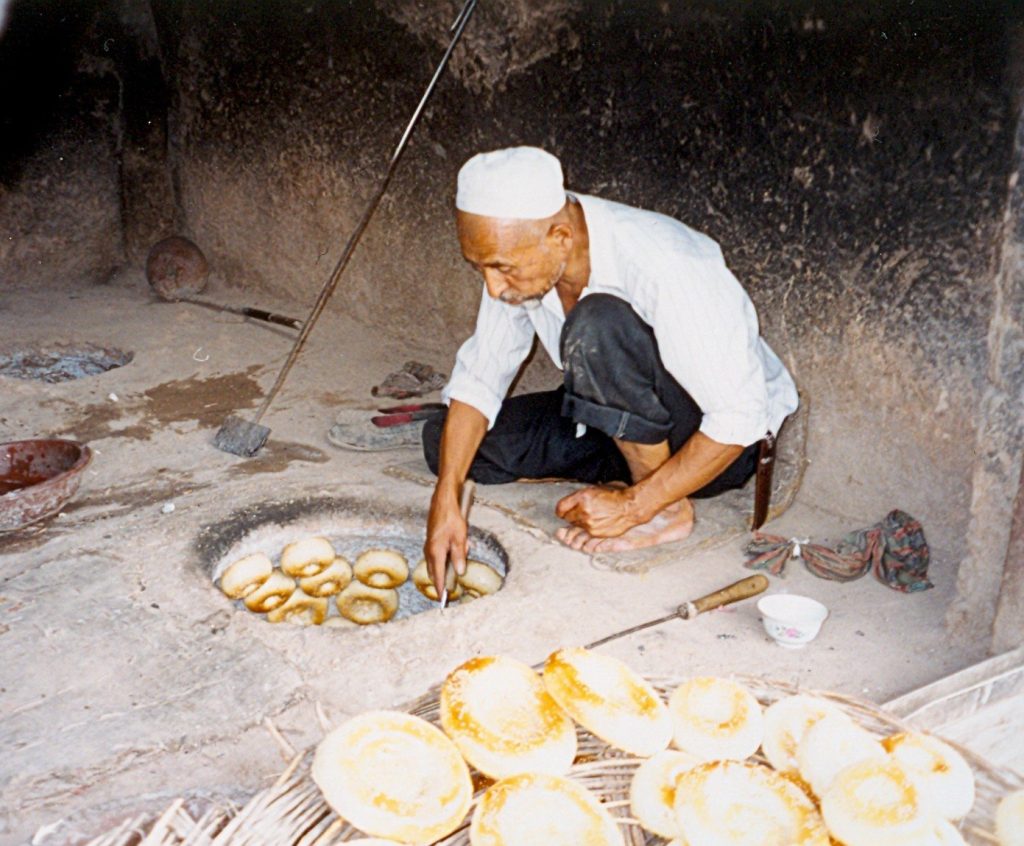
The first thing many travellers notice in a Xinjiang bazaar is the smell of bread. Round, golden flatbreads stacked on carts and shop counters, some as big as a tray, some as small as a palm, some thick with a dimple in the middle. This is nang (馕, náng), the bread that Xinjiang’s Uyghur and other communities eat every day — and the most practical food a traveller can carry across the region’s long distances.
This guide explains the main types of nang, how it is baked, how to eat it with other Xinjiang dishes, how long it keeps, where to find it beyond Xinjiang, and what to know about ingredients.
What is nang?
Nang is a leavened (or sometimes unleavened) flatbread baked on the inside wall of a clay oven. The Kashgar prefectural government’s food page describes it as a staple food of the Uyghur people and quotes a saying that one cannot go a day without nang (一日不可无馕). The same page notes that the word comes from Persian and is shared with bread traditions across Central Asia and beyond — so yes, it is related to the “naan” you may know from South Asian restaurants, though Xinjiang nang is usually drier, crisper and longer-keeping.
The basic dough is wheat flour (some types use corn flour), salt, water and a little starter. Depending on the type, bakers add onion, sesame seeds, milk, egg, vegetable oil or mutton fat. Many breads are stamped with a pattern of small holes in the centre, which keeps the middle thin and crisp while the rim puffs up.
Nang-making techniques were added to China’s national list of intangible cultural heritage in 2021, under “traditional noodle and pastry making techniques” for the Xinjiang Uygur Autonomous Region, according to the China Intangible Cultural Heritage website.
How nang is baked: the tonur oven
Nang is baked in a tonur (吐努尔, the clay oven known in Chinese as 馕坑, “nang pit”). The Kashgar government describes it as about a metre high, made of clay mixed with sheep’s wool, with a wide belly and a narrow mouth, like an upturned water jar. The baker heats the oven with wood or charcoal until the walls are very hot, then slaps the shaped dough against the inner wall, where it bakes in a matter of minutes.
Watching this is one of the great free sights of a Xinjiang market. Stand back, ask before photographing people (拍照可以吗?), and buy a bread straight from the oven if you can. Our Kashgar Old City autumn tips and first visit to Urumqi guide cover where to wander.
The main types of nang
The Kashgar government says there are more than fifty kinds. You do not need to know them all; these are the ones you are most likely to meet:
- Flat sesame and onion nang (芝麻馕 / 皮牙子馕). The everyday round bread, sprinkled with sesame and sometimes chopped onion (piyaz, 皮牙子). Crisp centre, chewy rim. The best all-rounder for first-timers.
- Large thin nang (片馕, aymak). The Kashgar government describes the biggest kind as 40–50 cm across. Great for sharing at a table.
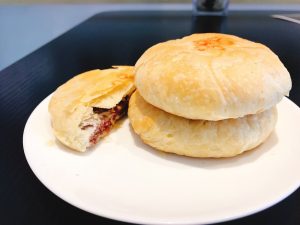
- Girde nang (窝窝馕). Small and thick — the Kashgar page gives about 5–6 cm — with a dimple in the middle. Looks like a bagel without a hole and is soft inside.
- Oil nang (油馕, toqach). Small, rich breads made with oil, milk and egg. The Kashgar page describes them as crisp, long-keeping and a classic travel and festival food.
- Meat nang (肉馕, göshnan). Dough filled or mixed with chopped mutton, onion, cumin and pepper. Eat it hot; it is a meal in itself.
- Sweet nang. Some breads are brushed with rock-sugar syrup before baking, giving a glossy, crystalline top.
Look out too for bakeries that sell tiny bite-sized nang as snacks, and modern versions topped with nuts, raisins or rose petals.
How to eat nang
Nang is eaten at almost every meal, and locals use it in several ways:
- On its own with tea. Break off a piece and dip it in milk tea or black tea; the Kashgar page notes that oil nang softens when it meets tea.
- With kebabs. A classic pairing with Xinjiang lamb skewers.
- In a stew. At the end of a plate of big plate chicken (dapanji), many restaurants will add belt noodles; others serve nang to mop up the sauce. Some menus also offer stewed nang dishes such as 馕包肉 (meat stew poured over nang).
- With noodles and rice. It sits on the table alongside laghman and polo.
- On the road. A stack of nang, dried fruit and nuts is the standard picnic on long drives and train rides.
Table manners: tear nang with your hands rather than cutting it, and place it right side up. In Uyghur homes bread is treated with respect, so avoid dropping it or throwing leftovers in the bin in front of your host. If you are given nang as a guest, accept it with thanks.
How long does nang keep?
Because it is baked hot and contains little moisture, nang keeps well in Xinjiang’s dry climate. The Kashgar government says ordinary nang can be stored for ten days to half a month, and oil nang for about a month. In more humid parts of China it will go stale or mouldy faster, so check it before eating.
Tips:
- Revive stale nang by sprinkling it with a little water and warming it in an oven, a dry pan or an air fryer.
- Keep it dry in a paper or cloth bag rather than sealed plastic in warm weather.
- Freeze it if you bring a stack home; reheat from frozen.
If you plan to fly home with nang, check your destination’s rules on bringing food, especially meat-filled breads.
Where to buy nang
- In Xinjiang: bakeries with a tonur by the door, bazaars such as the area around Urumqi’s Erdaoqiao, and food streets in Kashgar and Turpan. Our Turpan oasis guide has a day plan.
- Elsewhere in China: many Xinjiang restaurants in Beijing, Shanghai, Guangzhou and other big cities sell nang by the piece, and some cities have standalone nang bakeries. Look for 新疆馕 or 烤馕 on shop signs and food-delivery apps.
- Packaged nang: supermarkets and online shops sell vacuum-packed nang. It is convenient, but fresh bread from the oven is far better.
Prices vary with size and type; check the shop’s board or ask 多少钱一个?(How much each?).
Useful phrases
- 一个馕 — one nang
- 刚出炉的 — fresh out of the oven
- 芝麻馕 / 肉馕 / 油馕 — sesame / meat / oil nang
- 切开 — cut it for me (for large nang)
- 帮我装袋 — put it in a bag, please
Dietary notes
- Halal: nang sold by Uyghur and Hui bakeries is halal and is a reliable option for Muslim travellers. Our halal food guide covers more dishes.
- Vegetarian: plain sesame or onion nang is usually vegetarian, but some breads use mutton fat (羊油). Ask 有没有羊油?(“Is there mutton fat in it?”).
- Vegan: some types contain milk or egg; ask.
- Gluten: nang is a wheat bread. Not suitable for coeliacs.
- Sesame: many nang are topped with sesame seeds — avoid if allergic.
- Teeth: older nang can be very hard. Soak it in tea or soup.
Autumn in Xinjiang
Late October is a good time for nang: cooler days, harvest-season dried fruit and nuts in the bazaars, and hot bread straight from the oven on chilly mornings. Days can be short and cold in northern Xinjiang by November, so check weather and road conditions before long drives.
FAQs
Is nang the same as Indian naan? They share a name and the clay-oven method, but Xinjiang nang is usually drier, crisper and made to keep for days.
What is the best nang for first-timers? A round sesame-and-onion nang, fresh from the oven.
Is nang halal? Nang from Uyghur and Hui bakeries is halal.
How long does nang last? In Xinjiang’s dry climate, ordinary nang keeps for days to about two weeks, and oil nang longer, according to the Kashgar government. In humid places, eat it sooner.
Can I find nang outside Xinjiang? Yes. Xinjiang restaurants and nang bakeries in most big Chinese cities sell it.
How do I soften hard nang? Dip it in tea or soup, or sprinkle with water and reheat.
Before you go
Save 一个刚出炉的芝麻馕 on your phone, follow the smell to the nearest tonur, and buy one hot. Then buy a few more for the road. Nang is the most portable taste of Xinjiang you will find.
Lovely China was founded in 2025 to publish practical English guides for travellers and expats in China. Questions or a broken link? Email [email protected].
Cover photo: Doron / Wikimedia Commons (CC BY-SA 3.0).