Most Shaanxi noodles are about size: wide belts of biangbiang noodles, big bowls of oil-splashed noodles. Qishan saozi noodles (岐山臊子面, Qíshān sàozi miàn) go the other way. They come in small bowls holding just a mouthful of thin noodles in a glossy, red, sour-and-spicy broth, topped with diced pork and bright little vegetables — and you are expected to eat several bowls in a row.
The dish comes from Qishan County in Baoji, western Shaanxi, west of Xi’an. It is one of Shaanxi’s most loved noodle dishes and is easy to find in Xi’an. This guide explains what saozi noodles are, the famous “nine-character” standard, how to order and eat them, where to try them, and what to check if you have dietary restrictions.
What are saozi noodles?
Saozi (臊子) means a topping of finely diced, slow-cooked pork. In Qishan, the pork is cooked with spices and plenty of vinegar and chili until it is glossy and fragrant. Xinhua’s Daily Telegraph, in an August 2024 feature on Qishan, describes the saozi pork as the heart of the dish — get it right and the bowl is “seventy or eighty percent” done — and says it is prepared with techniques of stir-frying, simmering and stewing, with cinnamon, star anise and chili among the seasonings.
The bowl is built in layers:
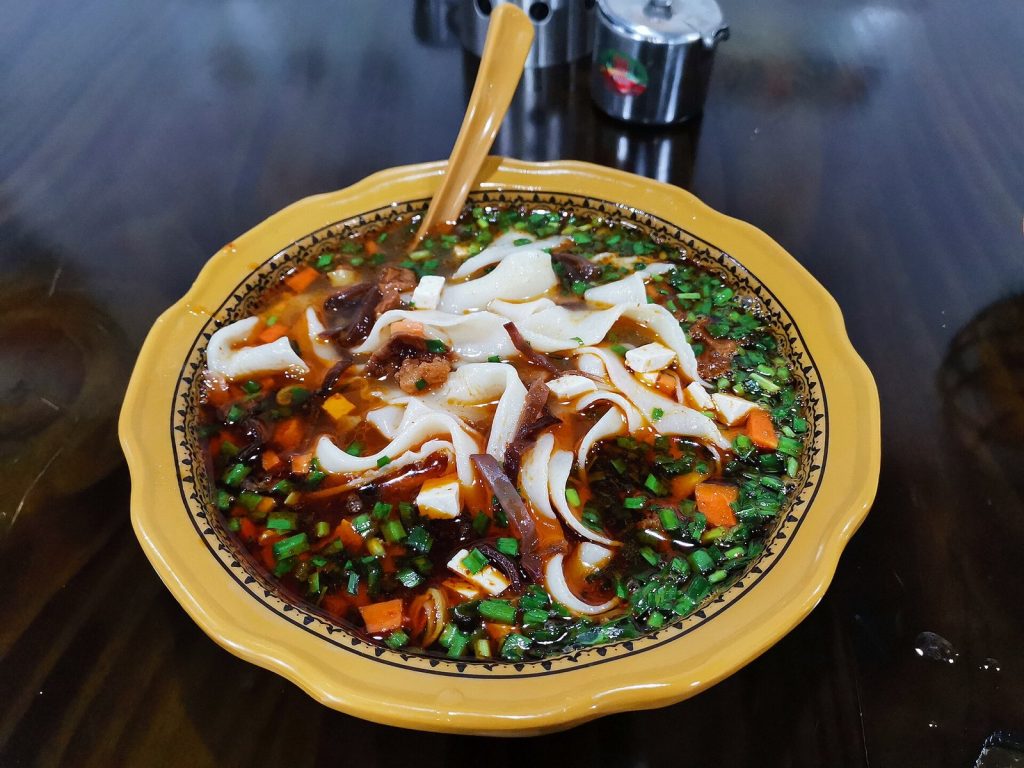
- Hand-made wheat noodles, rolled and cut, cooked briefly — classically thin, though you will also see wider noodles (the cover photo shows a wide-noodle bowl)
- A hot, sour, spicy broth, red with chili oil and sharp with vinegar
- The saozi pork
- Colourful garnishes, commonly egg pancake strips, wood-ear mushroom, carrot, tofu and green garlic shoots or chives — the exact mix varies by cook
The colours are part of the appeal: red oil, yellow egg, black wood ear, white tofu and green shoots.
The nine-character standard
Ask anyone from Qishan what makes a good bowl and you will hear nine characters. The Qishan County government lists them as 薄、筋、光、煎、稀、汪、酸、辣、香, and Xinhua explains them in three groups:
- Noodles — 薄 筋 光 (báo, jīn, guāng): thin, springy and smooth.
- Broth — 煎 稀 汪 (jiān, xī, wāng): piping hot; only a few noodles in plenty of broth; and a rich broth glistening with oil.
- Taste — 酸 辣 香 (suān, là, xiāng): sour, spicy and fragrant.
Noodle width has its own meaning, too. A Qishan villager quoted by Xinhua explained that thin noodles stand for a life that flows on steadily, while wide noodles remind you to stay broad-minded when times are hard.
If your bowl hits those notes — scalding broth, a sharp vinegar edge, a slow chili warmth and a clean noodle bite — you are eating the real thing.
“One mouthful” bowls
Saozi noodles are also called 一口香 (yì kǒu xiāng), “one fragrant mouthful”. According to a Qishan culture and tourism official quoted by Xinhua, each bowl holds only about one mouthful of noodles, which keeps the broth tasting fresh and the noodles springy. Locals “slurp” saozi noodles rather than eat them, she said, and a restaurant portion is now often six small bowls.
Don’t be surprised when a tray of little bowls arrives, or when the server keeps topping you up. Pace yourself, and say 够了 (gòu le, “that’s enough”) when you are full.
Traditions behind the bowl
Saozi noodles are woven into Qishan’s local rituals:
- Pouring the soup (泼汤礼). Xinhua describes how on the first day of the lunar new year, families make saozi noodles and the first bowl is carried outside and its broth poured out as an offering, with the custom repeated at weddings, funerals and other family occasions.
- Noodles only, not the soup. One legend recorded by Xinhua tells of cooks feeding a victorious Zhou army by serving the noodles and returning the broth to the pot, round after round. In the traditional Qishan way, diners eat the noodles while the broth goes back to the pot to be reheated and ladled over the next bowl — a practice known as 回汤 (huí tāng, “returning the soup”). In restaurants practices vary; drink yours if you like it.
- The “sister-in-law” name. The Qishan county annals, also cited by Xinhua, record a story that the dish was first called 嫂子面 (“sister-in-law noodles”) after a skilled young bride, and that the name later shifted to 臊子面. Both stories are legends; enjoy them as such.
Qishan saozi noodle-making is on Shaanxi’s provincial list of intangible cultural heritage, according to the county government.
How to order
In Xi’an and Baoji, saozi noodle shops are usually simple: order at the counter or scan a QR code, then wait for your tray. Useful phrases:
- 一份臊子面 — one portion of saozi noodles
- 汤面 / 干面 — soup version / dry, mixed version (many shops offer both)
- 少辣 / 不要辣 — less chili / no chili
- 少醋 — less vinegar
- 加面 — more noodles
- 再来一碗 — one more bowl
- 够了 — that’s enough
Prices and portion sizes vary by shop; check the menu board. Pay with Alipay or WeChat Pay.
What it tastes like
The first sip is hot and sharply sour, then the chili warms the back of your throat. The pork is rich and slightly chewy, the vegetables add crunch, and the thin noodles slide down quickly. It is spicier than it looks but rarely as numbing as Sichuan food; the vinegar is the dominant note. If you love Chinese sour flavours, this is one of the best bowls in the country. If vinegar is not your thing, ask for 少醋 and try the dry version.
Where to eat saozi noodles
- Qishan County itself. The source. Qishan has a station on the Xi’an–Baoji high-speed line; check 12306 or your booking app for times. Combine a bowl with the Duke of Zhou Temple (周公庙) or the Zhuge Liang Temple at Wuzhangyuan (五丈原诸葛亮庙), both in Qishan County. Our Baoji first-timer guide covers the wider area.
- Xi’an. Saozi noodle restaurants are common across the city, from neighbourhood shops to mall chains. Xinhua mentions a Qishan-based company’s “Lai Liu Wan” (来六碗, “bring six bowls”) brand with outlets in several Xi’an malls. Branches change, so search 岐山臊子面 on a map app and choose a busy place with good reviews.
- Elsewhere in China. Many Shaanxi restaurants in other cities list 臊子面 on the menu, though quality varies.
If you are in Xi’an in late October or November, a bowl of hot, sour noodles is a perfect warm-up after an autumn bike ride on the city wall or before visiting the Guanyin Zen Temple ginkgo when it turns gold.
How it compares with other Shaanxi noodles
- **Biangbiang noodles:** very wide hand-pulled belts, usually dry, with chili oil.
- **Oil-splashed noodles (youpo mian):** wide noodles with hot oil poured over chili and garlic.
- **Liangpi:** cold, slippery “skin” noodles in a sour, spicy dressing.
- Saozi noodles: thin noodles in tiny bowls of hot, sour, spicy broth with diced pork.
Doing a full Shaanxi noodle crawl? Add a roujiamo between bowls.
Dietary notes
- Pork: the classic saozi is pork, often with pork fat. Muslim travellers should look for halal versions — Xi’an’s Hui restaurants sometimes serve beef or mutton saozi noodles; ask 是清真的吗?(“Is it halal?”). See our halal food guide.
- Vegetarian: some shops offer a vegetable version (素臊子面), but the broth may still be meat-based. Ask.
- Gluten: the noodles are wheat. Not suitable for coeliacs.
- Spice and acidity: both are adjustable on request. People with sensitive stomachs should ask for less vinegar and chili.
- Egg: egg pancake strips are a common topping; ask 不要鸡蛋 if needed.
Common first-timer mistakes
- Thinking one small bowl is the whole meal.
- Drinking every drop of very hot broth too fast.
- Ordering the soup version when you dislike vinegar — try the dry version first.
- Expecting giant Xi’an-style biangbiang belts — even the “wide” saozi noodles are modest.
- Not saying 够了 when you are done, and receiving yet another bowl.
FAQs
What does saozi mean? Finely diced, slow-cooked pork used as a topping.
Why are the bowls so small? Saozi noodles are traditionally served as “one mouthful” bowls so the broth stays hot and the noodles springy; restaurants often serve about six.
Are Qishan saozi noodles spicy? Moderately, with a strong sour vinegar flavour. Ask for 少辣 for less chili.
Do I drink the broth? In the traditional Qishan way, people eat the noodles and the broth goes back to the pot; in restaurants, it is your choice.
Is there a halal version? Some Hui restaurants in Xi’an make beef or mutton versions. Ask before ordering.
Where is Qishan? A county in Baoji, western Shaanxi, reachable by high-speed rail from Xi’an.
Before you go
Save 一份臊子面 and 够了 on your phone, find a busy saozi noodle shop, and settle in for several small bowls. Sour, hot, spicy and quick, Qishan saozi noodles are Shaanxi in a mouthful.
Lovely China was founded in 2025 to publish practical English guides for travellers and expats in China. Questions or a broken link? Email [email protected].
Cover photo: Walter Grassroot / Wikimedia Commons (CC BY-SA 4.0).