Standing in front of a giant refrigerated wall filled with hundreds of colorful skewers, leafy greens, mushrooms, and mystery dumplings can be an intimidating initiation for any newcomer to China’s culinary scene. Welcome to Mala Tang (麻辣烫)—one of China’s most beloved street-food-turned-restaurant phenomena.
If you have ever stared blankly at a row of tongs and stainless steel bowls wondering what comes next, you are not alone. This guide breaks down everything a first-timer needs to know about choosing ingredients, understanding the difference between soup and dry pot, navigating heat levels, and paying like a pro.
—
What is Mala Tang?
Mala translates to “numbing and spicy” (derived from Sichuan peppercorns (huajiao) and dried chili peppers), while tang means soup or broth. Essentially, mala tang is a customizable, pick-your-own-adventure hot pot.
Unlike traditional hot pot where you sit around a large boiling table cooking dishes raw yourself, mala tang is a streamlined individual or collective experience:
1. You select raw ingredients yourself from a chilled display case.
2. You hand your basket or tray over to the kitchen.
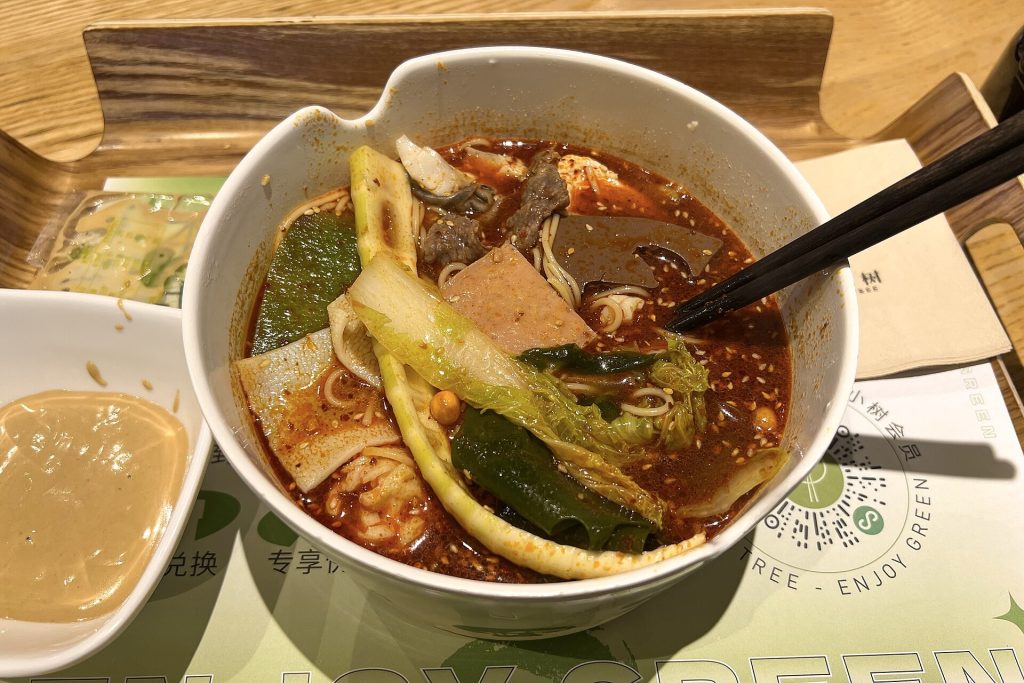
3. They blanch everything together in a boiling, deeply flavorful broth, ladle it into a bowl with your choice of soup base or seasoning, and hand it back to you ready to eat.
As autumn deepens into late October and November, there is arguably nothing more comforting than holding a steaming, spicy bowl of mala tang to fend off the chill.
—
Step-by-Step: How to Order Mala Tang
Navigating a mala tang shop for the first time is easy once you know the routine:
1. Grab Your Tools
As soon as you walk in, look for a stack of plastic baskets and a pair of tongs. Sometimes you’ll see separate bowls for skewers versus loose items, but a single large basket usually does the trick.
2. Raid the Refrigerated Display Cases
This is where the fun begins. The walls are lined with glass-door coolers packed with rows upon rows of ingredients. Generally, items fall into a few categories:
* Skewers: Meats (sliced beef, lamb, chicken wings), meatballs, shrimp paste, quail eggs, and sausage slices threaded onto bamboo sticks.
* Leafy Greens & Veggies: Bok choy, spinach, lotus root slices, bamboo shoots, potato slices, kelp knots, and bean sprouts.
* Mushrooms: Enoki, king oyster, shiitake, and wood ear mushrooms.
Carbs & Soy Products: Instant ramen noodles, rice noodles (mifen), sweet potato glass noodles (fensi*), frozen tofu, fried bean curd skin, and various stuffed fish balls or taro cakes.
Pro-Tip for Beginners: Don’t go too heavy on heavy items like dense root vegetables or water-logged mushrooms if your shop charges by weight, as you’ll end up paying a hefty price for water weight!
3. Choose Your Pricing Style
Mala tang shops generally use one of two pricing models:
By Weight (Most Common): You toss everything (skewers and loose items alike) into one basket. The staff weighs it on a digital scale at the counter. Sometimes, skewer sticks are counted individually at a flat rate per stick while loose ingredients are weighed by the gram or half-kilo (jin*).
* Fixed Price per Skewer: Every skewer costs the same flat rate, and larger items have color-coded tags indicating their price.
4. Pick Your Broth and Heat Level
Once your basket is weighed, you reach the checkout counter where you tell the cashier your cooking preference:
The Broth: Traditional mala tang comes in a spicy, fiery red broth packed with chili oil and Sichuan pepper. However, many modern chains (like Zhang Liang or Yang Guofu Mala Tang) also offer creamy bone broth (gutang*), tomato soup base, or a mushroom broth if you want a break from the heat.
The Heat & Numbness Level: You will usually be asked how spicy you want it. Options range from wei la (微辣 – mild), zhong la (中辣 – medium), to tuan la* (特辣 – extreme). If you are sensitive to spice—or if you want to fully appreciate the unique flavor profile without burning your tastebuds off—start with mild or clear bone broth with a side of chili oil.
To truly understand why your lips and tongue start vibrating, read up on the science behind the Sichuan Peppercorn (Huajiao) Explained: Why Your Mouth Goes Numb.
5. Add Your Sauces (DIY Station)
After paying, you will often find a self-serve condiment bar. This is where you customize your dipping sauce or soup booster. Common additions include:
Sesame paste (mayijiang*) – crucial for cutting through the spice and adding a rich, nutty depth.
* Minced garlic and chopped scallions.
* Cilantro, crushed peanuts, and chili oil.
A splash of Chinese black vinegar (cucu*) to add brightness.
—
Mala Tang vs. Mala Xiangguo: What’s the Difference?
Travelers often confuse mala tang with its dry counterpart, Mala Xiangguo. While both share the exact same concept of picking your own raw ingredients from a refrigerated wall, the execution is entirely different:
* Mala Tang (Spicy Soup): Ingredients are boiled in a rich, soup-heavy broth. It’s lighter, soupier, and feels more like an immersive noodle soup experience.
* Mala Xiangguo (Spicy Dry Pot): Ingredients are flash-fried in a wok with an intense, heavy paste of chili peppers, Sichuan peppercorns, garlic, ginger, and savory spices—no soup broth involved. It is intensely flavorful, oilier, and served dry.
If you want to try the stir-fried version next, check out our guide on Mala Xiangguo (Spicy Dry Pot) for First-Timers.
—
Essential First-Timer Ordering Tips
1. Don’t Overload on Noodles Early: Noodles absorb liquid rapidly. If you put too many instant noodles or glass noodles in your basket, they will soak up all the soup and swell up by the time you sit down to eat.
2. Watch the Skewers: If you are paying by the stick, keep count of how many you grab so there are no surprises at the register. Also, remember to remove the bamboo sticks before digging into your bowl (or place them in the designated cup on the table).
3. Have Your Digital Wallet Ready: Most modern mala tang shops operate entirely via cashless mobile payments. Before you head out, make sure your digital setup is sorted by reviewing Alipay and WeChat Pay for Foreign Visitors in China 2026.
4. Find Your Way Easily: Craving a bowl right now? Use navigation apps to track down the highest-rated spots near you by following the How to Use Amap (Gaode Maps) in China as a Foreigner: 2026 English Guide.
5. Stay Connected: To look up menu items or translate tricky ingredient labels in real-time, ensure you have stable mobile data by reading up on China SIM and eSIM for Foreign Visitors in 2026.
Mala tang is fast, infinitely customizable, and a staple of everyday Chinese dining. Dive in, mix your sesame sauce, and embrace the tingle!
FAQ
Is this guide current for late 2026?
It reflects commonly reported practice as of October 2026. Always re-check official sources before you travel, because rules, ticket platforms and seasons change.
Where can I verify details?
Use the official website, WeChat account or ticket platform named for this topic. For payments and maps, see Lovely China’s practical visitor guides linked above.
What if my situation is unusual?
Ask your hotel, airline, park ticket office or embassy/consulate for case-specific advice rather than relying only on a blog post.