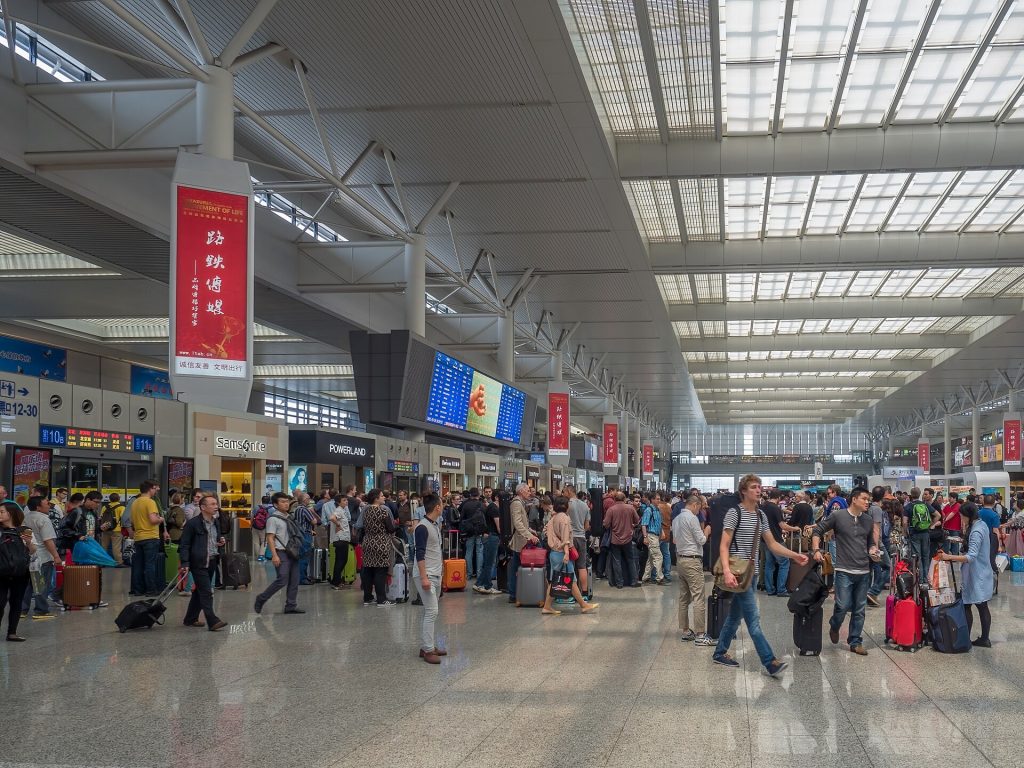
Shanghai Hongqiao Railway Station is one of Asia’s largest high-speed rail hubs, but its sheer scale can easily overwhelm arriving expats and international travellers. Connected directly to Hongqiao International Airport and multiple metro lines, this massive complex requires a solid game plan. If you are travelling through eastern China in November or December 2026, navigating this indoor labyrinth while hauling winter luggage adds another layer of complexity. Here is exactly how to manage security checks, passport gates, and departure halls without getting lost.
The Hongqiao Hub: Railway vs. Airport Confusion
The most common mistake foreign travellers make is confusing the railway station with Shanghai Hongqiao International Airport. They are located in the exact same mega-complex (the Hongqiao Comprehensive Transportation Hub), but they are distinctly separate buildings connected by a long underground corridor.
When you tell a taxi driver “Hongqiao,” you must specify “Hongqiao Railway Station” (Hongqiao Huochezhan). If you are dropped off at Airport Terminal 2 by mistake, you will have to walk 15 to 20 minutes through the connecting tunnels to reach the train departure hall. While walking indoors is comfortable enough during the colder November and December months, it burns valuable time if your high-speed rail departure is imminent. Always follow the clear, bilingual overhead signs pointing toward “Railway Station” and ignore signs pointing to “Terminal 2” unless you are catching a flight. If you are actually trying to connect between the city’s two major airports, review our Hongqiao vs Pudong transfer guide instead.
Arriving via Metro and Navigating the Levels
Shanghai Metro Lines 2, 10, and 17 all serve the Hongqiao Railway Station stop.
When you exit the metro, you will be on the B1 Arrivals Level. This level is strictly for arriving train passengers and metro transfers. You cannot board a high-speed train from B1. To catch your departing train, you must head up to the F2 Departure Hall. Look for the massive escalators leading upward from the metro exit.
B1 Level: Metro access, arriving train exits, taxi ranks, and the pedestrian corridor to Airport T2.
F1 Level: Train platforms (you will only go here when your train begins boarding).
F2 Level: The main Departure Hall, waiting areas, security checks, and ticket boarding gates.
F3 Level: Commercial dining area overlooking the main departure hall.
For more general tips on getting around the city’s metro network on your first trip, check our Shanghai first-visit guide.
Security and Passport Verification for Foreigners
Unlike many Western countries, China requires all passengers to pass through security and ID verification before entering the main railway departure hall.
Initial Security Check: As you enter the F2 Departure Hall, you must put all luggage, coats, and bags through an X-ray scanner. You will also be scanned with a metal detector. Flammable items, large aerosols, and certain tools are strictly prohibited.
ID Verification at the Entrance: Following security, you must verify your identity. Chinese citizens swipe their ID cards at automated turnstiles. Foreigners travelling on passports should look for the “Manual Lane” (人工通道) or “Staffed Counter,” usually located at the far left or right of the gate array. Hand your physical passport to the railway staff member, who will scan it to verify your ticket purchase on the China Railway 12306 system.
Note: Some newer automated gates at Hongqiao can read the biometric chip in foreign passports, but this technology is not yet uniform across all lanes. Always default to the manual staff lane if an automated gate rejects your passport. For a deep dive into how ticketing software reads your ID, read our guide to 12306 e-ticket gates.
Finding Your Departure Gate and Boarding
Once inside the cavernous F2 Departure Hall, locate the massive digital screens to find your train number (e.g., G123). The screen will display your departure time, destination, and your specific boarding gate.
Gates are numbered (e.g., Gate 14) and split into “A” and “B” sections (e.g., 14A and 14B) directly across the hall from one another. Both A and B lead to the exact same platform and the exact same train. However, “A” gates usually align with the front half of the train cars, while “B” gates align with the rear half. Check your 12306 app booking to see which carriage number you are in, and line up at the corresponding A or B gate to minimize how far you have to walk on the platform.
Boarding typically begins 15 to 20 minutes before departure and gates close strictly 3 to 5 minutes before the train leaves. When boarding begins, foreigners must again use the manual passport lane (or passport-compatible e-gate) to access the escalators down to the F1 platform.
Food, Amenities, and Winter Travel Prep
If you arrive early, the F3 mezzanine level offers dozens of dining options, ranging from Western fast food (McDonald’s, KFC, Starbucks) to Chinese noodle shops and convenience stores.
Since late-year travel in Shanghai can be chilly, take advantage of the free hot water dispensers located near the bathrooms on the F2 level. Many expats bring a thermos to fill up for the train ride, which is a staple of local travel culture and a great way to stay warm on travel days.
FAQ
How early should I arrive at Hongqiao Railway Station?
We recommend arriving at the station 60 to 90 minutes before your departure time. This provides enough buffer for metro navigation, security lines, and finding your gate in the massive hall. If you are travelling during a major Chinese public holiday, increase this to two hours. Always verify your train status via the official 12306 app or website near your travel week, as schedules can adjust slightly.
Do I need to print a paper ticket?
Related Lovely China reading
For payments, start with Alipay and WeChat Pay hub and WeChat Pay vs Alipay for tourists. For trains, keep high-speed rail first-timers guide and 12306 passport signup for foreigners handy. City hubs: Beijing first-visit guide, Shanghai first-visit guide. Connectivity: roaming vs local SIM honest guide, pocket Wi-Fi vs eSIM for China, offline maps for foreigners. Bookmark China travel tools page.
Practical checklist
- Confirm official rules on the relevant government, park, airline, or bank page near your travel week
- Screenshot bookings, tickets, and QR codes while you still have stable Wi-Fi
- Save hotel and attraction names in Chinese characters in your phone notes
- Carry passport, a backup payment method, and a small cash float (why cash is still needed)
- Test one small mobile payment before you rely on wallets at a gate or taxi
- Keep the China travel tools page page bookmarked for related Lovely China hubs
FAQ
Is this travel advice official?
No. Lovely China orients travellers. Verify live rules on official pages, apps, and counters near your travel week.
Will every city behave the same?
No. Airports, stations, parks, and markets differ. Use local signage and staff instructions when they conflict with a general guide.
What should I screenshot before I lose Wi-Fi?
Bookings, tickets, hotel Chinese address, pickup pins, and payment success screens.
Notes for late 2026 travellers
November and early December bring cooler mornings, earlier sunsets, and comfortable walking weather across much of eastern and central China. Pack layers and leave extra time on clear weekends at popular sights.
This article does not invent ticket prices, opening hours, processing times, consular fees, or official statistics. When a number matters, verify it on the official site, app screen, or ticket board near your travel week.
If an official rule page disagrees with this guide, follow the official page. Lovely China orients English-speaking travellers; we are not an immigration, banking, or medical authority.