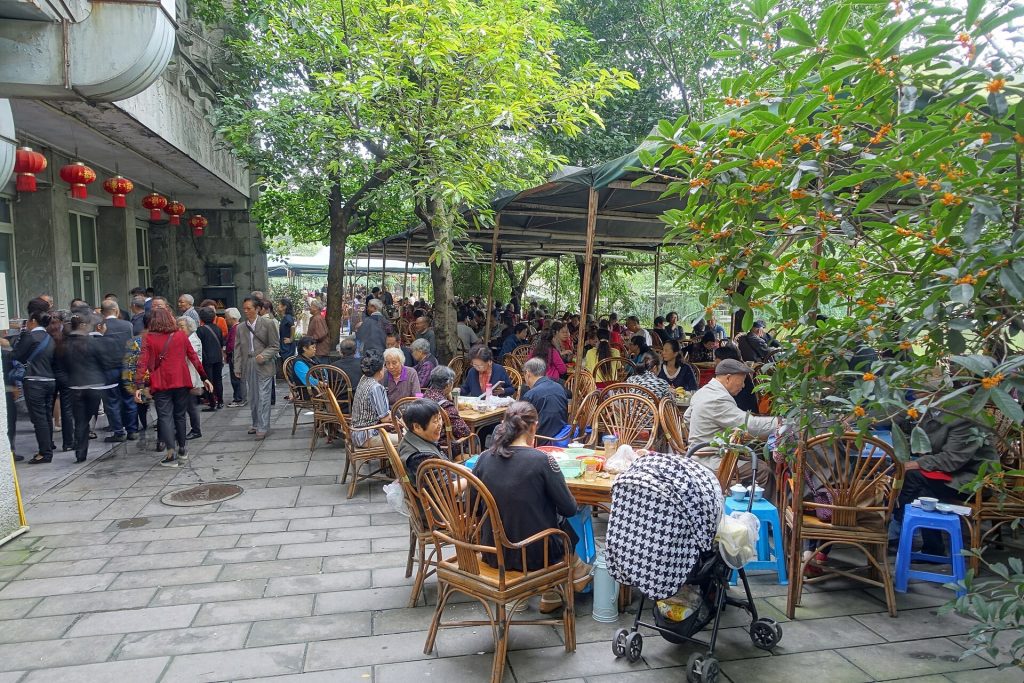
A Chinese teahouse can be a neighborhood living room, a covered-bowl Chengdu-style hall, or a quieter room where a server tends a gaiwan at your table. The shared idea is unhurried time, not a quick caffeine transaction. This is a manners and how-to piece: how to sit, order, top up water, and share space without treating the room as a stage. It is not the November Chengdu teahouse story (November Chengdu teahouse story), and it is not a dinner-toast or ganbei article. We will not invent cover charges or a single sacred ritual that every house follows.
Chopstick and queue habits that travel well are in chopsticks etiquette for foreigners and queue etiquette for foreigners. Tipping expectations are in tipping in China for foreigners. Temple incense and photo care, which sometimes sit next door to a teahouse visit, are in temple incense etiquette and temple photo etiquette.
Choose a seat the way the room is already using it
At the door, wait to be shown a place if someone is greeting guests. In a casual hall with long bamboo chairs or shared tables, you may be waved to an open stretch of bench. Put a bag under the table or at your feet, not on a seat that would hold another person during a busy hour. In a house with private rooms, do not wander into a closed room to photograph it.
Shared long tables are normal in some cities, especially in the Chengdu-style covered-bowl tradition. You are sharing air and a surface, not making new best friends by default. A nod is enough. Keep your belongings inside your own rectangle.
If you only wanted a takeaway cup, say so early. Many teahouses are sit-in places with a different logic from a coffee counter.
Ordering tea without performing a ceremony you were not taught
Menus may list teas by name, grade, or region, and they may be only in Chinese. Pointing, a translation photo, or a simple “jasmine,” “longjing,” “pu’er,” or “whatever is popular and not too strong” all work. You do not need a specialist vocabulary to sit down honestly. If a server suggests a pot or a covered bowl for one or two people, that is usually the unit—not a flight of six ritual pours unless you asked for a formal tasting.
Gaiwan or covered-bowl service is common: a bowl with a lid, sometimes a saucer, and a repeating pour of hot water. In some halls, a server with a long-spout kettle will refill you from a distance that looks dramatic and is, for them, ordinary skill. Sit still, keep fingers out of the path, and say thank you. You do not need to applaud.
We do not invent a fixed price, a mandatory cover, or a “two-hour rule” that applies to every house. Look at the menu or the chalkboard. Some places charge for tea and let you sit; some expect you to order snacks; some have a time or minimum that they will tell you. Ask if the bill is unclear rather than assuming a trick.
Snacks—seeds, sweets, a simple savory plate—are optional unless the house has a set. Share plates if you are two or more; do not build a picnic from outside food unless you can see that others do and staff do not mind.
Water, lids, and the pace of the table
When the cup or bowl runs low, you can often ask for water, lift a lid in a way the server already understands as a signal, or wait for the kettle to come around. Watch one cycle before inventing a gesture. Leave the lid in a stable place; a wet lid face-down on a wood table may be unwelcome.
Drink at a human pace. The point of a teahouse is that you are allowed to stay. That is not a license to occupy an eight-person table for a laptop workday if the room is clearly for tea and talk. If you need to take a call, step outside. Voices stay moderate. You are in a room with other people’s afternoons.
Children are welcome in many neighborhood houses if they can sit without turning the aisle into a playground. If the room is quiet and formal, choose a more casual hall for a lively family rest.
Photographs, other guests, and paying
A photograph of your own bowl, the wooden table, or an empty corner of architecture is usually fine if you are brief and do not use a flash in someone’s face. Other guests are not extras. Do not lean over a stranger’s table for atmosphere, and do not film a server’s hands as a close-up job without a yes. The same care you would use in a temple courtyard applies here in softer form (temple photo etiquette).
Pay at the end unless the house collects first. A working mobile wallet is the usual tool (Alipay and WeChat Pay hub). Cash still solves the occasional small shop (when you still need cash). Tipping is not the North American default (tipping in China for foreigners, tipping etiquette). If you are splitting a bill, do it quietly and fairly; this is not the place to rebuild banquet toast culture.
Early winter is a natural time for this habit. A damp Chengdu morning, a grey Hangzhou afternoon after the lake, or a cold Beijing wind all improve with a long sit and a second refill. Arrive, take the seat you were offered, order one honest tea, let the water come, keep your voice down, and leave the table as tidy as you found it. That is enough etiquette to be a welcome guest in almost any house that was already willing to pour for you.
Related Lovely China reading
For payments, start with Alipay and WeChat Pay hub and WeChat Pay vs Alipay for tourists. For trains, keep high-speed rail first-timers guide and 12306 passport signup for foreigners handy. City hubs: Beijing first-visit guide, Shanghai first-visit guide. Connectivity: roaming vs local SIM honest guide, pocket Wi-Fi vs eSIM for China, offline maps for foreigners. Bookmark China travel tools page.
Practical checklist
- Confirm official rules on the relevant government, park, airline, or bank page near your travel week
- Screenshot bookings, tickets, and QR codes while you still have stable Wi-Fi
- Save hotel and attraction names in Chinese characters in your phone notes
- Carry passport, a backup payment method, and a small cash float (why cash is still needed)
- Test one small mobile payment before you rely on wallets at a gate or taxi
- Keep the China travel tools page page bookmarked for related Lovely China hubs
FAQ
Is there a mandatory cover charge or a fixed two-hour rule?
Not something we invent. Look at the menu or ask the house in front of you. Some places charge for tea and let you sit; some have a minimum or snack expectation they will tell you.
May I photograph other guests or a server’s hands up close?
Treat other guests as people, not scenery. A brief photo of your own bowl is usually fine. Do not lean over a stranger’s table, and do not film a server’s hands without a yes.
How do I ask for more water?
Watch one refill cycle first. You may ask, wait for the kettle, or use a lid signal the house already understands. Do not invent a dramatic gesture you have not seen in that room.
Notes for late 2026 travellers
November and early December bring cooler mornings, earlier sunsets, and comfortable walking weather across much of eastern and central China. Pack layers and leave extra time on clear weekends at popular sights.
This article does not invent ticket prices, opening hours, processing times, consular fees, or official statistics. When a number matters, verify it on the official site, app screen, or ticket board near your travel week.
If an official rule page disagrees with this guide, follow the official page. Lovely China orients English-speaking travellers; we are not an immigration, banking, or medical authority.