Hong Kong West Kowloon Station is the high-speed rail terminus that ties the mainland network to Hong Kong. For visitors, the ride itself is the easy part. Tickets, passports, and the unusual immigration layout take more attention. This is a practical station-and-ticket guide, not a policy essay about mid-stay Hong Kong or Macau side trips under 30-day visa-free entry; that belongs in 30-day visa-free Hong Kong or Macau side trips. It is also not a Shenzhen land-border walk, which Shenzhen–Hong Kong border day trip covers, and not a general first-timer rail primer, which is high-speed rail first-timers guide.
You must re-check visa implications for your own status. Leaving the mainland may affect 240-hour transit or another stay. Entering Hong Kong has its own arrival rules. We will not invent eligibility, and we will not invent border wait times.
Tickets, passports, and a realistic booking path
Trains to West Kowloon run from Shenzhen North, Guangzhou South, and a list of longer-distance mainland cities that includes major hubs on some timetables. Check the live 12306 schedule for your date rather than memorising a service that used to exist. Short hops from Shenzhen or Guangzhou are frequent on many ordinary days; a late-December or New Year seat is still a seat you should book when you can see one.
Foreigners can usually buy through a 12306 account linked to the passport, as 12306 passport signup for foreigners explains, or at a ticket window with the passport, as buying a 12306 ticket at the station with a passport explains. The name on the ticket must match the booklet. If the machine will not read a foreign passport, use the window early, not two minutes before departure. pay 12306 Alipay vs foreign card matters if a foreign card fails in the app.
Bring the same passport you used to buy the ticket. An e-ticket on your phone is useful; so is a screenshot. Platform and carriage habits are the same as elsewhere on the network (find platform carriage and seat on HSR). Luggage limits still apply (high-speed rail luggage limits).
Station flow: mainland port and West Kowloon
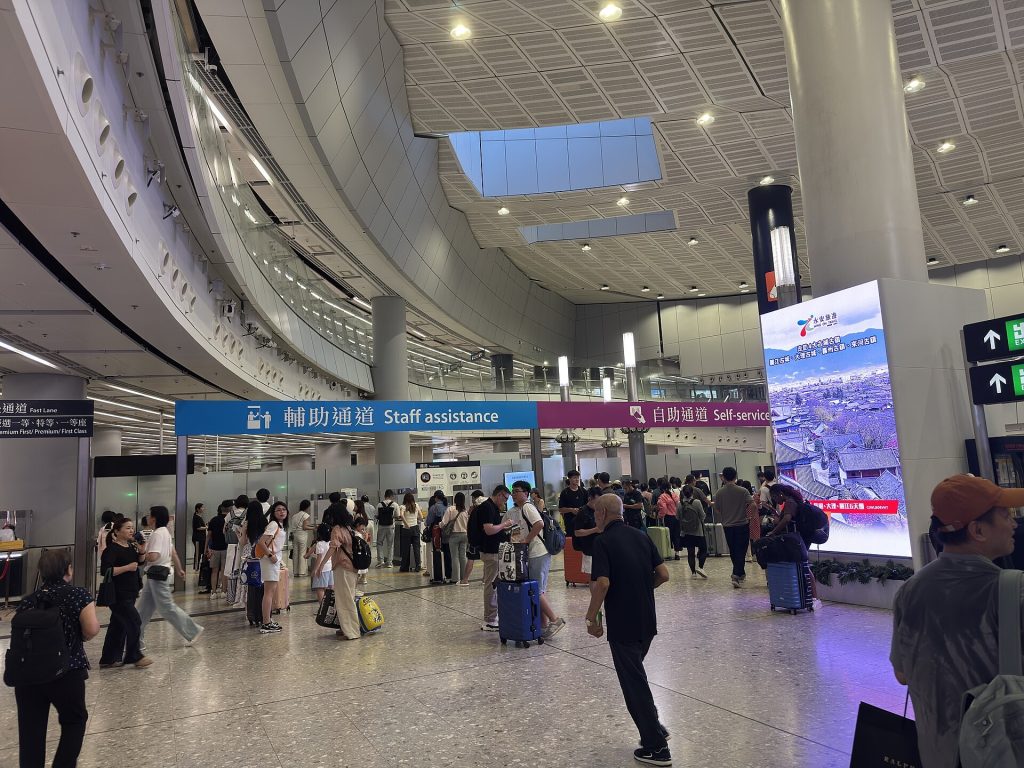
West Kowloon uses a co-location arrangement. Part of the station is a Mainland Port Area, where mainland exit or entry formalities are handled, and part is a Hong Kong Port Area, where Hong Kong immigration is handled. Follow the signs for your direction rather than a memorised blog diagram, because temporary fences and queue markings change.
In broad terms, passengers arriving from the mainland get off at West Kowloon and then complete mainland exit formalities in the Mainland Port Area before going through Hong Kong arrival immigration. Passengers leaving Hong Kong for the mainland usually complete Hong Kong departure formalities, then mainland entry formalities in the Mainland Port Area, and then board the train; on arrival at a mainland station they typically leave as passengers who have already entered. That is a description of the usual flow, not a promise about every special service or every temporary arrangement. If a sign or an officer tells you to join a different line, join that line.
Do not invent how long each queue will take on a Friday in late December 2026. Build a buffer. A short Shenzhen hop can still become a tight connection if you linger on the platform and then meet a busy immigration hall.
Keep children and luggage together in the same queue. Have arrival cards or e-forms completed if Hong Kong or the mainland asks for them on your date; we will not invent the current form name. Officers may ask about your onward plans and your permission to have been in the mainland. Answer with the tickets and status you actually have.
Visa questions you must re-check yourself
If you are in the mainland on 240-hour visa-free transit, leaving for Hong Kong may end or interrupt that stay. Do not assume you can ride to West Kowloon “for the afternoon” and return on the same transit facility. Official language is on nia.gov.cn, and it is yours to re-read. If you are on 30-day visa-free entry and considering a mid-stay side trip, use 30-day visa-free Hong Kong or Macau side trips rather than this station guide.
Hong Kong entry is a separate permission. Many visitors enter Hong Kong visa-free; many others need a visa or another document. Your nationality, not your mainland hotel booking, decides that. Check the official Hong Kong immigration pages, not a screenshot from a friend.
Returning to the mainland later is a third question: you will need a facility that allows that later arrival. Plan the whole loop before you buy the rail ticket, not after you have already exited.
A simple travel-day order
1. Confirm train, ticket, and passport the night before, and re-read both sides’ official entry language if your status is not obvious.
2. Arrive at the departure station with a real buffer, not a transfer timed to the minute.
3. Follow signs through security, ticket checks, and, in the relevant direction, the mainland and Hong Kong immigration halls.
4. Keep onward tickets and hotel names available if an officer asks.
5. On arrival, do not leave the station until you have completed the immigration steps the signs describe.
Late December and New Year week can be busy at both ends of this line. That is a reason for earlier trains and calmer connections, not a number we will invent. Lovely China orients travellers; immigration officers decide admission. If an official page disagrees with this guide, follow the official page.
Related Lovely China reading
For payments, start with Alipay and WeChat Pay hub and WeChat Pay vs Alipay for tourists. For trains, keep high-speed rail first-timers guide and 12306 passport signup for foreigners handy. City hubs: Beijing first-visit guide, Shanghai first-visit guide. Connectivity: roaming vs local SIM honest guide, pocket Wi-Fi vs eSIM for China, offline maps for foreigners. Bookmark China travel tools page.
Practical checklist
- Confirm official rules on the relevant government, park, airline, or bank page near your travel week
- Screenshot bookings, tickets, and QR codes while you still have stable Wi-Fi
- Save hotel and attraction names in Chinese characters in your phone notes
- Carry passport, a backup payment method, and a small cash float (why cash is still needed)
- Test one small mobile payment before you rely on wallets at a gate or taxi
- Keep the China travel tools page page bookmarked for related Lovely China hubs
FAQ
Do I pass immigration on the train?
No. West Kowloon uses a co-location arrangement with a Mainland Port Area and a Hong Kong Port Area. Follow station signs for mainland exit or entry and for Hong Kong arrival or departure in your direction. We do not invent wait times.
Can I go to Hong Kong for the afternoon if I am on 240-hour transit?
Do not assume that. Leaving the mainland may end or interrupt that stay. Recheck National Immigration Administration rules for your facility, and check official Hong Kong entry rules for your nationality, before you buy the ticket.
Where do I buy the ticket as a foreigner?
Often through a 12306 account linked to your passport, or at a ticket window with the same booklet. The name must match. If a machine will not read the passport, use the window early.
Is this the same as crossing the land border in Shenzhen?
No. High-speed rail to West Kowloon is a station-to-station journey with a specific immigration layout. Land crossings at Shenzhen are a different route and a different guide.
Notes for late 2026 travellers
Late December 2026 and the New Year week into 2027 bring colder mornings, earlier sunsets, and holiday crowds in many city hubs. Pack real winter layers in the north, and leave extra time on weekends and around 1 January.
This article does not invent ticket prices, opening hours, processing times, consular fees, or official statistics. When a number matters, verify it on the official site, app screen, or ticket board near your travel week.
If an official rule page disagrees with this guide, follow the official page. Lovely China orients English-speaking travellers; we are not an immigration, banking, or medical authority.