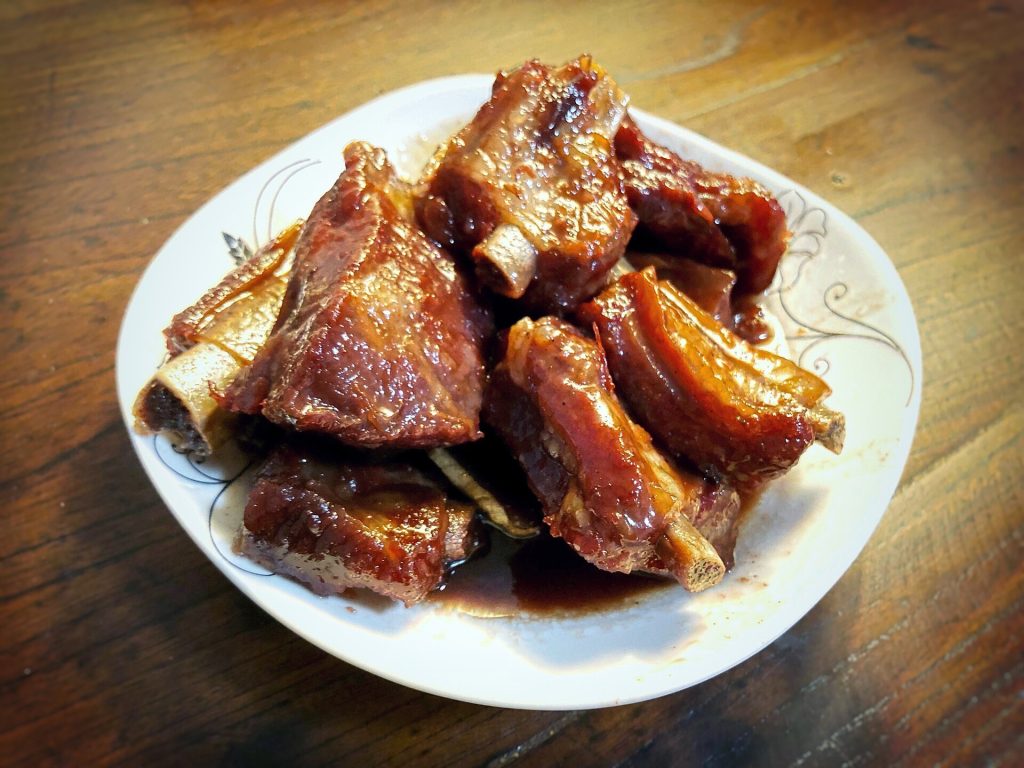
Wuxi spareribs (无锡排骨, Wúxī páigǔ) are a Jiangnan braise that surprises many first-timers with their sweetness. The ribs come glossy, often a deep reddish amber, in a sauce that is savoury and frankly sugary rather than sharp. If you arrived in China expecting pork ribs to taste like a vinegary sweet-and-sour, or like a dry, salty grill, this plate will recalibrate you in one bite.
This is a first-timer guide to recognising the dish, ordering it as 无锡排骨, and eating it so the sauce and the bone-in meat make sense together. It is not a protected-recipe claim, not an official standard, and not a restaurant ranking. Prices do not belong here. If you already know hong shao rou braised pork for first-timers or Hangzhou Dongpo pork for first-timers, you will recognise a family resemblance—soy, sugar, a slow sheen—without confusing the dishes. Suzhou squirrel fish for first-timers is a different Jiangnan idea entirely: a whole fish, a different texture, a different sweet-sour balance.
What you are looking at
The usual plate is bone-in pork ribs, cut into short sections, braised until the meat will come away with chopsticks, and coated in a thick, shiny sauce. The colour is often darker and redder than a pale stew, and paler than a scorched barbecue. You may see a simple garnish; you should not need a hidden chili landscape to understand the dish. The flavour is sweet first, then savoury, with soy and often a little spice-aromatic warmth in the background. It is not typically a hot-and-numbing Sichuan plate, and it is not the brighter, sharper sweet-and-sour that some visitors know from other Chinese restaurants abroad.
The sweetness is the point, not a mistake. Visitors who have been eating northern or Sichuan food for a week sometimes think the kitchen added too much sugar. In Wuxi and in many Jiangnan restaurants, that profile is ordinary. If you dislike sweet savoury meat, this may not be your dish; order something else rather than asking the cook to make Wuxi paigu “less Wuxi” after it has already been glazed.
There is no single official cut or official sweetness level. House recipes vary. Some plates are stickier, some saucier, some a little darker. The shared idea is glossy ribs you eat in small, rich bites, usually with rice.
How to order and how to eat it
Say 无锡排骨 or point to the characters. In Wuxi, Suzhou, Shanghai, and many Jiangnan restaurants, staff will know the name. In a restaurant far from that region, check the characters so you are not served a generic chili rib under an English label.
It is a shared meat dish, rich enough that a table of two or three often wants vegetables, tofu, or a lighter soup beside it, plus rice. The rice is not optional for most first-timers; the sauce wants a place to go. Pick up a rib with chopsticks, bite the meat from the bone, and let the bone rest on your side plate or in a designated bowl. Do not be shy about using your hands briefly if the bone requires it and if the table culture around you is casual; a napkin and a wet towel, when they arrive, are there for that reason.
If serving chopsticks are offered, use them on the shared plate. chopsticks etiquette for foreigners is the etiquette companion. Because the sauce clings, take a piece rather than dragging sauce in a wide sweep across the platter.
If you are comparing as you eat, notice what is not on the plate. This is usually not a heap of onions in a transparent sour sauce. It is not the same as Shanghai-style hong shao rou, which is typically belly, in cubes, with a different fat-to-meat feel, even if the seasoning family overlaps; see hong shao rou braised pork for first-timers. Dongpo pork is another belly braise, often presented as a thick, gelatine-rich square; see Hangzhou Dongpo pork for first-timers. Wuxi paigu is the rib version of that sweet Jiangnan instinct.
How sweet is “too sweet,” and what to put next to it
If the first bite feels candied, take it with rice and a bland green vegetable before you decide. Many diners find the second bite more balanced than the first. If it is still not for you, leave it and eat the other dishes; you are not required to finish a house signature as a test. A well-made plate should still taste of pork and soy, not of sugar alone, and the meat should be tender without being mushy.
Children often like this dish more quickly than they like chili-forward food. Adults who have been travelling in Chongqing or Chengdu may need a moment to reset their expectations. Both reactions are ordinary.
Pay with a tested official wallet or a card if a terminal is there; Alipay and WeChat Pay hub and restaurant self-order kiosks for foreigners cover the mechanics. The culinary task is simpler than the payment one: order it by name, give the sweetness a fair test with rice, and let the glossy ribs be a Jiangnan plate rather than a translation of a rib recipe you already know from home.
Related Lovely China reading
For payments, start with Alipay and WeChat Pay hub and WeChat Pay vs Alipay for tourists. For trains, keep high-speed rail first-timers guide and 12306 passport signup for foreigners handy. City hubs: Beijing first-visit guide, Shanghai first-visit guide. Connectivity: roaming vs local SIM honest guide, pocket Wi-Fi vs eSIM for China, offline maps for foreigners. Bookmark China travel tools page.
Practical checklist
- Confirm official rules on the relevant government, park, airline, or bank page near your travel week
- Screenshot bookings, tickets, and QR codes while you still have stable Wi-Fi
- Save hotel and attraction names in Chinese characters in your phone notes
- Carry passport, a backup payment method, and a small cash float (why cash is still needed)
- Test one small mobile payment before you rely on wallets at a gate or taxi
- Keep China travel tools page bookmarked for related Lovely China hubs
FAQ
Why do Wuxi spareribs taste so sweet?
Sweetness is part of the Jiangnan profile, not a kitchen error. 无锡排骨 is a glossy sweet-savoury braise, different from a sharp sweet-and-sour and from Shanghai-style hong shao rou.
Is it the same as hong shao rou or Dongpo pork?
No. Those are usually pork belly. Wuxi paigu is bone-in ribs in a related sweet soy family. Eat it with rice and a green vegetable.
How do I order it?
Say 无锡排骨 or point to the characters. It is a shared, rich meat dish; order something lighter beside it.
Notes for late 2026 travellers
Late December 2026 and the New Year week into 2027 bring colder mornings, earlier sunsets, and holiday crowds in many city hubs. Pack real winter layers in the north, and leave extra time on weekends and around 1 January.
This article does not invent ticket prices, opening hours, processing times, consular fees, or official statistics. When a number matters, verify it on the official site, app screen, or ticket board near your travel week.
If an official rule page disagrees with this guide, follow the official page. Lovely China orients English-speaking travellers; we are not an immigration, banking, or medical authority.