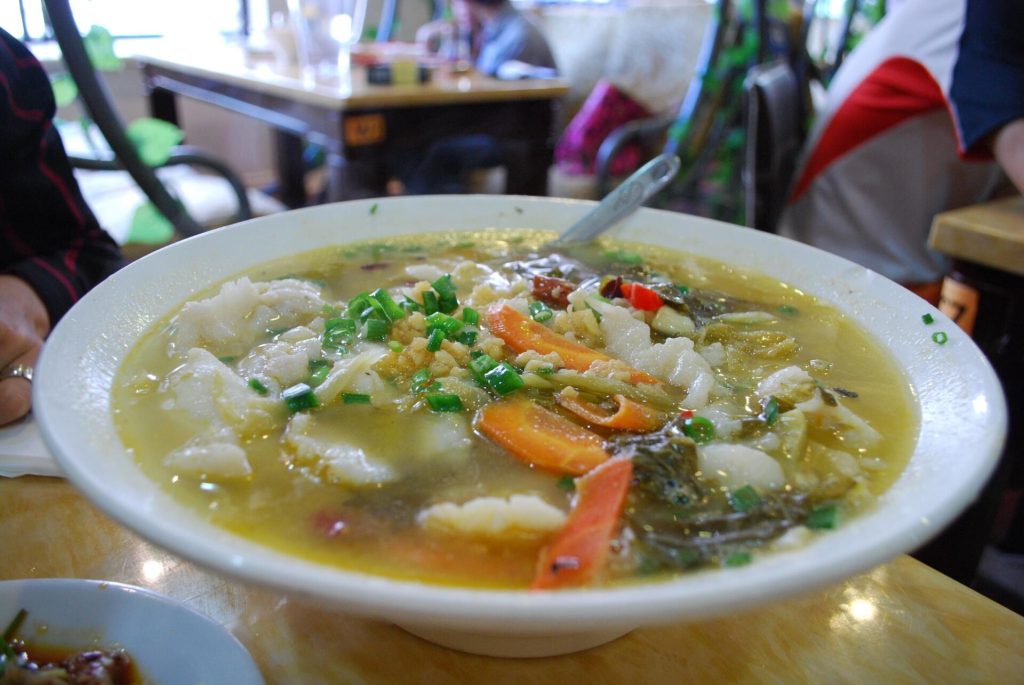
Suan cai yu (酸菜鱼) is sliced fish served in a sour, savoury broth with pickled mustard greens (酸菜). It can be gently tart or loudly spicy, and it is usually a shared pot in the middle of the table rather than a private bowl. First-timers who like sour soups and soft fish often love it. First-timers who do not expect bones, chili oil, or a bubbling tureen need a slower approach.
This guide is about ordering and eating, not about ranking restaurants or inventing a mandatory fish species. It is distinct from Sichuan shui zhu yu (水煮鱼), which sits in a different, typically oilier and more chili-blanketed style. Nearby flavour context: Chengdu mapo tofu and yu xiang rou si. Table habits: chopsticks etiquette. If you are visiting in the holiday window, see the Chengdu late December planner.
What arrives at the table
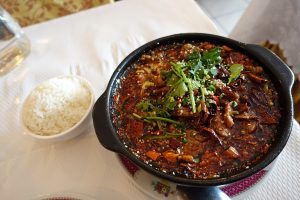
A typical suan cai yu is a large bowl or pot: pale fish slices, a tangle of pickled cabbage, and a broth that smells sour before it smells spicy. Some shops pour a chili-oil garnish over the top; others keep the tartness clearer. The fish is usually a freshwater fillet the kitchen has sliced thin so it cooks quickly in the hot soup. This article will not name a required species or a weight; order the fish the menu actually offers, and ask if you need a smaller pot.
It is not the same as Guangdong-style sour soups, and it is not the same as shui zhu yu, where the fish often sits under a heavier blanket of dried chilies and oil. If you specifically want the pickled-cabbage version, say 酸菜鱼, not only “spicy fish.”
How to order the heat
Ask for 微辣 or 少辣 if you want the sour greens to lead. 中辣 is already a committed Sichuan table for many visitors. You can also ask for less oil or fewer dried chilies on top. Staff will not always calibrate to a foreign diner’s idea of “mild,” so share other non-spicy dishes if you are a mixed table.
If someone at the table cannot eat chili at all, confirm that a non-spicy or very mildly seasoned pot is actually available before you sit down. Not every shop will do a truly mild version.
Bones, sharing, and pace
Even sliced fish can hide small bones. Eat slowly, and do not tip a whole ladle into a child’s bowl without checking. The broth is genuinely hot; let the surface settle, and use the ladle rather than leaning over steam.
Sharing is the normal pattern: rice on the side, greens from the pot, fish slices into small bowls. Do not treat the tureen as a private soup. If you are dining alone, a small portion, if the shop offers one, is more reasonable than a banquet pot.
Pickled cabbage is salty and sour by design. Drink water or a mild drink, and do not add extra salt before you taste. A plain vegetable stir-fry on the same table makes the meal easier if the pot is intense.
Practical notes
This is a sit-down restaurant dish more often than a street-stall snack. Peak hours mean a wait; reserve if the shop takes reservations, or arrive slightly off-peak. Do not invent prices. Pay with a method that already works, and keep a little cash as backup.
If the first spoonful is more chili than sour, you can still eat around the oil, add rice, and leave what you cannot finish. The dish should taste of pickled greens and fish, not only of heat. When it does, you will understand why it is a winter-table staple.
Ground-level reminders for this topic
Stay flexible when a counter, app screen, or staff instruction disagrees with a blog. Lovely China orients travellers; live official pages and bilingual signs win. Keep China travel tools page, essential apps for foreigners, and Alipay and WeChat Pay hub bookmarked so logistics stay boring while you focus on the angle of this guide: A first-timer’s guide to suan cai yu (酸菜鱼): sliced fish in a sour, savory, often spicy broth with pickled mustard greens (酸菜). Cover how to share the pot, watching for bones, spice level requests, typical fish types without inventing a mandatory species, and how it differs from shui zhu yu (水煮鱼). No invented prices..
Related Lovely China reading
For payments, start with Alipay and WeChat Pay hub and WeChat Pay vs Alipay for tourists. For trains, keep high-speed rail first-timers guide and 12306 passport signup for foreigners handy. City hubs: Beijing first-visit guide, Shanghai first-visit guide. Connectivity: roaming vs local SIM honest guide, pocket Wi-Fi vs eSIM for China, offline maps for foreigners. Bookmark China travel tools page.
Practical checklist
- Confirm official rules on the relevant government, park, airline, or bank page near your travel week
- Screenshot bookings, tickets, and QR codes while you still have stable Wi-Fi
- Save hotel and attraction names in Chinese characters in your phone notes
- Carry passport, a backup payment method, and a small cash float (why cash is still needed)
- Test one small mobile payment before you rely on wallets at a gate or taxi
- Keep China travel tools page bookmarked for related Lovely China hubs
FAQ
How is suan cai yu different from shui zhu yu?
Suan cai yu is sliced fish in a sour pickled-cabbage broth. Shui zhu yu is a different, typically oilier and more chili-blanketed boiled-fish style. If you want the pickled-cabbage version, say 酸菜鱼.
Are there bones in the fish?
There can be, even when the fish is sliced. Eat slowly, use the ladle, and check a child’s portion before serving.
Can I ask for a milder pot?
Ask for 微辣 or 少辣, and confirm if someone at the table cannot eat chili at all. Not every shop will make a truly mild version.
Is this a solo street snack?
It is usually a sit-down, shared pot. Dining alone, ask whether a small portion exists rather than ordering a banquet tureen.
Notes for late 2026 travellers
Late December 2026 and the New Year week into 2027 bring colder mornings, earlier sunsets, and holiday crowds in many city hubs. Pack real winter layers in the north, and leave extra time on weekends and around 1 January.
This article does not invent ticket prices, opening hours, processing times, consular fees, or official statistics. When a number matters, verify it on the official site, app screen, or ticket board near your travel week.
If an official rule page disagrees with this guide, follow the official page. Lovely China orients English-speaking travellers; we are not an immigration, banking, or medical authority.