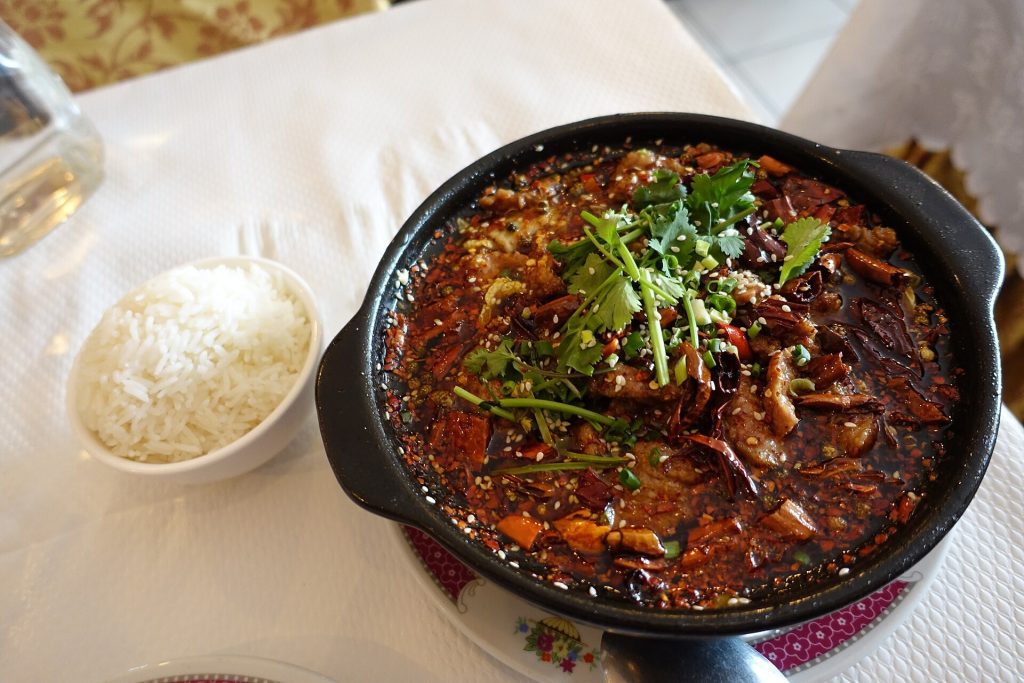
Sichuan shui zhu niu rou (水煮牛肉, shuǐzhǔ niúròu) looks like a red lake with beef hiding underneath. Thin slices of beef are briefly cooked and then covered with chili oil, dried chilies, and Sichuan pepper, often with a layer of vegetables below. It is a home-and-restaurant classic, and it is easy to eat badly on the first try: either you scoop mostly oil, or you treat it like a soup and drink the fire.
It is the beef cousin of shui zhu yu (水煮鱼), not the same dish, and it is not suan cai yu. If you are in Chengdu, the first-visit guide will put lunch in context; mapo tofu is a different kind of heat on the same table.
What you are looking at
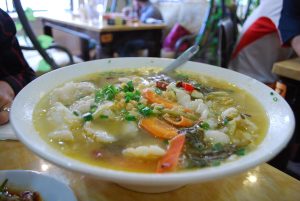
A wide bowl or deep plate arrives with vegetables (often cabbage, bean sprouts, or leafy greens) and beef, then a ladle of hot oil and a heap of chili and peppercorn on top. The oil is a flavour blanket, not a broth to finish. The beef should be thinly sliced and cooked briefly so it stays tender. If the meat is thick and tough, that is a kitchen problem, not something you fix by chewing longer in silence.
The numbness on your lips is Sichuan pepper (花椒) doing its usual work. The heat is dried chili and oil. They are different sensations. You can like one and ask the restaurant to go easier on the other, within the limits of a house recipe. There is no official Scoville number and no mandatory cut of beef. “Mild” still means Sichuan mild.
How to eat it so you get beef, not only oil
Use a ladle or wide spoon plus chopsticks. Push the chili cap aside, lift meat and vegetables from below, and let excess oil drip back. Put them on rice, or in your own small bowl, then eat. Do not drink the remaining oil “for the flavour.” The flavour is already on the meat.
Rice is not optional for most first-timers. A plain vegetable, tofu, or soup on the side gives you a reset, just as it does with mapo tofu. Shared-table manners still apply: use serving chopsticks if they are offered, and see chopsticks etiquette if you want the calm version of those habits.
If you need less heat, ask when you order, not after the oil has gone on. Some kitchens will go lighter on the poured oil or the pepper. Some will not. You can also eat more of the vegetables underneath, which often catch flavour without quite the same blast as the surface.
Ordering in a mixed group
Shui zhu niu rou is usually one shared dish among others, not a whole meal for one person unless you are very hungry. Balance it with something mild—a dry vegetable, a simple soup, perhaps a non-spicy meat or tofu. If one diner cannot eat beef, this is not their dish; order them something else rather than expecting the oil to be “vegetarian” after the beef has been in it.
Allergies and chili sensitivity are real. Say so clearly. A restaurant can sometimes help; it cannot un-prickle a peppercorn once you have swallowed it. Water and rice are better first aids than a dare.
You do not need a tasting script. You need rice, a spoon, and the patience to fish for the beef. When it is well made, the slices are tender, the vegetables are sweet under the heat, and the oil stays where it belongs: as a dressing, not as a drink.
Ground-level reminders for this topic
Stay flexible when a counter, app screen, or staff instruction disagrees with a blog. Lovely China orients travellers; live official pages and bilingual signs win. Keep China travel tools page, essential apps for foreigners, and Alipay and WeChat Pay hub bookmarked so logistics stay boring while you focus on the angle of this guide: A first-timer’s guide to Sichuan shui zhu niu rou (水煮牛肉): thinly sliced beef served under chili oil, Sichuan pepper, and vegetables. Distinguish it clearly from shui zhu yu (水煮鱼) and from suan cai yu. Cover spice and numbness, how to scoop meat vs oil, rice pairing, and ordering milder heat. No fake prices. Distinct from shui zhu yu, suan cai yu, mapo tofu, and hotpot etiquette articles..
Related Lovely China reading
For payments, start with Alipay and WeChat Pay hub and WeChat Pay vs Alipay for tourists. For trains, keep high-speed rail first-timers guide and 12306 passport signup for foreigners handy. City hubs: Beijing first-visit guide, Shanghai first-visit guide. Connectivity: roaming vs local SIM honest guide, pocket Wi-Fi vs eSIM for China, offline maps for foreigners. Bookmark China travel tools page.
Practical checklist
- Confirm official rules on the relevant government, park, airline, or bank page near your travel week
- Screenshot bookings, tickets, and QR codes while you still have stable Wi-Fi
- Save hotel and attraction names in Chinese characters in your phone notes
- Carry passport, a backup payment method, and a small cash float (why cash is still needed)
- Test one small mobile payment before you rely on wallets at a gate or taxi
- Keep China travel tools page bookmarked for related Lovely China hubs
FAQ
Is this the same as shui zhu yu?
No. Shui zhu niu rou is the beef version. The method looks similar, but it is a different dish from boiled fish or suan cai yu.
Should I drink the chili oil?
No. Lift the beef and vegetables from below, let excess oil drip back, and eat with rice. The oil is a dressing, not a soup.
The beef was tough. Did I eat it wrong?
The slices should be thin and tender. Tough meat is usually a kitchen issue, not something the diner is doing wrong.
Notes for late 2026 travellers
Late December 2026 and the New Year week into 2027 bring colder mornings, earlier sunsets, and holiday crowds in many city hubs. Pack real winter layers in the north, and leave extra time on weekends and around 1 January.
This article does not invent ticket prices, opening hours, processing times, consular fees, or official statistics. When a number matters, verify it on the official site, app screen, or ticket board near your travel week.
If an official rule page disagrees with this guide, follow the official page. Lovely China orients English-speaking travellers; we are not an immigration, banking, or medical authority.