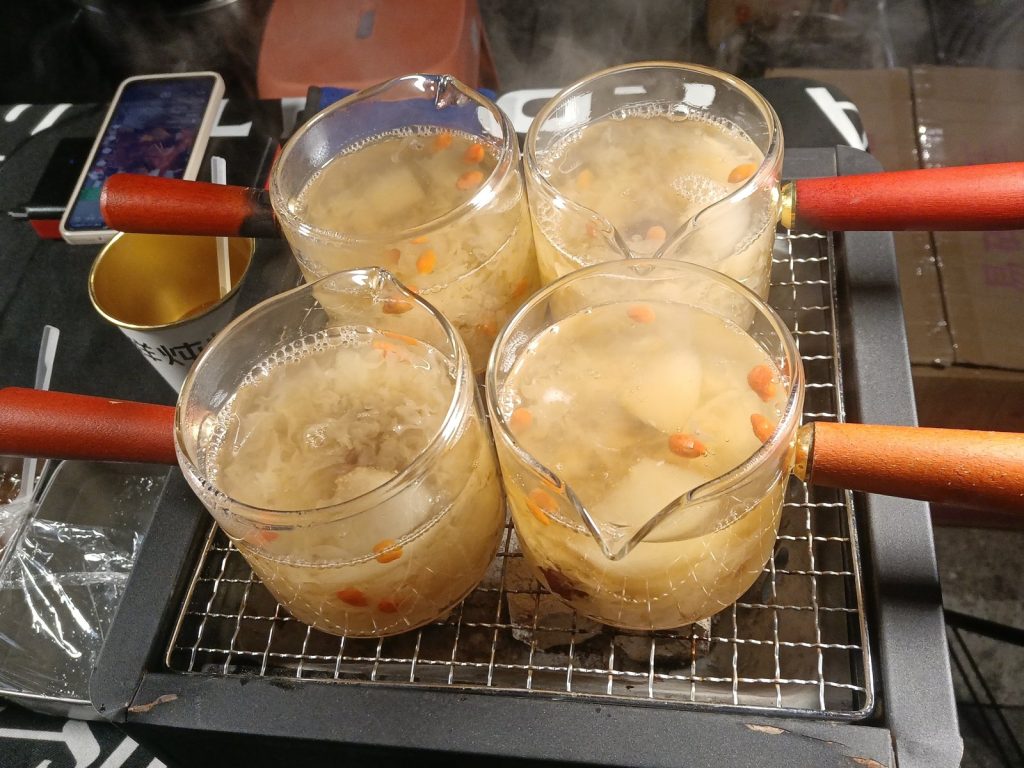
Rock sugar pear soup (冰糖雪梨, bīngtáng xuělí) is the drink-dessert that shows up everywhere in China once the air turns dry: in dessert shops, on restaurant drink menus, as bottled drinks in convenience-store fridges, and on the stove of almost every family with a cough in the house. It is simply pear simmered with rock sugar, sometimes with snow fungus, goji berries or jujubes. For first-timers it is one of the gentlest Chinese autumn foods — sweet, warm, alcohol-free and usually vegetarian. This guide explains what it is, why it is linked to autumn, how to order or make it, and what to keep in mind.
Why rock sugar pear soup is an autumn thing
Northern and central China get noticeably drier from late September. In everyday Chinese, people talk about qiūzào (秋燥), “autumn dryness”: dry lips, a scratchy throat, dry skin. Traditional Chinese food therapy treats pears as cooling and moistening, and rock sugar as a mild, soothing sweetener, so a warm bowl of pear soup is the classic home response.
The calendar backs up the habit. The solar term Cold Dew (寒露) begins on 8 October 2026 and Frost’s Descent (霜降) on 23 October 2026 — the stretch when Chinese health columns, including People’s Daily’s health channel, suggest pears, lily bulb, snow fungus and lotus root for dry weather. Our guides to Cold Dew 2026 for travellers and Frost’s Descent 2026 cover the wider seasonal customs.
Today, Monday 5 October 2026, is day five of Golden Week (roughly 1–7 October, makeup workday Saturday 10 October). If you have spent the holiday in trains, heated hotel rooms or long sightseeing days, a warm pear soup is an easy, comforting reset.
A note on health claims: this is a traditional food habit, not medicine. A sweet pear drink will not cure an infection. A Chinese family-health site’s 2026 explainer stresses that pear soup is not right for every kind of cough (it is traditionally matched to “dry” or “hot” coughs, not cold, phlegmy ones) and that a cough lasting more than two weeks should be seen by a doctor.
What is in the bowl
The name breaks down simply:
- 冰糖 (bīngtáng) — rock sugar, large crystals of sugar common in Chinese kitchens for teas and dessert soups.
- 雪梨 (xuělí) — “snow pear”, a market name for several crisp, juicy Asian pear varieties.
A basic version is just pear, rock sugar and water. Common add-ins include:
- Snow fungus / white fungus (银耳, yín’ěr) — a mild, jelly-textured fungus that turns the soup silky.
- Goji berries (枸杞, gǒuqǐ) — small red berries, as in our cover photo.
- Red dates / jujubes (红枣) for extra sweetness.
- Lily bulb (百合) or lotus seeds (莲子).
- Chuanbei (川贝) — fritillaria bulb, a traditional medicinal ingredient sometimes added at home or in herbal shops. It is a herb, not just a garnish; see the dietary notes below.
A Beijing municipal TCM administration article also mentions variations with ginger (to temper the pear’s “cooling” nature for people with sensitive stomachs), white radish, kumquat, or brown sugar instead of rock sugar.
Relatives you may meet
- Beijing pear drinks served warm in small pots at some Beijing-style restaurants, sweeter and thicker than home soup.
- Autumn pear paste (秋梨膏, qiūlígāo), a thick syrup sold in jars, stirred into hot water.
- Cantonese tong sui (糖水) — the wider family of sweet dessert soups, of which pear and snow fungus soup is a common member.
Where to order it
- Dessert shops (甜品店, 糖水铺): look for 冰糖雪梨 or 雪梨银耳 on the menu. Served hot or warm, sometimes chilled in summer.
- Restaurant drink lists: many Sichuan, Hunan and hotpot restaurants offer a jug of house pear soup — a cooling counterpart to spicy food.
- Breakfast and congee shops: some sell small cups beside congee and buns.
- Convenience stores and supermarkets: bottled 冰糖雪梨 drinks are everywhere. They are convenient but usually much sweeter and thinner than the homemade kind.
- Delivery apps: search 冰糖雪梨 or 炖梨 for shops that stew it to order.
Useful phrases:
- 冰糖雪梨 — rock sugar pear soup
- 热的 / 温的 / 冰的 — hot / warm / iced
- 少糖 / 不要太甜 — less sugar / not too sweet
- 有银耳吗? — Does it have snow fungus?
- 里面有没有药材? — Are there any herbal ingredients in it?
- 一壶 / 一杯 — a jug / a cup
Prices depend on the shop and portion; check the menu. In a restaurant, a jug is meant to be shared round the table.
What to expect when you taste it
Good rock sugar pear soup is clear to lightly golden, smells of cooked pear, and tastes gently sweet rather than syrupy. The pear should be soft and slightly translucent but still hold its shape; snow fungus adds a slippery, jelly-like texture that surprises some first-timers. Eat the pear pieces with a spoon and drink the liquid. If there are jujubes, watch for stones.
Bottled versions taste more like a sweet juice drink. Try a freshly stewed bowl at least once before judging the dish.
A simple home method
If your apartment has a stove or even a rice cooker, rock sugar pear soup is one of the easiest Chinese dishes to make. Ingredients are sold in any supermarket or wet market.
1. Wash one or two pears well. The Beijing TCM article recommends keeping the peel on and scrubbing it (salt or a little baking soda helps remove wax).
2. Core the pear and cut it into chunks. If using dried snow fungus, soak it until soft and tear it into small pieces.
3. Put pear (and fungus) in a pot, cover with cold water, bring to the boil, then simmer gently.
4. Add rock sugar to taste — start with a small amount; you can always add more.
5. The Beijing article suggests about 20–30 minutes, until the pear flesh turns slightly translucent. Snow fungus needs longer to get silky.
6. Add goji berries in the last few minutes so they stay plump.
The same article advises a clay, glass or enamel pot rather than an iron one. Serve warm.
Etiquette and a pear superstition
Pear soup is usually served in individual bowls or poured from a shared jug. Pour for others before yourself, especially elders.
There is one superstition worth knowing: in Chinese, “sharing a pear” (分梨, fēn lí) sounds like “separation” (分离, fēnlí). Some people avoid cutting one pear to share between partners or close friends. A pot of soup made from several pears does not raise the issue, but if you are slicing a single raw pear for your date, give them their own.
When visiting someone who is unwell, a bag of good pears or a jar of pear paste is a thoughtful, traditional gift.
Dietary notes
- Vegetarian and vegan: the basic soup is plant-based (pear, sugar, water, fungus, goji). Shops rarely add animal products, but ask if unsure.
- Sugar: even “less sugar” versions are sweet. Diabetics should be careful, especially with bottled drinks and pear paste.
- Herbal add-ins: chuanbei and other medicinal ingredients are traditional remedies. If you are pregnant, breastfeeding, taking medication, or ordering for a child, ask what is in the pot and consult a doctor or pharmacist; our first visit to a TCM clinic guide explains how to talk to practitioners.
- Goji berries can interact with some medications such as blood thinners — check with your doctor if relevant.
- Allergies: pear allergy exists and can cross-react with birch pollen or other fruit allergies.
- Not a treatment: fever, breathing trouble, or a cough that has not eased after about two weeks needs medical care.
Common first-timer mistakes
- Judging the dish only by a very sweet bottled drink
- Peeling away the skin when making it at home
- Over-boiling until the pear turns to mush
- Treating it as medicine rather than a comforting food
- Ignoring herbal ingredients when pregnant or on medication
FAQs
What does bingtang xueli mean? 冰糖 is rock sugar and 雪梨 is “snow pear”, so “rock sugar snow pear”.
Is rock sugar pear soup served hot or cold? Traditionally warm or hot, especially in autumn and winter. Some shops serve it chilled in summer.
Which pear should I use? Crisp, juicy Asian pears sold as 雪梨 or 鸭梨 (Ya pear) are the classic choice. Western pears also work but turn softer.
Is it caffeine-free? Yes, unless a shop mixes it with tea.
Can kids drink it? Plain pear soup is a common family drink. Avoid herbal add-ins for children unless a doctor agrees, and watch the sugar.
Does it cure a cough? No. It is a soothing traditional food. See a doctor for a persistent or severe cough.
Before you go
Learn the four characters 冰糖雪梨, ask for 少糖 if you prefer it less sweet, check for herbal ingredients if that matters to you, and try a freshly stewed bowl rather than a bottle. As Cold Dew arrives on 8 October and the air dries out, it is the easiest way to eat like a local this autumn.
Lovely China was founded in 2025 to publish practical English guides for travellers and expats in China. Questions or a broken link? Email [email protected].
Cover photo: Fumikas Sagisavas / Wikimedia Commons (CC0).