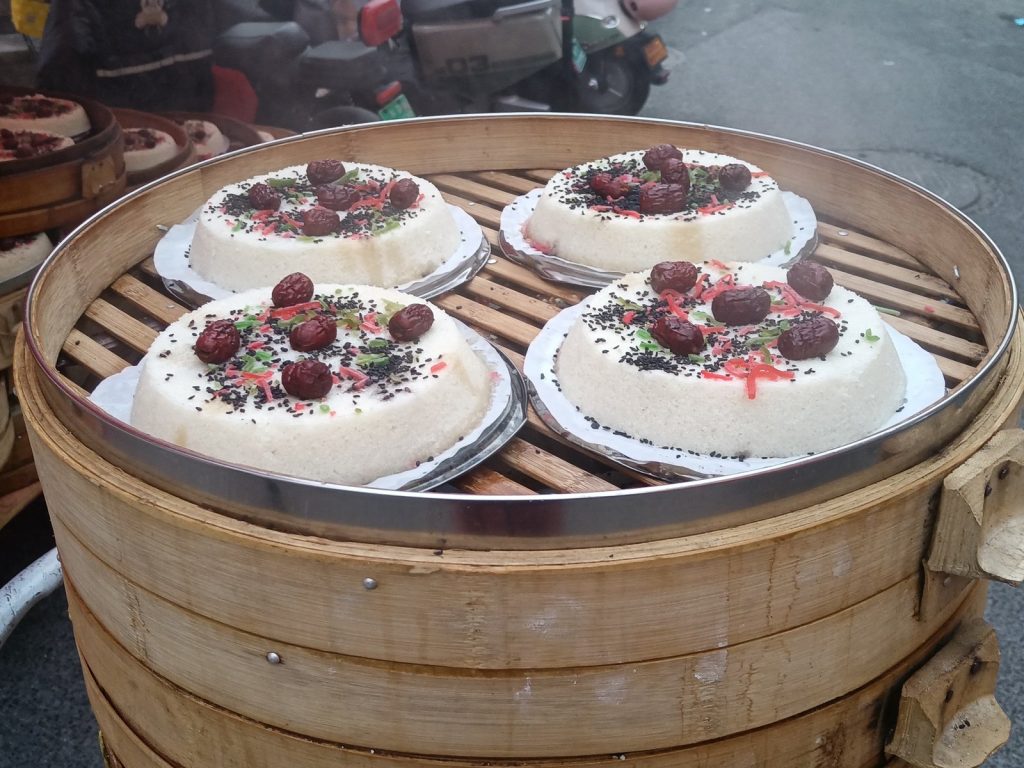
Chongyang cake (重阳糕, chóngyáng gāo) is the steamed rice cake that appears in Chinese bakeries, market stalls and supermarket chillers in the days before the Double Ninth Festival. If you live in China or are travelling through October, it is one of the easiest festival foods to try: no booking, no ritual you can get wrong, just a soft, mildly sweet slice that many families buy for older relatives. This first-timer guide explains what the cake is, when to look for it in 2026, how to order and taste it, and what to check if you have dietary limits.
When is Double Ninth in 2026?
The Double Ninth Festival (重阳节, Chongyang Festival) falls on the ninth day of the ninth lunar month. In 2026 that is Sunday 18 October 2026 — the date listed in Wikipedia’s festival table and confirmed by Chinese lunar-calendar converters. It is not a national day off on the mainland; Hong Kong and Macau do observe it as a public holiday (Chung Yeung). On the mainland, the same date is also designated Seniors’ Day (老年节) under the national law on protecting the rights and interests of older people, which is why so much Chongyang cake is bought for grandparents.
Today, Monday 5 October 2026, is day five of the Golden Week holiday (roughly 1–7 October, with a makeup workday on Saturday 10 October under State Council notice 国办发明电〔2025〕7号). Bakeries tend to put Chongyang cakes on display in the week or two before the festival, so the window to try them opens soon after you get back to work. For the wider festival — mountain climbs, chrysanthemums and family visits — read our Double Ninth Festival 2026 guide to dates, city climbs and elders and what visitors notice during Double Ninth in China.
What Chongyang cake actually is
At its simplest, Chongyang cake is a steamed cake made mainly from rice flour (often glutinous rice) and sugar, then decorated with jujubes (red dates), chestnuts, nuts or dried fruit. Chinese-language references also call it flower cake (花糕), chrysanthemum cake (菊糕) or five-colour cake (五色糕), and describe toppings such as candied red and green peel and dates.
The name works as a pun. Gāo (糕, cake) sounds like gāo (高, high), and the festival’s classic custom is “ascending heights” — climbing a hill or mountain. Eating cake on Double Ninth is often explained as a stand-in for climbing for people who cannot get to a hill, and as a lucky wish to “rise higher” in life. Some shops make tall, pagoda-like versions with several layers, and a traditional decoration in some regions is a pair of little sheep, because chóng yáng (重阳) sounds like “double sheep” (重羊).
Sources trace the cake’s popularity to the Tang dynasty and describe it spreading through Song-dynasty cities such as Kaifeng and Hangzhou. Today you will see it across China, but especially in Jiangnan cities such as Shanghai, Suzhou and Hangzhou, where old-name cake shops (老字号) have long sold seasonal steamed cakes.
Little flags and what they mean
Many Chongyang cakes come with tiny coloured paper flags stuck into the top. They are not just decoration: the Double Ninth custom of wearing zhuyu (茱萸, Cornelian cherry / dogwood) to ward off misfortune is represented by the flags. Do not eat the flags, and pull out the toothpick before cutting a slice for a child.
Styles you might see
Shapes and recipes vary by city and by bakery. Common types include:
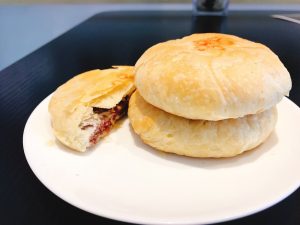
- Round steamed cakes with jujubes and nuts pressed on top, sold whole or by the slice — the type in our cover photo.
- Layered cakes with a sweet bean paste, date paste or osmanthus layer between rice-flour sheets.
- Small individual cakes in paper cups or plastic boxes, easiest for office sharing.
- Supermarket packs with a printed date — fine for a first taste, usually firmer than fresh ones.
If you have already tried osmanthus cake (guihuagao) this autumn, Chongyang cake will feel familiar: same family of steamed rice-flour sweets, less floral and more fruit-and-nut.
How to buy Chongyang cake without guessing
You do not need a specialist shop. Look for the characters 重阳糕 on handwritten boards, price tags or delivery apps in the days before 18 October.
- Traditional cake and pastry shops (糕团店, 点心店) in older neighbourhoods usually have the freshest, still-warm cakes, sometimes with a queue on the day itself.
- Bakery chains and supermarkets stock boxed versions — check the production date.
- Food delivery apps list 重阳糕 from local shops; search the Chinese name.
- Wet markets and morning stalls may sell slices by weight.
Useful phrases:
- 重阳糕 — Chongyang cake
- 有重阳糕吗? — Do you have Chongyang cake?
- 一块 / 一盒 — one piece / one box
- 今天做的吗? — Was it made today?
- 里面有什么? — What’s inside?
- 有没有猪油? — Is there lard in it?
- 帮我切一下 — Could you cut it for me?
Prices vary widely by size, shop and toppings; check the tag or ask. Payment is the usual mix of Alipay and WeChat Pay for foreign visitors; small stalls may not take cards.
What it tastes like
Expect a soft, slightly springy or sticky crumb, mild sweetness, and bursts of flavour from the dates and nuts. It is closer to a steamed rice cake than to a Western sponge or birthday cake — no frosting, no cream. Fresh cakes are moist and tender; a day later they firm up.
To refresh a firm slice, steam it for a few minutes or microwave briefly with a damp paper towel over it. Many families eat it with hot tea, which balances the sweetness. A green or oolong tea works well; chrysanthemum tea is a nice festival match, since chrysanthemum viewing is another Double Ninth custom. If you want a chrysanthemum outing to go with it, see our autumn chrysanthemum shows in China 2026.
Etiquette: sharing with elders and colleagues
Because Double Ninth is also Seniors’ Day, Chongyang cake is a natural, low-pressure gift for older people — a landlord, a neighbour, a colleague’s parents, or your partner’s grandparents.
- Bring a whole cake or a neat box rather than loose slices if it is a gift.
- Offer it with both hands and a simple greeting such as 重阳节快乐 (“Happy Double Ninth”) or 祝您健康长寿 (“Wishing you good health and long life”).
- Offer older people the first slice at a family table.
- Keep it modest. The gesture matters more than the price; an expensive box can feel awkward.
- In the office, small individual cakes on a shared table are easier than cutting a sticky cake with no knife.
The festival can include visits to ancestors’ graves in some families and regions. If you are invited along, follow your hosts’ lead and ask before taking photos. Our explainer on Qingming vs Chongyang ancestor days helps avoid mix-ups.
Dietary notes and allergens
Recipes differ, so always ask or read the label.
- Gluten: rice and glutinous rice contain no gluten, but some cakes mix in wheat flour, and shop kitchens handle wheat. Coeliacs should ask and treat unlabelled cakes with caution.
- Nuts: walnuts, almonds, pine nuts, peanuts or chestnuts are common toppings and fillings.
- Lard and animal fat: some traditional fillings (especially bean or date paste) may use lard (猪油). Vegetarians, vegans and anyone avoiding pork should ask 有没有猪油?
- Eggs and dairy: not typical in classic recipes, but modern bakery versions may add them.
- Sugar: sweetness ranges from mild to quite sweet; diabetics should check.
- Sticky texture: glutinous-rice cakes can be a choking risk for small children and very elderly people — cut small pieces and eat slowly with a drink.
If you need halal food, packaged cakes from halal-certified bakeries are the safest choice; see our halal food guide for Chinese cities.
Common first-timer mistakes
- Buying on the festival day at 6 pm and finding popular shops sold out
- Biting into a toothpick flag
- Storing a fresh cake in the fridge for days, then finding it rock-hard
- Assuming every cake is vegetarian or nut-free
- Treating it as a dessert to finish a heavy meal — it is filling; many people eat it as a breakfast or tea-time snack
Storage tips
Fresh steamed cakes are best eaten the same day or the next. Wrap leftovers tightly to stop them drying out. Refrigerating makes rice cakes harden; re-steaming brings back most of the softness. Supermarket packs follow the date and storage instruction on the label.
FAQs
What is Chongyang cake called in Chinese? 重阳糕 (chóngyáng gāo). You may also see 花糕 (flower cake).
When should I buy Chongyang cake in 2026? Shops usually stock it in the days before Double Ninth on Sunday 18 October 2026. Buy a day or two early if you want a specific shop’s cake.
Is Double Ninth a public holiday in mainland China? No. It is a traditional festival and Seniors’ Day, but not a day off on the mainland. Hong Kong and Macau have a public holiday.
Is Chongyang cake gluten-free? Not reliably. The base is rice flour, but recipes and kitchens vary. Ask or read the label.
Is it vegetarian? Often, but not always — some fillings use lard. Ask 有没有猪油?
Can I give it to my Chinese colleague’s parents? Yes. It is a thoughtful, modest Double Ninth gift for older people.
Is it the same as nian gao? They are relatives — both rice cakes whose name puns on “high” — but nian gao is the Lunar New Year version, while Chongyang cake is the Double Ninth one.
Before you go
Write down 重阳糕, plan your purchase for the week of 12–17 October, check toppings and fillings if you have allergies, and think about who you could share it with — ideally someone older. A slice of Chongyang cake with a pot of tea is one of the simplest ways to join in the Double Ninth Festival.
Lovely China was founded in 2025 to publish practical English guides for travellers and expats in China. Questions or a broken link? Email [email protected].
Cover photo: Fumikas Sagisavas / Wikimedia Commons (CC0).