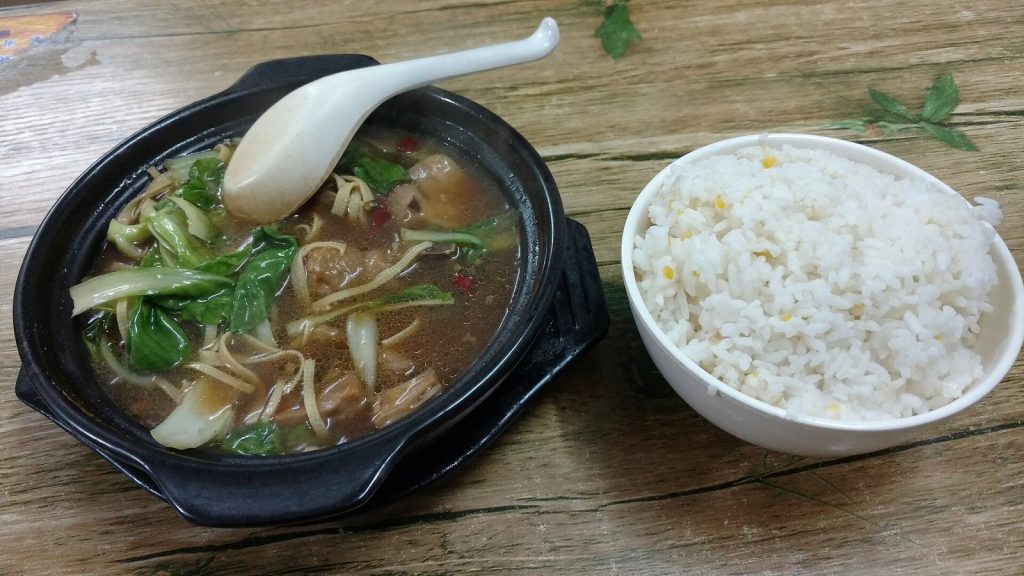
Walk down almost any street near a Chinese university, office block or train station and you will pass a shop with a yellow sign reading 黄焖鸡米饭 (huángmèn jī mǐfàn). Inside, rows of small clay pots bubble on burners: chicken pieces braised with mushrooms and green peppers in a glossy, dark, savoury sauce, served with a bowl of rice. It is fast, filling and familiar — and, for many foreigners in China, the first meal they learn to order with confidence.
This guide explains what huangmenji is, where it comes from, how to order it in a shop or on a delivery app, and what to watch for if you have dietary restrictions.
What is huangmenji?
The name breaks down simply: 黄 (huáng) yellow, 焖 (mèn) braise in a covered pot, 鸡 (jī) chicken, 米饭 (mǐfàn) rice. Despite the “yellow”, the sauce is usually a deep brown. A typical chain-shop pot includes:
- Chicken pieces, usually thigh or leg, chopped on the bone or boneless depending on the shop
- Shiitake mushrooms
- Green peppers and sometimes chili
- A braising sauce that is savoury and slightly sweet, made with soy sauce and other seasonings
- Rice on the side — often refillable in chain shops, but check
It is served bubbling hot in a small clay pot (砂锅 shāguō), so give it a minute before your first bite.
Where does it come from?
Huangmenji is from Jinan, the capital of Shandong province. A 2021 report in The Paper points out that braised “yellow” chicken dishes exist in several regions — Shandong, Yunnan, Guizhou, Hunan — but that huangmenji as a rice snack comes from Jinan. It recounts that in the 1930s a famous Jinan restaurant, Jilingyuan, was known for a “hundred-herb” braised chicken.
The fast-food version is more recent. According to Shandong broadcaster iqilu and People’s Daily Overseas Edition, a Jinan entrepreneur named Yang Xiaolu revived his family’s old restaurant dish and in 2011 began selling braised chicken with rice as a quick meal. His first shop opened near the Zhougong Shrine (周公祠) in Jinan in June 2011. He named the brand Yang Ming Yu (杨铭宇) after his son, franchised it widely, and opened shops overseas — People’s Daily reported a store in Tustin, California in 2017. Countless independent shops now sell the same dish under the generic name.
The traditional Jinan dish also has heritage status. A 2024 Jinan news report says “Jinan huangmenji making techniques” were listed as district-level intangible cultural heritage in Tianqiao District in 2021 and at Jinan city level in 2023. It explains that traditional Jinan huangmenji uses free-range chicken from the mountains south of Jinan and sweet bean sauce from Luokou, and relies on two techniques: caramelising sugar for colour (炒糖色) and frying the bean sauce (沸酱). The same report quotes a Jinan banquet saying, 鸡打头,鱼扫尾 — “chicken to start, fish to finish”.
One of China’s “fast food big three”
Ask Chinese friends about cheap, everywhere meals and three names come up: Shaxian snacks, Lanzhou beef noodles and huangmenji. The Paper’s 2021 report frames huangmenji exactly this way — and notes the irony that while Shaxian and Lanzhou put their hometowns in the name, many diners have no idea huangmenji comes from Shandong.
For visitors, that ubiquity is the point: wherever you are in China, you can usually find a huangmenji shop nearby, and the menu will look much the same.
How to order
Most shops work the same way. Choose your size, spice level and add-ons, then pay at the counter or by scanning a QR code. Useful words:
- 黄焖鸡米饭 — braised chicken with rice
- 小份 / 中份 / 大份 — small / medium / large (sizes differ between shops)
- 微辣 / 中辣 / 特辣 — mild / medium / extra spicy
- 不辣 — not spicy
- 去骨 / 无骨 — boneless (where offered)
- 加土豆 / 加豆皮 / 加金针菇 / 加青菜 — add potato / tofu skin / enoki mushrooms / greens
- 加饭 — more rice
- 打包 — to take away
Many shops also sell braised pork ribs (黄焖排骨) or beef (黄焖牛肉) in the same style. Spice levels here are usually gentler than in Sichuan or Chongqing, but start with 微辣 or 不辣 if you are unsure. Prices vary by city and shop; check the board. Our QR menu guide and menu translation tips help if there is no English.
Ordering on delivery apps
Huangmenji is one of the most popular delivery meals in China because it travels well. Search 黄焖鸡 in Meituan or Ele.me, choose a shop with good ratings, and pick options just like in the shop. Our Meituan vs Ele.me guide for foreigners explains how to set up the apps. Delivery versions usually come in a plastic bowl rather than a clay pot.
What it tastes like
Soft, tender chicken in a rich sauce that is savoury first, then slightly sweet, with earthy mushrooms and a little heat from the peppers. Spoon the sauce over your rice — that is half the pleasure. Add-ons like potato and tofu skin soak up the sauce and stretch the meal.
Where to eat huangmenji
- Anywhere. Chain and independent shops are found in almost every Chinese city, especially near universities, offices, malls and transport hubs. Search 黄焖鸡米饭 on a map app.
- On trains and at stations. Station food courts often have a version; railway catering has also sold huangmenji set meals.
- In Jinan. If you want to taste the dish in its home city, combine it with a visit to Jinan’s springs. See our Baotu Spring and Daming Lake autumn guide, and add a Shandong jianbing for breakfast.
Dietary notes
- Bones: chicken is often chopped through the bone into small pieces, so watch for bone fragments — especially when feeding children. Ask for 去骨 where available.
- Gluten: soy sauce and bean sauce usually contain wheat. Not suitable for coeliacs.
- Halal: most huangmenji shops are not halal, and many also cook pork ribs in the same kitchen. Look for 清真 signs; see our halal food guide.
- Vegetarian: the whole dish is built on chicken; the sauce is not vegetarian. See our vegetarian guide for alternatives.
- Sugar and salt: the sauce is rich in both.
- Heat: the clay pot stays very hot for a long time. Don’t touch it with bare hands.
Common first-timer mistakes
- Biting straight into a bubbling clay pot.
- Ordering 大份 alone — large portions can feed two.
- Chewing carelessly and hitting a bone shard.
- Assuming the sauce is spicy. Usually it is not, unless you ask.
- Leaving the sauce. Pour it on your rice.
FAQs
What does huangmenji mean? “Yellow braised chicken” — chicken braised in a covered pot — served with rice (米饭).
Where is huangmenji from? Jinan, Shandong. The fast-food version spread nationwide after 2011.
Is huangmenji spicy? Usually mild; most shops let you choose 不辣, 微辣 or hotter.
Is huangmenji healthy? It is a balanced, filling meal, but the sauce is salty and slightly sweet. Add greens to round it out.
Does huangmenji contain bones? Often yes. Some shops offer boneless chicken; ask for 去骨.
Can I order huangmenji for delivery? Yes, it is one of the most popular delivery dishes in China.
Before you go
Save 黄焖鸡米饭, 微辣 and 加土豆 on your phone, find the nearest yellow sign, and let the clay pot cool for a minute. Simple, cheap and everywhere, huangmenji is the comfort meal that will see you through your first weeks in China.
Sources
- The Paper (thepaper.cn), “攻占全球的黄焖鸡米饭,来自山东济南!”, 25 March 2021.
- iqilu / Qilu Evening News, “’网红’黄焖鸡:济南菜中的’战斗鸡’”, 25 March 2021.
- People’s Daily Overseas Edition via people.com.cn, “是谁把黄焖鸡米饭带到世界的每个角落?”, 23 November 2017.
- Subao News Jinan (jinan.subaoxw.com), report on Jinan huangmenji making techniques as intangible heritage, 1 March 2024.
Lovely China was founded in 2025 to publish practical English guides for travellers and expats in China. Questions or a broken link? Email [email protected].
Cover photo: 汮汐 / Wikimedia Commons (CC BY-SA 4.0).