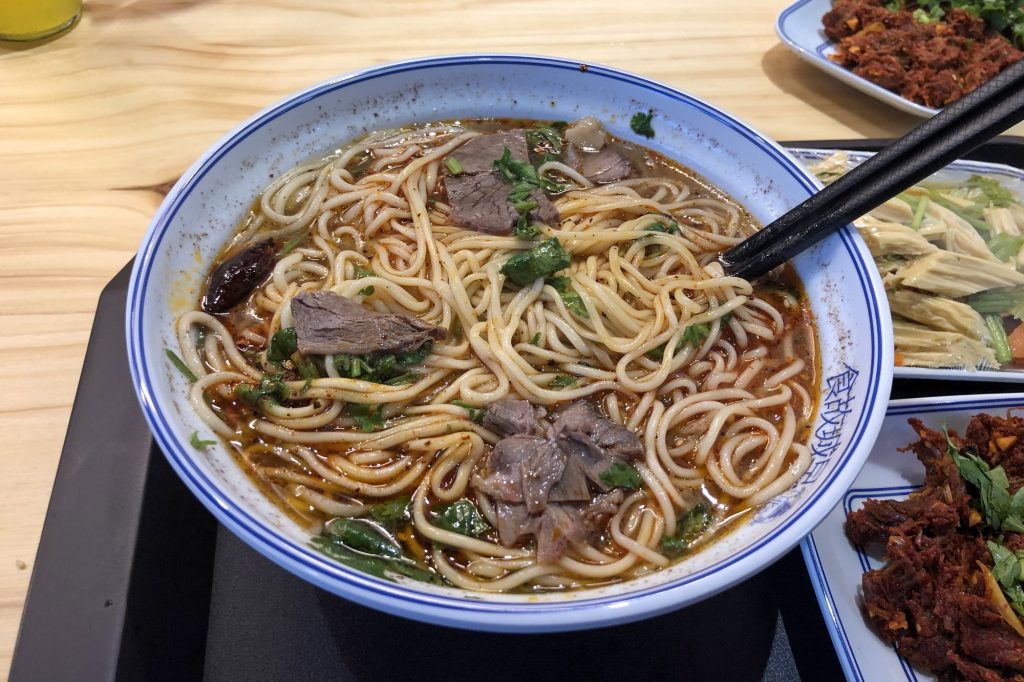
A bowl of Lanzhou beef noodles looks simple until you reach the window and someone asks which width you want. That question is the whole game. The dish is not a generic “lamian” plate with mystery toppings. It is a fast, clear-broth system: hand-pulled wheat noodles, thin beef, white radish, red chili oil, green herbs, and a broth meant to taste clean rather than muddy. Once you know the order flow and one safe width, you can eat well in Lanzhou itself or in the countless Halal noodle shops that carry the style across China.
This guide is for travelers and expats who want a first bowl without inventing prices, rankings, or crowd myths. Read the live menu. Watch how locals move. Decide your noodle width before you speak. Then eat while the strands still have spring.
What “Lanzhou beef noodles” actually means
In Chinese you will see 兰州牛肉面 (Lánzhōu niúròu miàn) more often than a casual English “Lanzhou ramen.” Shops may also write 兰州拉面. Many authentic kitchens are Hui Muslim–run and Halal (清真). That matters for the beef and for the broth: pork is not the point of this bowl.
The classic visual standard is often summarized as “one clear, two white, three red, four green, five yellow” (一清二白三红四绿五黄): clear broth, white radish, red chili oil, green cilantro and garlic sprouts (or scallion), and yellow, glossy noodles. If the broth looks cloudy and heavy like a stew, you may still enjoy it—but you are tasting a different philosophy than the clear Lanzhou ideal.
You will find strong versions in Gansu, of course, and workable everyday versions in Beijing, Shanghai, Xi’an, Chengdu, and almost every city with a morning commute. Quality varies. Turnover and a puller working dough in sight are better signals than English signage alone.
How the shop usually works
Most Lanzhou-style shops run like efficient breakfast counters, not slow dinner theaters.
- Pay first at the till and take a ticket or token.
- Hand the ticket to the noodle station.
- When the puller or server asks, state your noodle width clearly.
- Collect the bowl, find a seat, and start eating.
Do not wait for table service theater. Staff move bowls fast because pulled noodles soften if they sit. If language fails, point at a width chart on the wall—many shops post photos of 毛细, 细, 二细, 韭叶, and 大宽.
Morning and late morning are the classic windows. Some traditional shops wind down after lunch; others stay open later in big cities. Check the branch hours, especially if you are fitting a bowl between trains. For payment, many urban shops lean on Alipay or WeChat Pay; cash still appears in smaller spots. If you are still setting up mobile pay as a visitor, our Alipay and WeChat Pay guide for foreign visitors is worth a read before you rely on a breakfast line.
Noodle widths: what to ask for
The dough is pulled to order. Width changes chew, broth cling, and how fast the bowl softens. Common options include:
- 毛细 (máoxì) — hair-thin. Softens quickly; easy to overcook in the bowl.
- 细 (xì) — thin.
- 三细 (sānxì) — “third-thin,” a step up.
- 二细 (èrxì) — “second-thin.” The safest first-timer default: chew without being a belt.
- 韭叶 (jiǔyè) — chive-leaf flat ribbons.
- 宽 / 大宽 (kuān / dàkuān) — wide to very wide. More chew, more work.
Say 二细 if you want the least drama. If you love wide noodles in other cuisines, try 韭叶 on a second visit rather than jumping straight to 大宽 on day one.
Useful scraps of Chinese:
- 牛肉面 — beef noodles
- 二细 — erxi (default width)
- 加牛肉 — add beef
- 少辣 / 不辣 — less chili / no chili
- 不要香菜 — no cilantro
Pointing still works. Decide before you reach the window so you are not blocking the line while translating in your head.
Broth, chili oil, and how to taste the bowl
Start with a sip of broth before you stir everything into a red swirl. Clear broth should taste beefy and clean, not greasy. Then decide how much chili oil you want mixed through. Some shops ladle chili by default; others wait for you to ask. If you are chili-cautious, say 少辣 or 不辣 early.
Radish is not filler. It cools the richness and keeps the bowl from feeling like pure meat. Herbs finish aroma. Beef slices in a basic bowl can be modest; adding beef (加牛肉) or a tea egg is a common local upgrade when you want a fuller meal. Cold side plates of beef or pickled vegetables appear in many shops—order from the board, not from imagination.
Eat soon. Pulled noodles continue to drink broth and lose snap. Locals do not treat this as a leisurely soup to photograph for twenty minutes first. If you need a photo, take it fast, then eat.
Choosing a shop without tourist panic
Ignore the need for a permanent “best in China” list. Use a practical filter:
- Halal / 清真 signage when you want the classic Muslim-kitchen lineage.
- Visible pulling and steady ticket flow.
- Broth that looks clear in other diners’ bowls.
- A width chart or staff who ask width as a normal question.
Airport and station bowls can be fine when you are in transit; neighborhood breakfast shops are often where regulars return. Fancy décor is not a quality guarantee. Empty rooms at peak breakfast hour are a soft warning.
If you are building a China food week, a Lanzhou-style breakfast pairs well with other technique-first meals later in the day—say, learning how to eat xiaolongbao in Shanghai or pacing yourself through Sichuan hotpot in Chengdu. Different regions, different rules; same traveler skill: watch the room, then copy the rhythm.
Breakfast culture, not only lunch
In Lanzhou, beef noodles are morning food as much as anytime food. Broth is often at its brightest early. If your itinerary is train-heavy in September—Teachers’ Day week, then Mid-Autumn travel later in the month—a noodle breakfast before a station run is a practical pattern. Book long-distance seats early when festival weeks approach; our 12306 train booking guide helps with the ticket side while the bowl handles the calorie side.
Do not expect every city shop to match a famous Lanzhou name. Expect a recognizable template: ticket, width, clear broth, chili, herbs, speed. That template is enough for a confident first bowl.
Mistakes that flatten a good bowl
Waiting too long before eating is the quiet killer. Ordering hair-thin noodles when you plan to chat for fifteen minutes is the second. Dumping all the chili oil at once before tasting broth is the third. Treating soy sauce like a mandatory base—when the shop did not invite it—can muddy a clear soup.
Another miss: assuming every shop labeled “Lanzhou” is identical. Franchise quality drifts. Use your eyes and the first sip. If the broth tastes dull and the noodles arrive pre-soft, finish politely and try another address tomorrow morning rather than declaring the whole category a failure.
A simple first order script
Walk in. Pay for one beef noodle bowl. At the window say 二细. If asked about chili, say 少辣 unless you already know your heat tolerance. Sit. Sip broth. Mix chili to taste. Eat while the noodles still bounce. Add beef next time if the basic bowl leaves you hungry.
That is the whole first lesson. Width first, broth second, chili third, speed always. Lanzhou beef noodles reward travelers who treat the counter like a practiced local habit instead of a mystery tasting menu.