The first xiaolongbao many visitors eat ends the same way: a brave bite, a flash of pain, and soup on the tablecloth. That is not a character flaw. Soup dumplings are designed to hold hot broth inside a thin skin, and the broth is hottest in the first minutes after the steamer lid lifts. Once you learn a small, repeatable sequence—lift, spoon, vent, sip, then finish—you stop treating the dumpling like a regular bao and start treating it like what it is: a tiny, portable bowl of soup.
This guide is technique-first. It is for people landing in Shanghai, or elsewhere in Jiangnan, who want to enjoy xiaolongbao without drama, without fake restaurant rankings, and without inventing prices. Order from the live menu. Ask for vinegar if it is not already on the table. Then slow down for sixty seconds.
What xiaolongbao actually are
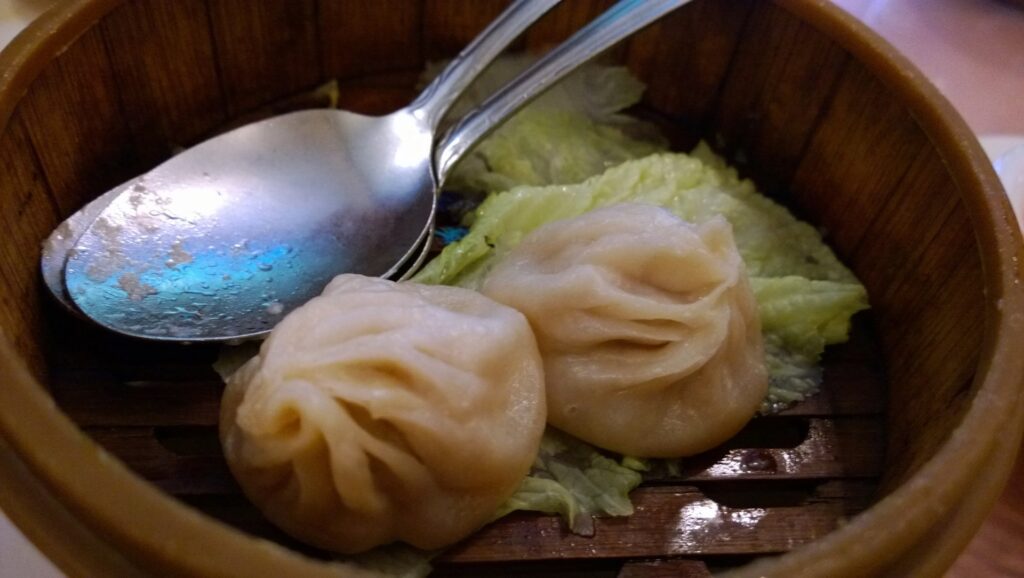
Xiaolongbao (小笼包) are steamed dumplings with a thin wheat wrapper, a meat filling, and aspic that melts into soup during steaming. The “xiao long” refers to the small bamboo steamer. The pleasure is not only the filling; it is the broth that stays sealed until you open the dumpling yourself.
They are strongly associated with Shanghai and nearby Jiangnan towns such as Nanxiang, but you will find good versions across the Yangtze Delta and in other Chinese cities. Fillings vary. Pork is the everyday baseline. Crab-roe or crab-meat versions appear more often when crab is in season—overlapping the autumn months when Jiangnan also leans into hairy crab. Sweet or “creative” fillings exist; treat them as side experiments, not the first lesson.
A well-made dumpling looks taut, with many fine pleats gathered at the top. The top knot is not decoration only. It is the safest place to grip with chopsticks. If the skin tears before it reaches your spoon, the soup is already gone—and so is half the point.
The tools on the table
You need two things working together: chopsticks and a Chinese soup spoon (the deep ceramic spoon, not a flat Western teaspoon).
Chopsticks lift. The spoon catches, cools, and carries.
Vinegar arrives as Chinese black vinegar, often Zhenjiang-style in the Jiangnan south, sometimes with thin ginger matchsticks on top. Soy sauce is not the default partner here. Chili oil is optional and personal. If you only remember one accompaniment, remember vinegar and ginger in small amounts.
Ask simply if needed: vinegar is 醋 (cù). A basket is often ordered as one steamer—小笼包一笼—though wording varies by shop. Pointing at the steamer on someone else’s table also works when language fails.
How to eat xiaolongbao: the safe sequence
There is more than one “correct” school of thought among cooks and regulars. The shared goal is the same: do not puncture the dumpling in mid-air, and do not send a mouthful of boiling soup straight onto your tongue.
1. Let the steamer settle for a moment
When the bamboo lid comes off, steam billows. Give the dumplings a short pause—long enough that the skins stop looking fragile from pure heat shock, short enough that the soup does not cool into something dull. If you are sharing, wait until everyone has a spoon ready before the first person digs in.
2. Grip the top, not the belly
Pinch the pleated crown with chopsticks. Do not squeeze the sides. The bottom will sag slightly; that sag is broth doing what gravity asks. Slide the spoon underneath immediately so you are not holding a water balloon over the table.
3. Park it on the spoon
Transfer the dumpling fully onto the spoon. This is the moment many first-timers skip, and it is why they burn. On the spoon, you control angle, vinegar, and bite size.
4. Open a small “window,” then sip
Nibble a small hole in the side or near the top—a popular Shanghai mnemonic is often summarized as lift gently, move slowly, open a window, then drink the soup. Sip the broth carefully. It will still be hot. Blow if you need to. This is not theatrical; it is temperature management.
5. Finish with vinegar, not under vinegar
After the sip, dip lightly in black vinegar with ginger, or drip a little vinegar onto the spoon, then eat the dumpling. Do not drown it. The vinegar cuts richness; it should not replace the soup’s flavor. Some people taste the first dumpling almost plain, then add vinegar on the second. That comparison is worth doing once.
An alternate approach you will see: vinegar already in the spoon, dumpling placed on top, then eaten more or less in one careful go once it has cooled slightly. Both methods work if the spoon is doing its job.
Mistakes that waste a good steamer
Biting straight through like a closed dumpling is the classic fail. Stabbing with a chopstick tip to “check” also fails. Dragging the dumpling through a communal vinegar bowl so the skin softens and tears is messy and, in shared settings, a little rude—portion vinegar into your own dish or spoon instead.
Another quiet mistake is treating takeaway the same as table service. Xiaolongbao are happiest immediately from the steamer. Packed skins soften; soup cools and can thicken. If you must take some away, eat soon, and lower your expectations for the skin’s snap.
How to choose a spot without tourist panic
Ignore the need for a definitive “best in Shanghai” list. Those lists age badly and often chase the same three names. Use a simpler filter.
Look for a shop where steamers move. Turnover matters more than décor. Watch whether dumplings leave the kitchen in small batches rather than sitting lukewarm under a lamp. Notice whether locals are eating them as a quick meal, not only photographing them. Thin, even skins and intact soup when lifted are better signals than English menus alone.
Tourist-heavy areas still serve edible xiaolongbao; they also serve average ones at busy pace. If a place is famous mainly because it is next to a landmark, sample one steamer, then decide whether a second stop elsewhere is worth your afternoon. Chain restaurants with consistent training can be a calm first lesson when you want technique practice without hunting a hidden alley on day one. Neighborhood breakfast-and-lunch spots can be excellent when you already know how to eat and simply want another basket.
For crab-enhanced versions, match the calendar to the season rather than forcing the order in midsummer. Autumn is when Jiangnan’s crab story is loudest; that is also when mooncakes, osmanthus sweets, and cooler evenings stack up in the same weeks. If you are building a food day, a soup-dumpling lunch and a later walk for osmanthus scent or a Mid-Autumn bakery stop can sit comfortably in one itinerary—just do not expect one meal to do every seasonal job.
What to order beside the basket
One steamer of pork xiaolongbao is enough for a first lesson if you are alone; sharing two steamers makes more sense for two people who want to compare fillings. Add a light side—greens, simple noodles, or a soft tofu dish—so you are not filling up only on rich broth. Tea or a mild drink helps; ice-cold soda right before a hot sip is a personal choice, not a rule.
If the menu lists crab versions, ask whether they are available today rather than assuming. Quality tracks supply. When it is good, use less vinegar so you can taste the crab aroma. When you are unsure, stick with pork and save the specialty for a second visit.
Language crumbs that help
You do not need fluency. You need a few anchors:
- 小笼包 — xiaolongbao
- 一笼 — one steamer / one basket
- 醋 — vinegar
- 姜丝 — ginger shreds
- 打包 — to pack for takeaway
- 有蟹粉的吗? — Do you have the crab version?
Pointing plus “这个” (this one) remains undefeated.
After the burn: why the ritual sticks
Once the sequence is in your hands, xiaolongbao stop feeling like a dare. They become a paced Shanghai habit: morning or lunch, a few pieces, vinegar on the side, conversation between sips. The dish rewards attention. That is why people remember their first successful dumpling as clearly as their first burn.
If your trip continues into festival season, keep the same practical mindset for other seasonal foods—mooncakes are a different skill set entirely, more about gifting and sharing than spoon technique. For the dumpling itself, the rule stays humble: spoon first, ego second, soup last into the mouth only when it has somewhere safe to go.
Shanghai will offer you countless steamers. You only need one good one, eaten slowly, to understand why the city keeps making them.