Kunming, famously known as China’s “Spring City,” enjoys mild weather and bright, clear skies year-round. But as the crisp air of late October and November 2026 rolls into Yunnan province, the cool mornings and chilly, high-altitude evenings demand a meal that warms you from the inside out. There is no dish more iconic, or more deeply comforting, for this seasonal transition than Guoqiao Mixian (过桥米线)—Crossing-Bridge Rice Noodles.
For first-time visitors to the capital of Yunnan, ordering this dish is less about simply eating a bowl of soup and more about participating in a celebrated culinary ritual. While southern cities have their own delicate noodle traditions—like the shrimp-infused broths you’d learn about in a first-timer’s guide to Guangzhou Wonton Noodles—Kunming’s version is heartier, richer, highly interactive, and a visual feast.
Here is everything you need to know to tackle your first bowl of Crossing-Bridge Noodles like a local, from understanding the lore to mastering the assembly.
Crossing-Bridge Noodles in Kunming. Source: Wonders Of Yunnan Travel
The Legend Behind the Bowl
The culture of Guoqiao Mixian is deeply intertwined with local folklore, giving the dish a romantic, historical weight. The most famous origin story dates back to the Qing Dynasty, originating in Mengzi, a county in southern Yunnan.
According to the legend, a scholar was studying rigorously for his imperial exams on a small, tranquil island in South Lake. His devoted wife would prepare his daily meals at home and carry them over a long wooden bridge to the island. However, the trek was long, and by the time she arrived, the soup was inevitably cold and the noodles were soggy.
One day, she made a culinary breakthrough. After boiling a plump, fatty chicken in an earthen pot, she realized that a thick layer of chicken fat floating on top of the broth acted as an incredible insulator, trapping the heat tightly inside. Rather than pre-mixing the meal, she decided to keep the raw meat, delicate vegetables, and rice noodles on separate plates. She only plunged them into the scalding broth once she had crossed the bridge and reached her husband. The ingredients cooked instantly in the intense heat, and the meal stayed perfectly hot and fresh.
Her husband eventually passed his exams, and the ingenious method of soup transport was immortalized. Today, this exact table-side assembly is the hallmark of the dish, served in restaurants across the globe.
The Anatomy of the Broth
Before looking at the ingredients, it is crucial to understand the foundation of the meal: the broth. The soup base is the soul of Guoqiao Mixian.
Unlike clear consommés, the broth here is a rich, milky-white elixir. It is traditionally made by simmering old hens, pork bones, and sometimes duck for upwards of six to eight hours. This prolonged, rolling boil emulsifies the fats and extracts every ounce of collagen and marrow, resulting in a soup that is incredibly savory, umami-dense, and deeply restorative.
The defining characteristic of this broth is the glistening layer of melted goose or chicken fat sitting on the surface. This fat layer is deceptive—it suppresses the steam completely. A bowl can arrive at your table sitting at a furious 200°F+ (95°C+), yet look entirely tranquil. Never attempt to sip the broth right when it arrives, or you will severely burn your mouth. The heat is precisely calibrated to cook raw meats at your table, not for immediate drinking.
Decoding the Ingredients
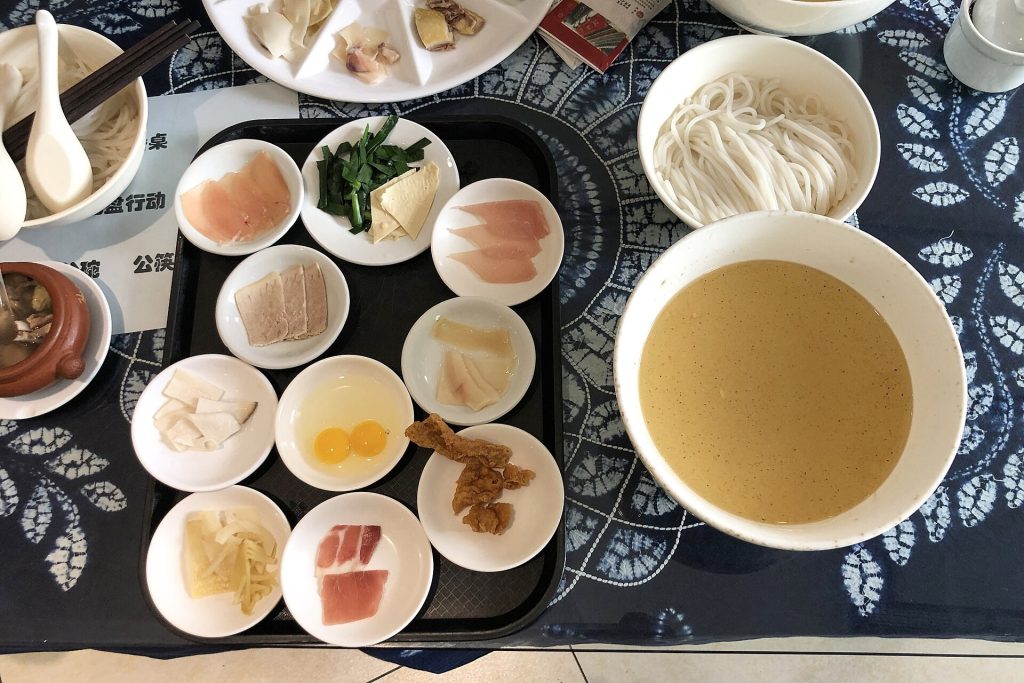
The separate raw ingredients for assembly. Source: Wikipedia
When you order Crossing-Bridge Noodles, you are usually presented with a tiered menu. Prices dictate the number and luxury of the ingredients. A standard “scholar” set might come with 10 small plates, while an “emperor” or premium set could boast 20 or more.
Here is what you will typically find on your spread of tiny dishes:
The Proteins: Wafer-thin slices of raw pork tenderloin, chicken breast, and sometimes delicate white fish. You will also receive a raw quail egg.
The Cured Meats: Yunnan is famous for its cured meats. Expect thin slices of Xuanwei ham (Yunnan’s equivalent to prosciutto) and crispy, puffed fried pork skin known locally as su meat.
The Fungi: Yunnan is China’s wild mushroom capital. Your set will likely include fresh wood ear mushrooms, shiitake, and perhaps premium additions like matsutake or termite mushrooms if you order a high-end bowl.
The Greens: Delicate vegetables that wilt beautifully in hot liquid, such as chrysanthemum leaves (which add a wonderful, herbal bitterness), garlic chives, pea shoots, and sweet corn kernels.
The Noodles: The star carbohydrate is mixian—fresh, slippery, spaghetti-like rice noodles that are slightly fermented, giving them a distinctively chewy, springy texture.
The Ritual: How to Assemble Your Noodles
When your order arrives, the massive, dangerously hot bowl of broth is placed in the center, flanked by your colorful mosaic of ingredients. Here is the proper, time-tested sequence for the ultimate “crossing the bridge” ritual.
Step 1: The Egg and Raw Meats First
Temperature drops every time you add an ingredient, so you must cook the raw items while the broth is at its absolute hottest. Immediately crack the raw quail egg into the broth. Follow this quickly with the thinly sliced raw meats. Use your chopsticks to gently stir them so they submerge completely. They will turn opaque and cook through in mere seconds.
Step 2: The Cured Meats and Mushrooms
Next, slide in the heartier, pre-cooked, or textured ingredients. Add the Xuanwei ham, the crispy pork skin, the tofu skin, and the mushrooms. These ingredients will begin to soak up the rich chicken broth, releasing their own flavors into the soup.
Step 3: The Vegetables
Slide in the delicate greens, bean sprouts, and chives. Pushing these in later ensures they retain a pleasant crunch and vibrant color rather than turning to mush.
Step 4: The Noodles
Finally, gently slide the fresh rice noodles into the bowl. Because the noodles are already pre-cooked and served at room temperature, they only need to be warmed up. Give everything in the massive bowl a gentle toss, let it mingle for about 60 seconds so the flavors marry, and then begin your meal.
Spice Level: A Blank Canvas
If you are worried about the legendary heat of Southwestern Chinese cuisine, fear not. Unlike the fiery, mala-heavy (numbing and spicy) broths of neighboring Sichuan or Chongqing, traditional Guoqiao Mixian is entirely non-spicy. It is designed to be soothing.
However, you have total control over the flavor profile. Every noodle shop features a communal condiment station or provides table-side jars. You will find roasted chili oil, fresh diced Thai bird chilies, black rice vinegar, soy sauce, minced garlic, cilantro, and sometimes Zhaotong sauce (a savory, fermented local soybean paste) or pickled mustard greens (suancai).
You can leave your bowl mild to appreciate the pure, roasted chicken flavor, or you can slowly add black vinegar and roasted chili oil until you transform it into a spicy, tangy, sweat-inducing powerhouse.
Where to Eat Guoqiao Mixian in Kunming
You don’t need to hunt down a specific “number one” restaurant or rely on dubious internet rankings to find an exceptional bowl. In Kunming, fantastic Guoqiao Mixian is ubiquitous, and the standard of quality is incredibly high.
Travelers typically find the best concentrations of noodle houses near Green Lake Park (Cuihu), the bustling Nanqiang Street Night Market area, or in the commercial blocks surrounding the Dongfeng Square subway station.
Look for busy, time-honored local chains like Jianxinyuan (建新园) or Qiaoxiangyuan (桥香园). Both have been serving reliable, authentic, and affordable bowls for decades. Their menus are highly standardized and offer great entry-level sets. If you want a more elevated experience, look for boutique noodle houses in the city center that offer premium versions featuring wild-foraged Yunnan mushrooms or high-end cuts of wagyu beef.
A quick tip on paying and getting around:
Most modern noodle shops in Kunming operate via QR code ordering at the table. Cash is rarely used, and waiters may not carry menus. To make your dining experience frictionless, ensure you review how to set up Alipay and WeChat Pay for foreigners in 2026 before you arrive in China.
If you are using Kunming as a jumping-off point to explore the ancient towns of Dali, Lijiang, or the high altitudes of Shangri-La, you’ll likely be passing through Kunming Railway Station or Kunming South Station. There are excellent, fast-casual noodle joints inside and immediately outside these transport hubs. If you haven’t sorted out your domestic transit yet, check out our 2026 hub for booking China High-Speed Rail on 12306 to secure your train seats in advance.
Etiquette and Pro Tips for First-Timers
Eating noodles in China comes with a relaxed, joyful set of customs. Here are a few tips to help you fit right in:
Slurping is Encouraged: Do not worry about making noise.
FAQ
Is this guide current for late 2026?
It reflects commonly reported practice as of October 2026. Always re-check official sources before you travel, because rules, ticket platforms and seasons change.
Where can I verify details?
Use the official website, WeChat account or ticket platform named for this topic. For payments and maps, see Lovely China’s practical visitor guides linked above.
What if my situation is unusual?
Ask your hotel, airline, park ticket office or embassy/consulate for case-specific advice rather than relying only on a blog post.