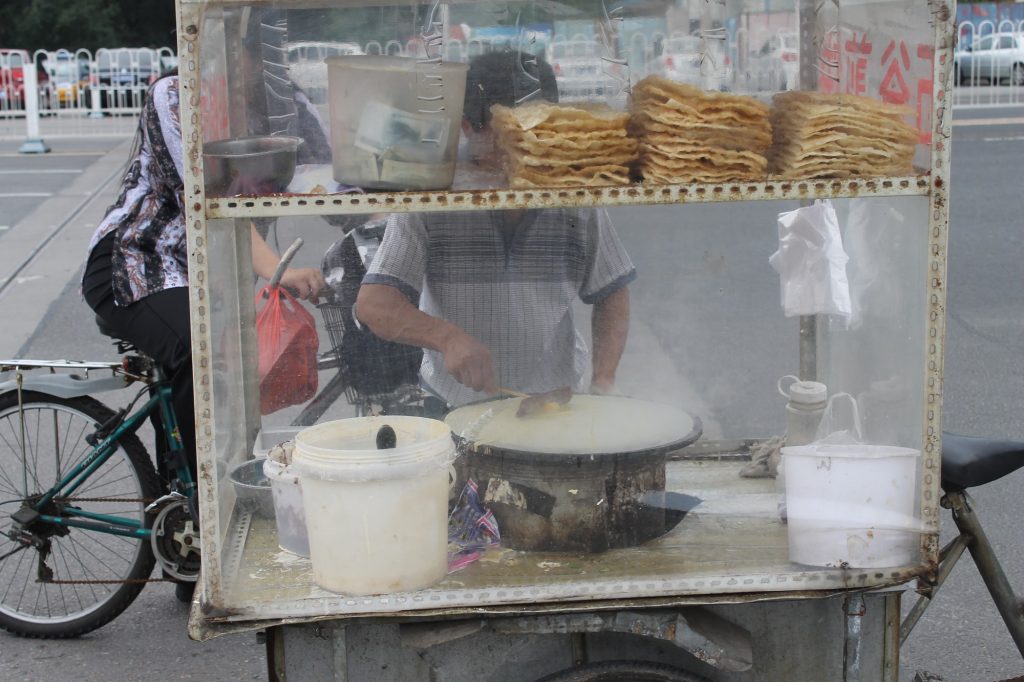
A jianbing line moves on confidence. Batter hits a round griddle, an egg spreads thin, sauce goes on, a crisp sheet cracks into place, and the whole thing folds into a handheld breakfast you can eat while walking to the metro. Beijing and Shanghai both run on this rhythm in the morning—though Shanghai street carts have thinned in some districts, so you may chase a shopfront window as often as a curb griddle. Either way, the first-timer skill is the same: decide egg, chili, cilantro, and crunch before the vendor folds.
This guide stays practical. No fake prices, no eternal “best stall” crown, no invented wait times. Watch one order ahead of you. Point if you need to. Eat while it is still hot and loud with crunch.
What jianbing is (and is not)
Jianbing (煎饼) is a savory Chinese breakfast crepe. Batter—often wheat-based, sometimes mixed with mung bean or other grains—is spread on a flat circular griddle. An egg is cracked and spread across the surface. Scallions and cilantro may go on. The crepe is flipped or finished, then brushed with fermented bean sauce and chili paste to taste. A thin crispy cracker (脆, báocuì) or, in some styles, a piece of fried dough stick (油条, yutio) adds structure. The vendor folds everything into a layered packet.
It is not a sweet French crepe. It is not a soft burrito. The pleasure is hot batter, egg richness, sauce depth, and crunch in the same bite.
Origins are often linked to Shandong and Tianjin traditions; Beijing’s street version is what many visitors meet first. Tianjin’s jianbing guozi (煎饼果子) leans into the fried-dough core. Shanghai serves plenty of Beijing- and Tianjin-influenced versions, plus local tweaks with lettuce, pickles, or extra fillings. Treat regional labels as flavor notes, not exam questions.
The order flow on a busy griddle
Stand where you can see the board or the toppings tray. Have payment ready—WeChat Pay and Alipay dominate urban stalls; some still take cash. If mobile pay is still new to you as a visitor, set it up before breakfast week becomes festival week; see our Alipay and WeChat Pay guide.
A simple sequence:
- Say you want one jianbing: 一个煎饼 (y ge jinbing).
- Confirm egg—usually one; two eggs if you want it richer.
- Choose crunch: crispy cracker (薄) or youtiao if offered.
- Set chili: 不辣 (no chili), 少辣 / 微辣 (mild), or 辣 if you mean it.
- Set herbs: 不要菜 if you dislike cilantro.
- Pay, take the packet in paper, step aside, eat soon.
Vendors work fast. Hesitation in the middle of folding means ingredients you did not want may already be on the crepe. Decide early. Pointing at the cracker tray or the chili jar works when pronunciation fails.
Beijing mornings: street logic
In Beijing, jianbing still feels like commute fuel. Look near metro exits, residential intersections, and older snack streets—not only inside malls. Tourist corridors around Qianmen or Wangfujing can deliver a workable first jianbing when your day already includes central sights; treat them as convenience, not a purity contest. Neighborhood stalls near offices often move faster and look less staged.
Beijing sauces often lean on sweet fermented bean paste with chili paste on the side of the brush. Ask for mild if you want sauce without a full burn. Lettuce appears at some stalls; it cools and adds bulk. Sausage or other extras are optional—master the basic egg-and-cracker build before you turn breakfast into a stuffed experiment.
If your Beijing day continues into autumn sightseeing, a jianbing breakfast leaves hands free for ticket apps and metro transfers. Pair the morning with later plans carefully when Mid-Autumn and Golden Week approach; festival travel weeks change station density even if your breakfast street looks normal.
Shanghai mornings: find the griddle that still exists
Shanghai’s street-vendor landscape has tightened in places, so “jianbing everywhere” is not always literally true on every block. You may find dedicated tiny shops, market edges, or surviving carts near residential roads. Hours skew early. If a stall is famous on social media, expect a line and decide whether the wait fits your morning—without treating the line as proof of perfection.
Shanghai versions can feel slightly softer or more “loaded,” depending on the cook: egg, cracker, sauce, scallion, cilantro, sometimes pickles or meat. The same decision tree applies. One egg, mild chili, cracker in the middle, cilantro only if you like it. That order travels well between cities.
If you are new to Shanghai in early autumn, a breakfast crepe plus a clear half-day plan beats racing three “must-eat” lists before noon. Our Shanghai first-visit early autumn guide helps with the wider day; jianbing handles the first hour.
Fillings and customizations worth knowing
Egg: One is the classic. Two makes a thicker, richer packet. No egg is possible at some stalls if you ask, but the structure changes.
Crunch: 脆 is the light snap many people mean by “jianbing cracker.” Youtiao makes a heavier, doughier breakfast closer to some Tianjin habits.
Sauce: Fermented bean-style paste for savoriness; chili paste for heat. You can usually separate them with “no chili.”
Herbs: Scallion is widely liked. Cilantro divides opinion—say no early.
Extras: Lettuce, pickles, Spam-like luncheon meat, crispy chicken, cheese—modern stalls invent freely. Try extras on a second visit after you know the baseline.
Useful phrases:
- 一煎饼 — one jianbing
- 要鸡蛋 / 两个鸡蛋 — with egg / two eggs
- 薄脆 — crispy cracker
- 不辣 / 辣 — no chili / mild
- 不要香菜 — no cilantro
How to eat it without wearing it
Jianbing is designed for walking, but the first bites drip if the fold is loose. Keep the paper wrap on as a sleeve. Bite from a corner, not the center seam. If sauce runs, tip the packet upright between bites. Do not unfold the whole thing on a windy corner unless you enjoy chasing cilantro down the sidewalk.
Eat within minutes. Steam softens the cracker. A jianbing that sat in a bag through a long subway ride is still food; it is no longer the same crunch.
Choosing quality without rankings
Watch the griddle temperature and batter spread—thin and even beats thick and pale. Egg should set into the crepe, not slide off as a wet patch. Crackers should snap when folded, not bend like cardboard left in rain. Sauce should smell toasty and savory, not only sugary. A stall that cooks to order in small batches beats a pile of pre-folded packets under a lamp.
Skip the fantasy that every Beijing jianbing is superior to every Shanghai one. Cook skill matters more than city pride. Your job is one good packet today and the confidence to order another tomorrow.
Festival-season mornings
In September 2026, Teachers’ Day falls on Thursday 10 September and Mid-Autumn’s public holiday window runs Friday 25 through Sunday 27 September, with Golden Week following in early October. Breakfast streets do not vanish, but office rhythms shift and some workers leave town. Go a little earlier if your usual stall sits beside a transfer station. If colleagues exchange mooncakes later in the month, you can still keep mornings simple: jianbing first, festival logistics second. For gift etiquette when boxes appear at work, see Mid-Autumn gift giving in China.
A boring, perfect first order
One jianbing. One egg. Crispy cracker. Mild chili or none. Cilantro only if you already know you like it. Pay. Step aside. Eat while the cracker still argues with the soft crepe. That boring order is how you learn the category. After that, Beijing and Shanghai both become easier: same grammar, local accents, hot breakfast in your hands before the day gets complicated.