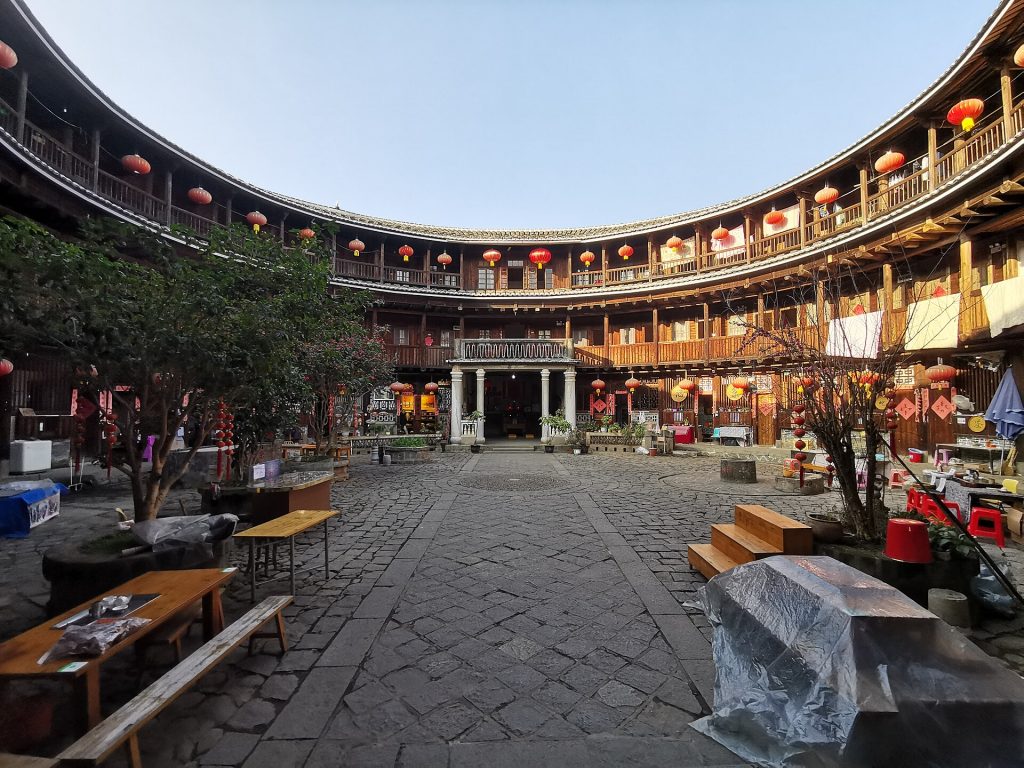
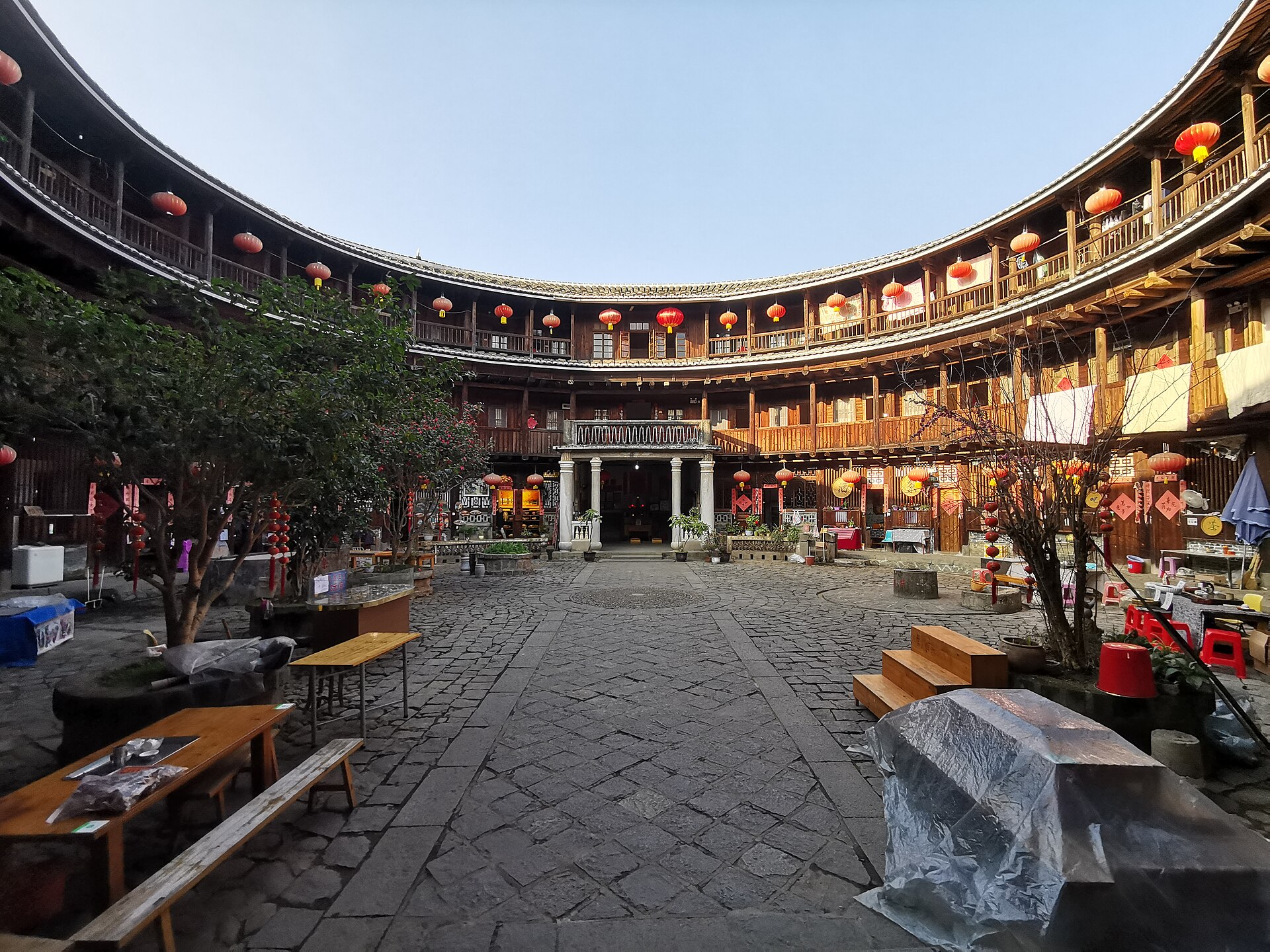
The minibus rattles up the switchback, tea terraces clinging to the hillsides like green staircases. Ahead, a grey cylinder rises from the valley floor — thick rammed-earth walls, a single iron-studded gate, and rows of dark-tiled roofs curling inward. No signage, no ticket booth at the gate itself, just an elderly woman sweeping the courtyard with a bamboo broom. She nods, points to a narrow alley, and goes back to work. This is Hongkeng on a weekday morning, before the tour coaches arrive.
Choosing a cluster that fits your pace
Yongding and Nanjing counties hold the densest concentration of tulou, but each cluster has a different rhythm. Hongkeng (洪坑) and the neighboring Liulian (六联) sit along the same river valley and share a long-distance bus stop. You can walk between a dozen major buildings in half a day — Zhencheng Lou’s concentric rings, Fuyu Lou’s mansard roof, the slender watchtowers of Kuiju Lou. The infrastructure is polished: English maps at the visitor center, clean toilets, a few cafés selling oolong and pineapple cake. Come here if you want the greatest variety with the least logistical friction.
Tianluokeng (田螺坑), twenty kilometers deeper into the mountains, arranges four round towers and one square hall in a rough plum-blossom pattern. The classic postcard shot comes from a viewing platform two hundred meters up the opposite slope. Reaching it requires a shuttle from the entrance gate or a steep twenty-minute hike. The village itself stays quieter; most day-trippers snap the panorama and leave. Stay for lunch at a family kitchen behind Buyun Lou — braised pork belly with preserved mustard greens, rice steamed in bamboo tubes — and you’ll see grandchildren doing homework on the ancestral hall’s stone steps.
Nanjing County’s Taxia (塔下) strings a dozen tulou along a clear stream crossed by stone slab bridges. The buildings here lean rectangular rather than circular. Yuchang Lou zigzags its wooden pillars at drunken angles, yet has stood through centuries of typhoons. Taxia feels more lived-in than curated: ducks patrol the lanes, laundry drapes from upper balconies, and the village school bell still rings at noon. It’s the easiest cluster to reach by public bus from Nanjing town, and the riverside path makes a pleasant two-hour loop if you prefer walking to hiring a driver.
For a half-day detour from Xiamen, the Gaobei (高北) cluster near Yongding’s county seat packs Wuyun Lou, Qiaofu Lou, and the massive Chengqi Lou — “King of Tulou” — into a tight radius. Chengqi’s four concentric rings once housed six hundred people; today a handful of elders maintain the ancestral shrines. The site runs a shuttle from the parking lot, but the walk through the olive groves takes only ten minutes and lets you hear the waterwheel turning in the irrigation ditch.
Getting there without a private car
High-speed rail now stops at Yongding and Nanjing stations. From Xiamen North, the ride is ninety minutes; from Shenzhen North, three hours. At either station, look for the minibus queue marked “土楼专线” (tulou special line). Buses depart when full, roughly every thirty minutes in season, less often in winter. Fares run twenty to thirty yuan depending on distance. Drivers know the clusters by name — say “Hongkeng” or “Tianluokeng” — and will drop you at the main gate.
If you arrive by conventional train at Longyan, the west square bus station runs direct coaches to Hongkeng and Gaobei. The schedule is posted on a whiteboard rather than online; ask the ticket seller for the next departure. From Nanjing town, local buses 2, 3, and 5 connect to Taxia and Yunshuiyao (云水谣), the latter a riverside village with two large tulou and a film-set atmosphere. Buses stop running around six in the evening, so plan your return before dusk unless you’ve booked a homestay inside the cluster.
Ride-hailing apps work in the county seats but often fail inside the valleys. If you need a lift between clusters — say Hongkeng to Tianluokeng — negotiate a flat rate with a driver waiting at the Hongkeng visitor center. A round trip with two hours of waiting typically costs 150 to 200 yuan. Confirm the price before the engine starts; meters are not used.
Sleeping inside the walls
Staying overnight transforms the experience. After the last shuttle departs, the courtyards revert to living rooms: grandparents shelling peanuts, teenagers scrolling phones on wooden benches, the smell of woodsmoke and fermented bean curd rising from woks. Most homestays occupy a single family’s rooms on the second or third floor — simple wooden beds, shared squat toilets at the end of the corridor, hot water from a solar heater on the roof. Rates range from 120 to 250 yuan per bed in a shared room; private suites with en-suite bathrooms run 400 to 600 yuan.
Book through the major Chinese platforms (search the village name plus “民宿”) or message the host on WeChat after a friend’s referral. English proficiency varies; send a voice note with your arrival time and ask them to reply with a location pin. At Hongkeng, the Li family behind Zhencheng Lou runs a clean courtyard with a rooftop tea table. At Taxia, the Chen household near Yuchang Lou offers a balcony overlooking the stream. Bring earplugs — roosters start crowing at four, and the walls, while thick, transmit the neighbor’s mahjong tiles clicking until midnight.
Eating with the clan
Meals in tulou homestays are communal affairs. The host family sets a round table in the ancestral hall or on the covered walkway. Expect eight to ten dishes for four people: steamed river fish with ginger and scallion, stir-fried bitter melon with salted duck egg, tofu braised in soy and rock sugar, a plate of wild fern shoots gathered that morning. Rice comes in a wooden bucket; you serve yourself with a communal spoon. Tea is poured continuously — tieguanyin in small cups, refilled before you can set yours down.
If you’re day-tripping, each cluster has a few storefront restaurants near the ticket gate. Menus overlap: Hakka stuffed tofu (客家酿豆腐), pork belly stewed with preserved vegetables (梅菜扣肉), rice noodles in clear broth with pickled mustard greens. Portions are generous; one main dish plus a vegetable feeds two light eaters. Pay at the counter after eating — cash or QR code. Tipping is not expected.
Mistakes that waste time or goodwill
Arriving at ten on a weekend in autumn means queuing behind three tour buses at Hongkeng’s ticket window. Buy the combined area ticket online the night before — search “福建土楼联票” on the official mini-program — and enter through the side gate where the QR scanner sits. The ticket covers all major clusters in Yongding and Nanjing for two days; single-entry tickets are not sold separately at most gates.
Wearing sandals on the stone staircases inside Chengqi Lou is a recipe for skinned knees. The steps are worn smooth by generations of feet, and the interior walkways slope toward open drainage channels. Closed shoes with grip are essential, especially after rain.
Pointing a camera into a bedroom doorway without asking earns a sharp “不要拍” (don’t shoot). These are homes, not museums. If you want a portrait of the grandmother weaving bamboo mats, sit on the stool opposite her, smile, and gesture at your lens. She may wave you off; she may pose. Either way, show the image on your screen afterward — it’s the polite close to the exchange.
Assuming the shuttle runs all day at Tianluokeng strands hikers on the viewing platform. The last departure is usually fifty minutes before the gate closes, and the gate locks at five-thirty in winter, six-thirty in summer. Check the posted timetable when you arrive, or ask the guard at the platform. The walk down takes forty minutes on a paved path; bring a headlamp if you cut it close.
Seasonal rhythms and quiet windows
Spring tea harvest (third lunar month) paints the hillsides with pickers in straw hats; the air smells of fresh leaf and wood fire. Summer brings afternoon thunderstorms that turn the red soil to slick clay — paths inside the tulou courtyards flood briefly, then drain through centuries-old stone culverts. Autumn harvest (eighth lunar month) sees golden rice drying on every flat roof and courtyard pavement; the light slants low through the gun ports at golden hour. Winter is thin crowds, crisp mornings, and the possibility of snow dusting the tile ridges — rare, but it happens once or twice a decade.
If you can, spend two nights: one in a round tulou at Hongkeng or Gaobei, another in a rectangular hall at Taxia. Wake before the first shuttle, climb to the top floor of your building, and watch the mist peel off the valley. The walls breathe — cool in the day, warm at night — and the wooden beams creak as the temperature shifts. That sound, more than any photograph, is what stays with you after the train pulls away.